
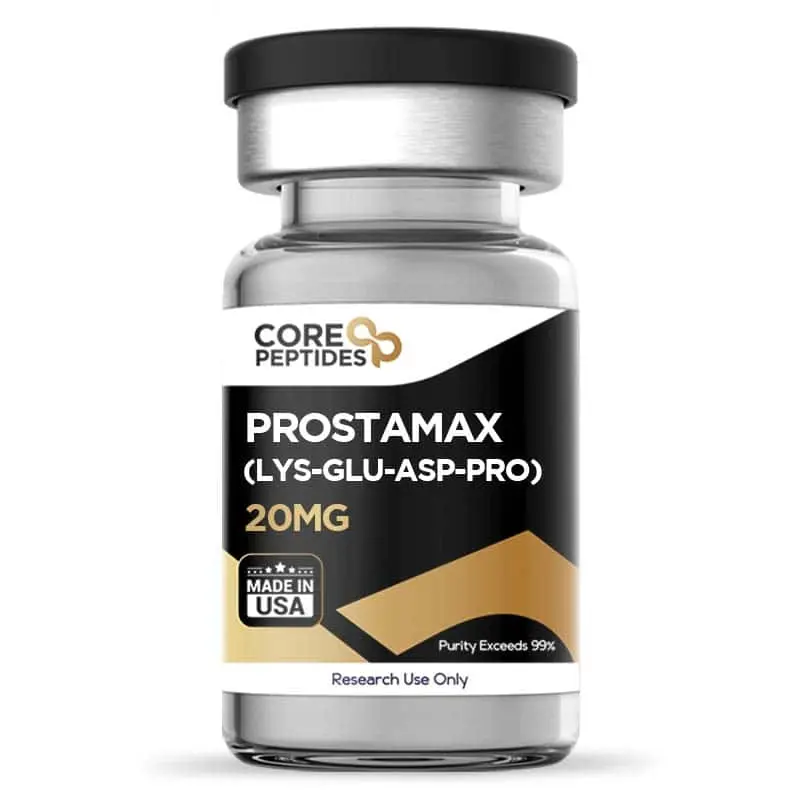
Prostamax (20mg) Peptide
Prostamax (20mg) is a synthetic tetrapeptide composed of Lys-Glu-Asp-Pro (KEDP) and belongs to the class of bioactive compounds commonly referred to as Khavinson peptides. This peptide has been widely studied in laboratory research for its potential influence on chromatin structure, gene expression, and tissue repair mechanisms—particularly within prostate cell cultures.
Prostamax has attracted research interest due to its apparent ability to modulate chromosomal organization, activate previously repressed genetic regions, and influence cellular aging processes. At Core Peptide, Prostamax (20mg) is supplied exclusively for research and laboratory purposes and is intended for qualified research institutions in the United States.
Explore additional regulatory peptides in our Research Peptides Collection.
What Is Prostamax Peptide?
Prostamax, also known as KEDP, is a short synthetic peptide derived from studies on tissue-specific bioregulators. Researchers have suggested that Prostamax may exert a primary repair influence on certain tissue types by altering chromatin dynamics and cellular gene accessibility.
Laboratory findings indicate that Prostamax may affect chromatin condensation states, potentially shifting chromatin from a tightly packed (heterochromatin) form to a more transcriptionally active (euchromatin) structure. This process is significant because chromatin decondensation may allow previously silenced genes to become active again.
Chemical Makeup of Prostamax
-
Molecular Formula: C₂₀H₃₃N₅O₉
-
Molecular Weight: 487.5 g/mol
-
Amino Acid Sequence: Lys-Glu-Asp-Pro
-
Other Names:
-
KEDP
-
SCHEMBL6660498
-
Chemical and molecular information on Prostamax can be referenced through international biochemical databases such as PubChem and the National Center for Biotechnology Information (NCBI).
PubChem – KEDP Peptide
Prostamax and Gene Expression in Cellular Aging
One major area of Prostamax research involves its potential effect on chromatin structure in aging cells. Studies on human lymphocytes have shown that chromatin undergoes specific thermal denaturation phases, reflecting changes in DNA-protein interactions. Prostamax exposure appeared to redistribute thermal energy across chromatin endotherms and slightly lower denaturation temperatures.
Researchers suggested these observations may indicate a relaxation of chromatin fibers, particularly the transformation of thicker 30-nm chromatin fibers into more transcriptionally active 10-nm filaments. Such structural relaxation may support increased gene accessibility and transcriptional activity.
Further investigations in aged cells indicated that Prostamax may:
-
Increase sister chromatid exchange (SCE) frequency
-
Elevate the number of Ag-positive nucleolus organizer regions (NORs)
-
Reduce large segments of C-pericentromeric heterochromatin
These changes suggest a potential deheterochromatinization effect, meaning Prostamax may help reverse age-associated chromatin condensation.
Prostamax and Chromosomal Dynamics
Additional trials have explored Prostamax’s influence on chromosome-specific behavior. Research suggests Prostamax may selectively affect chromosome 1, particularly its pericentromeric regions. Decondensation of these regions may lead to increased ribosomal RNA gene activity and altered nucleosomal organization.
Scientists hypothesize that this chromatin remodeling may enable the reactivation of genes that become suppressed due to age-related chromatin changes. While the precise molecular mechanisms remain under investigation, researchers have concluded that Prostamax’s protective properties may stem from its ability to modify chromatin structure rather than directly altering DNA sequences.
Prostamax Peptide and Prostate Tissue Research
Prostamax has also been studied in organotypic prostate gland tissue cultures. Research utilizing explants from both young and aged murine models examined whether Prostamax could influence reparative processes in prostatic tissue.
When compared to untreated control explants, tissues exposed to Prostamax demonstrated signs consistent with stimulated reparative activity, particularly in aging tissue samples. These observations led researchers to propose that Prostamax may support tissue-specific repair mechanisms during aging.
Prostamax and Inflammation Models
Another research focus examined Prostamax in experimental models of chronic aseptic prostatitis. In these studies, inflammation was induced in murine prostate tissue, after which Prostamax was introduced.
Findings suggested that Prostamax exposure was associated with:
-
Reduced tissue swelling
-
Decreased vascular hyperemia
-
Lower lymphoid cell infiltration
Researchers also observed a potential reduction in sclerotic and atrophic changes, which are commonly seen as complications in chronic inflammation models. These effects appeared more pronounced when compared to active control agents.
Additionally, Prostamax was observed to influence behavioral markers related to reproductive activity in animal models, suggesting broader biological research implications.
Why Choose Prostamax (20mg) from Core Peptide?
Core Peptide is committed to providing high-quality research peptides to support advanced scientific investigation.
Product highlights:
-
20mg vial for precise laboratory research
-
High-purity synthetic KEDP peptide
-
Suitable for chromatin, aging, and prostate tissue studies
-
Distributed within the United States
Explore related peptides such as Epitalon and Pinealon in our research catalog.
References
-
Meskhi T. et al. Influence of Prostamax on Heterochromatin of Human Lymphocytes., Biofizika, 2004.
-
Dzhokhadze T.A. et al. Deheterochromatinization Induced by KEDP., Georgian Medical News, 2012.
-
Khavinson V.Kh. et al. Effects of Short Peptides on Lymphocyte Chromatin., Bull Exp Biol Med, 2004.
Be the first to review “Prostamax (20mg)”
Related products
Peptides for sale
Peptides for sale
Peptides for sale
Peptides for sale
Peptides for sale
Peptides for sale
Peptides for sale
Peptides for sale
Reviews
There are no reviews yet.