
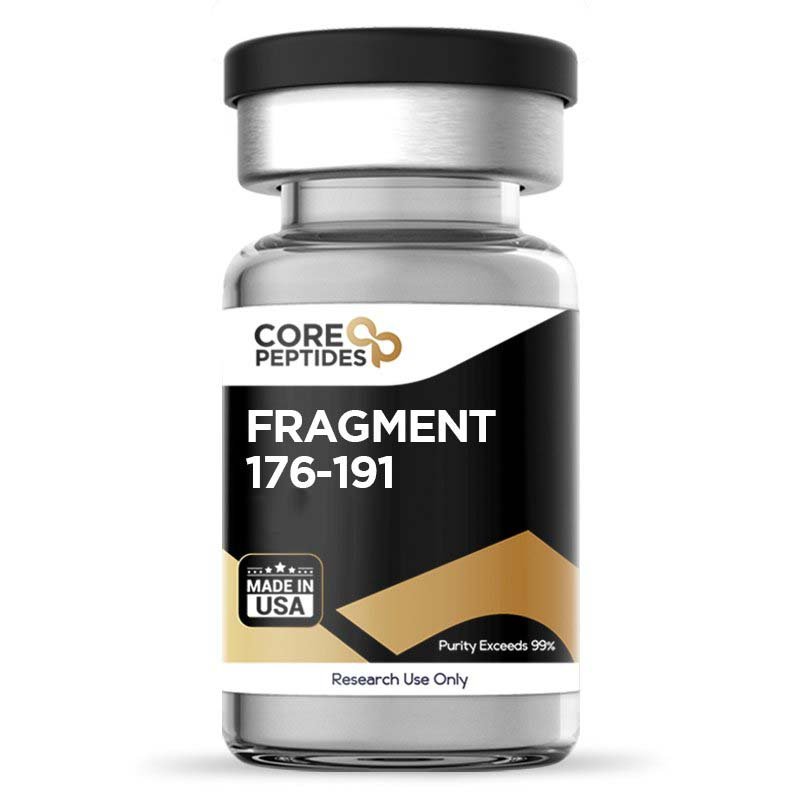
Fragment 176-191 (5mg / 10mg) Research Peptide
Fragment 176-191 (5mg / 10mg) is a synthetic peptide widely studied in laboratory and preclinical research for its potential role in fat metabolism, lipid mobilization, and energy balance. Also known as hGH Fragment 176-191, AOD-9604, or the lipolytic fragment of human growth hormone, this peptide represents the final 16 amino acids of the human growth hormone (hGH) sequence. Researchers have long been interested in this specific fragment due to its proposed ability to retain the fat-burning properties of hGH without triggering growth-related pathways.
At Core Peptide USA, we supply Fragment 176-191 (5mg / 10mg) strictly for research and laboratory use only, providing high-purity peptide compounds to qualified research professionals across the United States.
👉 Learn more about our peptide quality standards on our internal page:
https://corepeptide.us/pages/quality-assurance (internal link)
What Is Fragment 176-191?
Fragment 176-191 peptide is derived from the C-terminal portion of the human growth hormone molecule. Scientists propose that this region of hGH is primarily responsible for its lipolytic (fat-mobilizing) activity. To improve stability, the first amino acid in the sequence is replaced with tyrosine, leading to the alternate naming tyr-hGH 177-191.
Unlike full-length hGH, Fragment 176-191 does not appear to stimulate growth or insulin-like growth factor-1 (IGF-1) pathways. This selective activity has made Fragment 176-191 (5mg / 10mg) a popular subject in research focused on adipose tissue metabolism and energy expenditure.
Overview of Research Interest
Research suggests that Fragment 176-191 peptide may interact with beta-3 adrenergic receptors (β3-AR), which are believed to play a role in fat oxidation and thermogenesis. These receptors are primarily expressed in adipose tissue and skeletal muscle, where they regulate lipid mobilization and energy output.
In preclinical murine studies, exposure to Fragment 176-191 appeared to correlate with reductions in body fat and overall weight, even in models where traditional lipolytic receptors were impaired. This observation has led researchers to theorize that Fragment 176-191 may influence fat metabolism through multiple pathways, including enhanced energy expenditure and altered fat oxidation signaling.
Chemical Makeup
-
Molecular Formula: C78H125N23O23S2
-
Molecular Weight: 1817.12 g/mol
-
Amino Acid Length: 16
-
Other Names: hGH Fragment 176-191, AOD-9604, Lipolytic Fragment
The peptide contains a naturally occurring disulfide bridge between cysteine residues, which may contribute to its structural stability and resistance to degradation during experimental handling.
Fragment 176-191 and Fat Cell Research
One of the most studied aspects of Fragment 176-191 (5mg / 10mg) is its interaction with adipocytes (fat cells). Researchers suggest that the peptide may upregulate β3-adrenergic receptor RNA expression, potentially increasing the sensitivity of fat cells to endogenous lipolytic signals such as catecholamines.
This mechanism is of interest because it implies that Fragment 176-191 may not directly activate fat-burning receptors but instead enhances the body’s natural lipid-mobilizing response, making it a compelling research compound for metabolic studies.
A notable clinical investigation, METAOD005, involved approximately 300 participants and examined the peptide’s potential role in fat reduction and metabolic markers over 12 weeks. Some research groups observed reductions in body weight, along with potential improvements in cholesterol and glucose tolerance parameters.
🔬 External reference:
National Center for Biotechnology Information (NCBI) – AOD-9604 research
https://pubmed.ncbi.nlm.nih.gov/25208511/
Fragment 176-191 and Cartilage & Tissue Studies
Beyond fat metabolism, Fragment 176-191 has been studied for its potential regenerative properties. In experimental models of collagenase-induced knee cartilage damage, research groups observed that subjects exposed to Fragment 176-191 showed improved cartilage morphology compared to saline controls.
When combined with hyaluronic acid, the peptide appeared to demonstrate even greater improvements in tissue integrity and reduced lameness duration. These findings have encouraged further exploration of Fragment 176-191 in musculoskeletal research models.
Fragment 176-191 and Glucose Metabolism
Some studies have examined Fragment 176-191’s influence on glycogen metabolism. In murine models, researchers noted modest changes in blood glucose and lactate levels, along with altered glycogen synthase activity in muscle, adipose tissue, and liver cells.
These findings suggest that Fragment 176-191 peptide may influence metabolic enzyme regulation without drastically altering total enzyme concentrations. However, researchers emphasize that these mechanisms remain under investigation and require additional controlled studies.
Why Choose Core Peptide USA?
Core Peptide USA is a trusted United States-based research peptide supplier, offering:
-
High-purity peptide compounds
-
Accurate labeling and batch verification
-
Secure domestic shipping
-
Products intended strictly for laboratory and research use
Explore our full peptide catalog here:
https://corepeptide.us/collections/all
Be the first to review “Fragment 176-191 (5mg / 10mg)”
Related products
Peptides for sale
Peptides for sale
Peptides for sale
Peptides for sale
Peptides for sale
Peptides for sale
Peptides for sale
Reviews
There are no reviews yet.