
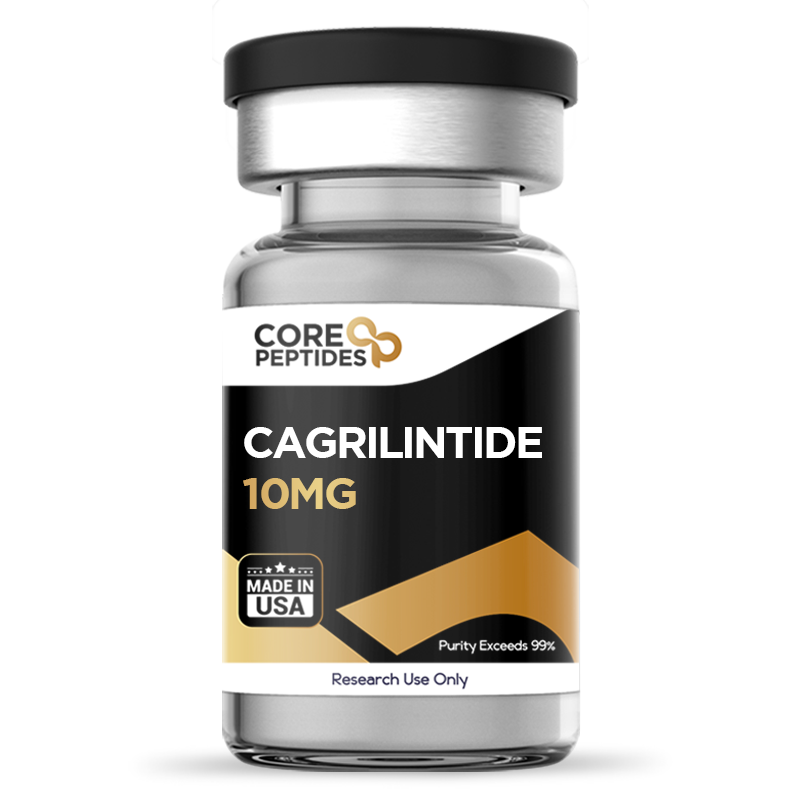
Cagrilintide (10mg) Research Peptide – USA Supplier
Cagrilintide (10mg) is an advanced research peptide belonging to the dual amylin and calcitonin receptor agonist (DACRA) class. Due to its unique receptor profile and long-acting molecular design, Cagrilintide has become an important compound in metabolic, energy-balance, and glucose-regulation research models.
At Core Peptide, we supply Cagrilintide (10mg) strictly for laboratory and research purposes to qualified buyers in the United States, with documented quality control and transparent sourcing.
What Is Cagrilintide Peptide?
Cagrilintide is a synthetic peptide analog of amylin, engineered to activate both:
-
Amylin receptors (AMY-R)
-
Calcitonin receptors (CTR)
This dual activity places Cagrilintide within the DACRA (Dual Amylin and Calcitonin Receptor Agonist) category. Unlike single-pathway peptides, DACRAs may allow researchers to investigate coordinated metabolic signaling across multiple regulatory systems.
Research suggests that AMY-R activation is closely associated with hunger-related signaling, gastric motility modulation, and satiety pathways, while CTR activation may influence carbohydrate metabolism and glucose homeostasis in experimental systems.
Chemical Makeup of Cagrilintide (10mg)
-
Other Names: AM833, AO43BIF1U8, GLXC-26801
-
Molecular Formula: C194H312N54O59S2
-
Molecular Weight: ~4409 g/mol
Cagrilintide’s chemical structure includes targeted amino acid substitutions and a fatty-acid acylation, distinguishing it from endogenous amylin and earlier analogs.
Structural Modifications & Extended Activity
Research by Dehestani et al. and others indicates that Cagrilintide’s N-terminal acylation allows reversible binding to albumin within experimental media. This binding appears to protect the peptide from rapid enzymatic degradation, forming a slow-release reservoir.
As a result, laboratory data suggest a half-life of approximately 159–195 hours, significantly longer than native amylin, which has a plasma half-life of roughly 13 minutes. This makes Cagrilintide (10mg) particularly useful for long-duration experimental protocols.
Additional amino acid substitutions—such as replacing asparagine with glutamate and valine with arginine—may enhance molecular stability and reduce aggregation tendencies. This is important because endogenous amylin is prone to β-sheet aggregation, which can complicate research outcomes and peptide handling.
Cagrilintide and Amylin Receptor Signaling
Amylin receptors are complexes formed by the calcitonin receptor plus receptor-activity-modifying proteins (RAMPs). According to Boyle et al., these receptors are widely distributed in neuronal populations involved in metabolic regulation, including the caudal hindbrain.
In research models, AMY-R activation by Cagrilintide has been associated with:
-
Enhanced satiation signaling
-
Reduced hunger-related signaling pathways
-
Altered gastric emptying dynamics
-
Modulation of glucagon production in pancreatic cells
Some data also suggest indirect interactions with hepatic glucose output and intestinal nutrient absorption.
Calcitonin Receptor (CTR) Activity
Beyond amylin pathways, CTR signaling appears to contribute additional metabolic effects. Research by Larsen et al. highlights CTR’s involvement in basal glucose regulation and peripheral metabolic tissues.
CTR activation may influence:
-
Liver glucose production
-
Skeletal muscle glucose utilization
-
Pancreatic β-cell insulin dynamics
While CTR signaling overlaps with amylin pathways, it appears to provide complementary metabolic modulation rather than redundancy—making Cagrilintide an especially interesting compound for multi-pathway metabolic research.
Potential Effects on Carbohydrate & Lipid Metabolism (Research Context)
In controlled experimental settings, Cagrilintide exposure has been associated with reductions in total tissue mass, largely attributed to changes in energy-storage compartments. Studies report shifts in metabolic markers consistent with:
-
Reduced nutrient intake
-
Delayed gastric nutrient delivery
-
Enhanced lipid mobilization
-
Improved carbohydrate handling
These outcomes are believed to result from combined central nervous system signaling and peripheral tissue responses.
Synergy Research: Cagrilintide and GLP-1 Pathways
Emerging research suggests potential synergistic interactions between Cagrilintide and GLP-1 receptor agonists. While GLP-1 receptors and amylin receptors are expressed on distinct neuronal populations, their combined activation may coordinate multiple metabolic control nodes.
Studies indicate that this dual signaling may influence:
-
Satiety hormone sensitivity (including leptin signaling)
-
Pancreatic hormone secretion dynamics
-
Gastric motility and nutrient flow
-
Central appetite regulation circuits
This has positioned Cagrilintide as a compound of interest in combination-pathway research designs.
For related research peptides, explore:
👉 Retatrutide Research Peptides
👉 Tirzepatide Peptides
Why Buy Cagrilintide (10mg) from Core Peptide?
When sourcing Cagrilintide (10mg) in the USA, research integrity and supplier transparency are critical. Core Peptide provides:
-
Research-grade peptide quality
-
Batch-specific documentation
-
Secure USA-based fulfillment
-
Strict research-only compliance
We prioritize consistency and purity to support reproducible laboratory outcomes.
External Scientific References
For peer-reviewed research on Cagrilintide and DACRA peptides, see:
-
Journal of Pharmacology and Experimental Therapeutics – Calcitonin receptor signaling
-
International Journal of Molecular Sciences – Amylin analog research
-
Journal of Clinical Medicine – Amylin receptor mechanisms
-
PubMed (NIH): https://pubmed.ncbi.nlm.nih.gov
Be the first to review “Cagrilintide (10mg)”
Related products
Peptides for sale
Peptides for sale
Peptides for sale
Peptides for sale
Peptides for sale
Peptides for sale
Peptides for sale
Reviews
There are no reviews yet.