
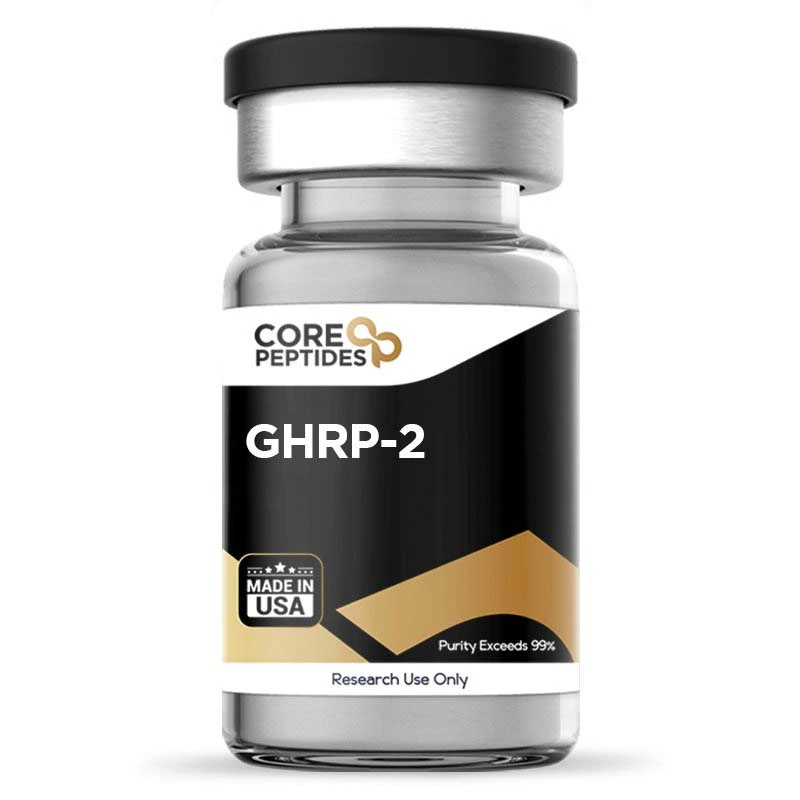
GHRP-2 (5mg / 10mg) Peptide Research Compound | Core Peptide USA
GHRP-2 (5mg / 10mg) is a synthetic pentapeptide widely studied in laboratory and research environments for its role as a growth hormone–releasing peptide (GHRP). At Core Peptide, we provide high-purity GHRP-2 peptides intended strictly for research and laboratory use within the United States, ensuring quality, consistency, and compliance for scientific investigations.
Also known as pralmorelin, GHRP-2 is structurally analogous to the endogenous opioid peptide met-enkephalin, yet it does not function as a neurotransmitter. Instead, it selectively activates growth hormone secretagogue receptors (GHS-Rs)—the same receptors stimulated by the naturally occurring hormone ghrelin.
👉 Learn more about our full peptide catalog on our internal page:
Internal Link: https://corepeptide.us/peptides
What Is GHRP-2?
GHRP-2 is a five–amino acid peptide designed to stimulate the release of growth hormone (GH) by acting on ghrelin receptors located primarily in the hypothalamus and pituitary gland. Ghrelin is known for regulating appetite and energy balance, making GHRP-2 a compound of interest in multiple areas of endocrinology and metabolic research.
Chemical Profile of GHRP-2 (5mg / 10mg):
-
Molecular Formula: C₄₅H₅₅N₉O₆
-
Molecular Weight: 817.97 g/mol
-
Alternate Name: Pralmorelin
Core Peptide offers GHRP-2 5mg and 10mg vials, allowing researchers flexibility depending on study design and dosage protocols.
Mechanism of Action: How GHRP-2 Works
The primary mechanism of GHRP-2 involves activation of the growth hormone secretagogue receptor (GHS-R1a). Once bound, this receptor undergoes a conformational change that initiates G-protein–mediated intracellular signaling.
Research suggests the following cascade:
-
Activation of Gαq/11 proteins
-
Stimulation of phospholipase C (PLC)
-
Cleavage of PIP₂ into IP₃ and DAG
-
Release of intracellular calcium ions
-
Activation of protein kinase C (PKC)
-
Enhanced growth hormone secretion from pituitary cells
Additionally, cyclic AMP (cAMP) pathways may amplify this signaling, further increasing GH synthesis. Notably, receptor desensitization may occur after exposure, with sensitivity typically returning after approximately four hours.
GHRP-2 and Appetite Regulation
GHRP-2 has been extensively studied for its interaction with appetite-regulating neuropeptides. Activation of GHS-Rs in the hypothalamus may stimulate the synthesis of:
-
Neuropeptide Y (NPY)
-
Agouti-related peptide (AgRP)
Simultaneously, GHRP-2 may suppress α-melanocyte-stimulating hormone (α-MSH), shifting signaling toward increased hunger responses. Research also indicates involvement of the mesolimbic reward pathway, linking GHRP-2 to food motivation and reward-based feeding behaviors.
Research Studies on GHRP-2 and Growth Hormone
Multiple peer-reviewed studies highlight the strong GH-stimulating properties of GHRP-2:
-
One trial demonstrated up to a 181-fold spike in GH secretion following GHRP-2 exposure.
-
Another study reported a 47-fold increase in pulsatile GH secretion over a 2.5-hour period.
-
Long-term exposure studies observed 3- to 5-fold increases in GH levels and significant elevations in IGF-1 concentrations.
These findings explain why GHRP-2 (5mg / 10mg) remains a valuable compound in growth hormone research.
External Reference:
National Center for Biotechnology Information (NCBI) – Growth Hormone and Aging
https://www.ncbi.nlm.nih.gov/books/NBK279163/
GHRP-2 and Muscle Tissue Research
Animal models suggest GHRP-2 may influence muscle preservation pathways. Studies in murine models of thermal injury showed reductions in inflammatory markers such as:
-
IL-6
-
MuRF-1
-
MAFbx
These markers are associated with muscle protein breakdown. The findings support continued interest in GHRP-2 as a tool for studying muscle catabolism and recovery mechanisms.
Antioxidative and Anti-Inflammatory Research
Additional studies indicate that GHRP-2 may exhibit antioxidative properties through interactions with the CD36 receptor, potentially reducing oxidized LDL uptake. Research in ApoE-deficient mouse models reported:
-
Increased circulating IGF-1
-
Reduced interferon-gamma
-
Decreased oxidative stress markers in vascular tissue
Further investigations also suggest GHRP-2 may suppress NF-κB activation, a central regulator of inflammatory pathways.
External Reference:
PubMed – Growth Hormone Releasing Peptide-2 Mechanisms
https://pubmed.ncbi.nlm.nih.gov/9331879/
GHRP-2 in Growth Hormone Deficiency Research
GHRP-2 has been studied as a diagnostic alternative to insulin tolerance tests (ITT) for evaluating growth hormone deficiency (GHD). Studies report consistent GH peaks within one hour of administration, with reproducible results across multiple trials.
Combination studies involving GHRP-2, GHRH, TRH, and GnRH suggest synergistic activation of endocrine axes, offering deeper insight into hormonal regulation.
Why Choose Core Peptide for GHRP-2 (5mg / 10mg)?
At Core Peptide, we serve U.S. researchers with:
-
🇺🇸 United States–based distribution
-
🧪 High-purity, lab-tested peptides
-
📦 Secure packaging and fast domestic shipping
-
📄 Transparent documentation and terms
👉 View our Terms and Conditions here:
Internal Link: https://corepeptide.us/terms-and-conditions
Be the first to review “GHRP-2 (5mg / 10mg)”
Related products
Peptides for sale
Peptides for sale
Peptides for sale
Peptides for sale
Peptides for sale
Peptides for sale
Peptides for sale
Peptides for sale
Reviews
There are no reviews yet.