
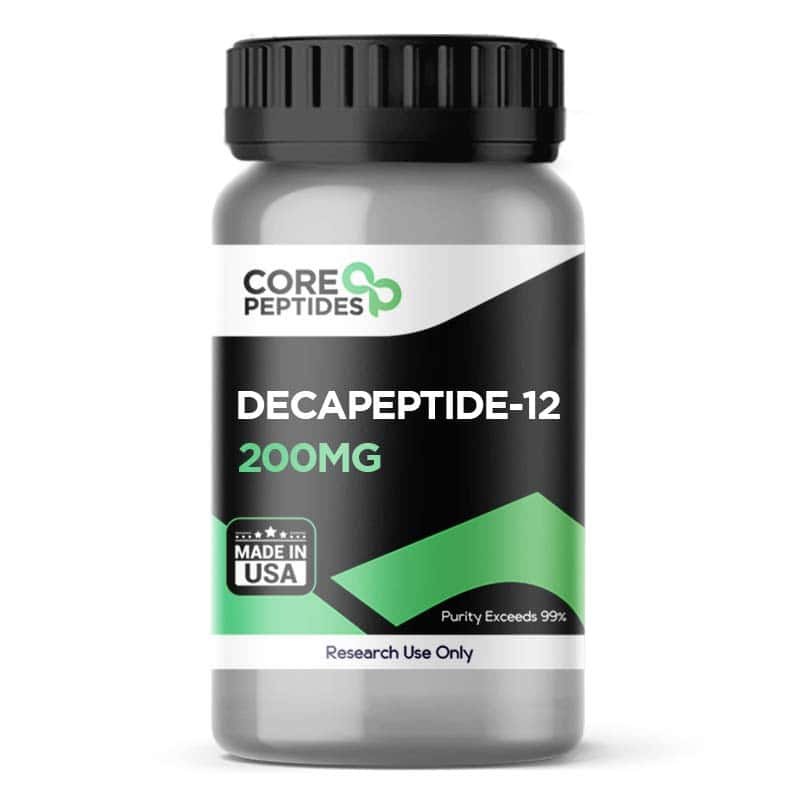
Decapeptide-12 (200mg) Research Peptide – Core Peptide USA
Decapeptide-12 (200mg) is a synthetic research peptide composed of ten amino acids and widely studied in laboratory environments for its potential role in melanin regulation, hyperpigmentation research, and cellular aging pathways. Unlike many peptides that mimic endogenous biological molecules, Decapeptide-12 was intentionally designed to exhibit specific biochemical properties, particularly its proposed interaction with tyrosinase, a key enzyme in melanogenesis.
At Core Peptide USA, we supply Decapeptide-12 (200mg) exclusively for research and laboratory use to qualified professionals within the United States. Our peptides are manufactured under strict quality control standards to support reproducibility and experimental accuracy.
What Is Decapeptide-12?
Decapeptide-12 is a synthetic decapeptide, meaning it consists of ten amino acids arranged in a precise sequence. It does not naturally occur in the human body and was engineered to study pigmentation-related biological pathways. Researchers have suggested that Decapeptide-12 (200mg) may support experimental efforts aimed at understanding melanin production and regulation at the cellular level.
Its primary area of research focuses on melanogenesis, the biochemical process responsible for melanin synthesis in specialized skin cells known as melanocytes. Due to its unique design, Decapeptide-12 has become a frequently referenced compound in pigmentation and dermatological research literature.
Chemical Makeup of Decapeptide-12 (200mg)
-
Molecular Formula: C₆₅H₉₀N₁₈O₁₇
-
Molecular Weight: 1311.46 g/mol
-
Peptide Length: 10 amino acids
-
Classification: Synthetic research peptide
The high purity and defined molecular structure of Decapeptide-12 (200mg) make it suitable for controlled experimental studies where accuracy and consistency are critical.
Mechanism of Action: Melanin and Tyrosinase Research
Research suggests that Decapeptide-12 (200mg) may primarily exert its effects by influencing tyrosinase activity. Tyrosinase is an enzyme believed to catalyze the first two steps of melanin synthesis:
-
The conversion of tyrosine into DOPA
-
The oxidation of DOPA into DOPAquinone
These reactions are essential for the formation of eumelanin and pheomelanin, the two primary pigments responsible for skin, hair, and eye coloration. Laboratory data suggests that Decapeptide-12 may interfere with this pathway by interacting directly with tyrosinase or influencing its gene expression, thereby reducing enzymatic activity in melanocyte cultures.
By studying Decapeptide-12 (200mg), researchers aim to better understand how peptide-based compounds may modulate pigmentation-related biochemical pathways.
Decapeptide-12 and Melasma Research
Several clinical and laboratory studies have evaluated Decapeptide-12 in experimental models related to melasma, a form of hyperpigmentation often associated with sun exposure and hormonal factors.
Published studies have reported visible reductions in melasma severity in research subjects following controlled exposure to Decapeptide-12–containing formulations. In some experimental observations, partial or complete clearance of melasma was reported within weeks, suggesting that Decapeptide-12 may be a valuable research compound for pigmentation-focused investigations.
These findings have positioned Decapeptide-12 (200mg) as a commonly referenced peptide in pigment modulation research.
Research into Post-Inflammatory Hyperpigmentation
Post-inflammatory hyperpigmentation (PIH) is another area where Decapeptide-12 (200mg) has been studied. PIH occurs when inflammation triggers excess melanin production, often following injury or dermatological procedures.
Laboratory and case-based research suggests that Decapeptide-12 may support faster clearance of pigmented lesions compared to control environments. Researchers hypothesize that this effect is linked to its potential tyrosinase-inhibiting properties, though further studies are required to fully elucidate the mechanism.
Solar Lentigo and Photodamage Studies
Decapeptide-12 (200mg) has also been examined in studies involving solar lentigines, a form of hyperpigmentation caused by chronic ultraviolet exposure. Experimental data suggests that Decapeptide-12 may support visible improvement in pigmentation irregularities over extended research periods.
In laboratory observations spanning several months, subjects exhibited varying degrees of improvement, ranging from mild reduction in pigmentation to complete clearance in some cases. These outcomes have encouraged continued research into Decapeptide-12 as a laboratory tool for studying photodamage-related pigmentation.
Decapeptide-12 and Cellular Aging Research
Beyond pigmentation, Decapeptide-12 (200mg) has been studied for its potential influence on cellular aging pathways, particularly those involving sirtuin genes. Sirtuins are a family of proteins associated with DNA repair, metabolic regulation, oxidative stress response, and cellular longevity.
In vitro studies examining keratinocyte progenitor cells suggested that Decapeptide-12 may increase transcription levels of several sirtuin genes, including SIRT1, SIRT3, SIRT6, and SIRT7. These findings have generated interest in Decapeptide-12 as a peptide for researching cellular resilience, mitochondrial function, and genomic stability.
Why Choose Decapeptide-12 (200mg) from Core Peptide USA?
When ordering Decapeptide-12 (200mg) from Core Peptide USA, U.S.-based researchers benefit from:
-
Domestic U.S. shipping
-
Consistent batch quality
-
Strict laboratory-grade manufacturing standards
-
Clear labeling for research use only
Explore related products and categories:
For additional scientific background, researchers may consult external resources such as:
-
National Center for Biotechnology Information (NCBI)
-
PubMed peer-reviewed journals
-
Journal of Drugs in Dermatology
Be the first to review “Decapeptide-12 (200mg)”
Related products
Peptides for sale
Peptides for sale

Peptides for sale
Peptides for sale
Peptides for sale
Peptides for sale

Peptides for sale
Reviews
There are no reviews yet.