
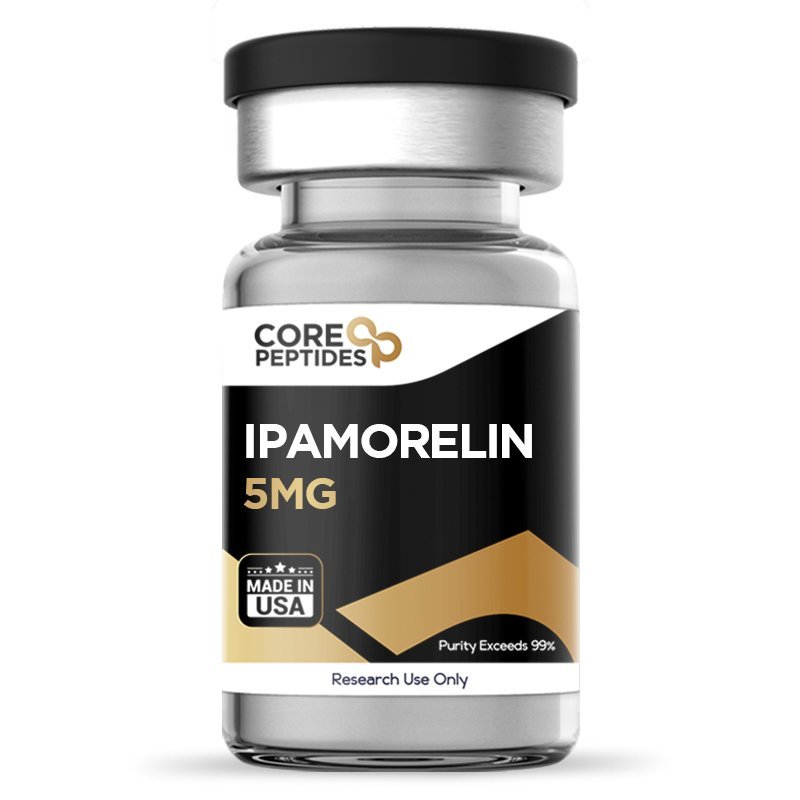
Ipamorelin (5mg) Peptide – Research Overview | Core Peptide USA
Ipamorelin (5mg) is a highly selective synthetic peptide classified as a Growth Hormone Secretagogue (GHS). Developed specifically to stimulate growth hormone (hGH) release through ghrelin receptor (GHS-R) activation, Ipamorelin has gained significant attention in peptide research due to its selectivity and favorable research profile.
At Core Peptide USA (https://corepeptide.us), we provide high-purity Ipamorelin (5mg) intended strictly for laboratory and research purposes. Our products are sourced and handled to meet the expectations of researchers across the United States, ensuring reliability, consistency, and compliance.
What Is Ipamorelin (5mg)?
Ipamorelin is a synthetic pentapeptide composed of five amino acids (Aib-His-D-2-Nal-D-Phe-Lys-NH₂). Unlike earlier growth hormone secretagogues, Ipamorelin was engineered to selectively target growth hormone release without significantly influencing other pituitary hormones such as prolactin or adrenocorticotropic hormone (ACTH).
This selectivity has positioned Ipamorelin (5mg) as a compound of interest in research exploring:
-
Growth hormone secretion mechanisms
-
IGF-1 mediated anabolic pathways
-
Metabolic and musculoskeletal signaling
-
Gastrointestinal motility and appetite signaling
Chemical Profile of Ipamorelin (5mg)
-
Molecular Formula: C₃₈H₄₉N₉O₅
-
Molecular Weight: 711.86 g/mol
-
Alternate Name: NNC 26-0161
-
Peptide Class: Growth Hormone Secretagogue (GHS)
This precise molecular configuration contributes to Ipamorelin’s receptor selectivity and research appeal.
Mechanism of Action: Growth Hormone Selectivity
Research suggests that Ipamorelin (5mg) interacts with GHS receptors located on somatotroph cells in the anterior pituitary gland. Upon receptor binding, Ipamorelin may activate intracellular signaling cascades involving phospholipase C (PLC), inositol triphosphate (IP₃), diacylglycerol (DAG), and calcium ion mobilization.
These signaling events are theorized to lead to the exocytosis of growth hormone-containing vesicles, potentially elevating circulating hGH levels without overstimulation of unrelated endocrine pathways.
Research Findings on Ipamorelin Peptide
Growth Hormone Release Studies
A foundational study published in Endocrinology identified Ipamorelin as the first GHS with GH selectivity comparable to Growth Hormone Releasing Hormone (GHRH). Animal models demonstrated significant growth hormone release following Ipamorelin exposure, supporting its classification as a selective GH agonist.
External reference:
🔗 National Center for Biotechnology Information (NCBI) – Growth Hormone Secretagogues
https://www.ncbi.nlm.nih.gov/pmc/articles/PMC7108996/
IGF-1 and Anabolic Signaling
Elevated growth hormone levels may stimulate insulin-like growth factor-1 (IGF-1) synthesis. IGF-1 is widely studied for its role in:
-
Cellular proliferation
-
Muscle and bone tissue signaling
-
Protein synthesis pathways
Ipamorelin’s indirect influence on IGF-1 production has made it a subject of interest in anabolic and metabolic research models.
Bone Tissue and Mineral Density Research
Preclinical studies suggest that Ipamorelin may influence bone mineral content (BMC) through hGH-mediated osteoblast activation. DEXA and pQCT imaging in murine models indicated potential increases in bone cross-sectional area and mineral content, without altering volumetric bone mineral density.
This suggests structural bone adaptation rather than density alteration—an important distinction in skeletal research.
Digestive Motility and Gastric Emptying
Ipamorelin has also been studied for its potential effects on gastric motility. Research models showed accelerated gastric emptying rates when exposed to Ipamorelin compared to controls. These findings suggest possible interactions with smooth muscle contractility and ghrelin-related digestive pathways.
Appetite and Weight Regulation
Due to its interaction with ghrelin receptors, Ipamorelin may influence hunger signaling. Some research models demonstrated increased food intake and body mass, potentially involving leptin modulation and GH-independent pathways related to appetite regulation.
Nitrogen Balance and Metabolic Research
Ipamorelin’s potential anabolic effects have been evaluated through nitrogen balance studies. Research indicates possible reductions in urea nitrogen synthesis and altered nitrogen distribution across organs, suggesting a role in protein metabolism and catabolic state modulation.
Why Choose Core Peptide USA for Ipamorelin (5mg)?
When sourcing Ipamorelin (5mg) in the United States, Core Peptide USA stands out for:
USA-focused research supply
-
High-purity peptide standards
-
Secure packaging and fast domestic shipping
-
Transparent research-only labeling
Explore related peptide research products on our website:
Ipamorelin Research Collection – https://corepeptide.us
Be the first to review “Ipamorelin (5mg)”
Related products
Peptides for sale
Peptides for sale
Peptides for sale
Peptides for sale
Peptides for sale
Peptides for sale
Peptides for sale

Peptides for sale
Reviews
There are no reviews yet.