
Humanin (10mg) Research Peptide | Core Peptide USA
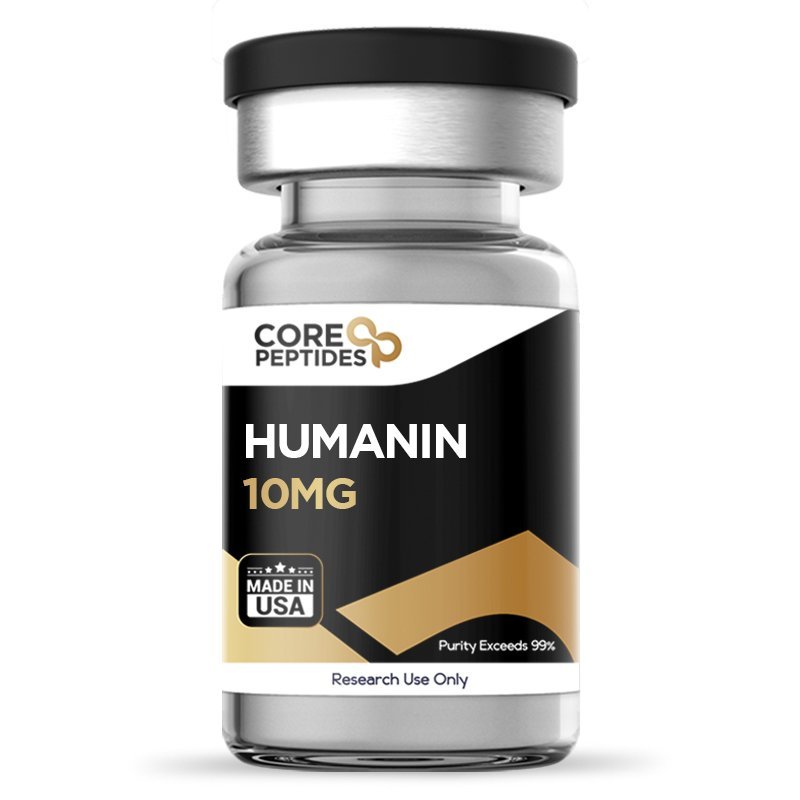
Humanin (10mg) is a naturally occurring, mitochondrial-derived peptide studied extensively for its potential role in cellular metabolism, mitochondrial signaling, oxidative stress response, and neuroprotection. At Core Peptide, we provide research-grade Humanin (10mg) exclusively for laboratory and scientific research purposes to qualified customers throughout the United States.
Humanin is encoded by the mitochondrial 16S ribosomal RNA gene, making it one of the first recognized mitochondrial-derived peptides (MDPs). Due to mitochondria’s central role in energy production, apoptosis regulation, and cellular signaling, Humanin has attracted significant interest in aging, metabolic, neurological, and ischemia-related research.
Browse our full peptide research catalog:
https://corepeptide.us/peptides
What Is Humanin?
Humanin is a short endogenous peptide composed of either 21 or 24 amino acids, depending on its site of synthesis. When synthesized within mitochondria, Humanin contains 21 amino acids; when produced in the cytosol, it contains 24 amino acids. Both forms exhibit biological activity and have been widely studied in experimental models.
Mitochondria originated through an endosymbiotic relationship between early eukaryotic cells and prokaryotes. Over time, mitochondria retained a distinct genome that encodes signaling molecules, including Humanin, which may act as a retrograde signal influencing nuclear and cellular functions.
Chemical Profile of Humanin (10mg)
-
Molecular Formula: C₁₁₉H₂₀₄N₃₄O₃₂S₂
-
Molecular Weight: 2687.3 g/mol
-
Peptide Class: Mitochondrial-Derived Peptide (MDP)
-
Other Names: HNGF6A protein
At Core Peptide, Humanin (10mg) is supplied in securely sealed vials designed to preserve peptide integrity for controlled laboratory research.
Mechanism of Action
Research suggests that Humanin may exert cytoprotective and neuroprotective actions through both intracellular and receptor-mediated pathways. One of the most studied mechanisms involves its interaction with Bcl-2–associated X protein (Bax), a key regulator of apoptosis.
By binding to the inactive form of Bax, Humanin may inhibit Bax activation and translocation, potentially preventing the initiation of programmed cell death. Additionally, Humanin has been shown to interact with other intracellular proteins involved in apoptosis regulation, such as actinin-4 and phosphoprotein 8.
Humanin also appears to bind with G protein–coupled receptors FPRL-1 and FPRL-2, which are associated with neurological signaling. This receptor binding may prevent amyloid-β from interacting with these receptors, suggesting a possible mechanism for neuroprotective research applications.
Humanin (10mg) and Mitochondrial Function Research
Mitochondria are particularly vulnerable to reactive oxygen species (ROS), which can impair bioenergetics and induce cellular damage. Studies indicate that Humanin may help mitigate ROS formation, thereby supporting mitochondrial efficiency.
In experimental models involving retinal pigment epithelial cells exposed to oxidative stress, Humanin exposure reportedly reduced ROS accumulation and restored mitochondrial bioenergetics. These findings have positioned Humanin (10mg) as a compound of interest in mitochondrial stress and degeneration research.
Cellular Longevity and Aging Research
Research involving murine models has revealed an intriguing relationship between Humanin levels and growth hormone (GH) and insulin-like growth factor 1 (IGF-1) signaling. Models with elevated GH and IGF-1 levels exhibited significantly lower Humanin concentrations and shorter lifespans.
Conversely, GH- and IGF-1–deficient models showed elevated Humanin levels and increased lifespan. These findings suggest a negative correlation between Humanin and GH/IGF-1 activity and a potential association with cellular longevity research.
Neurological Research Applications
Humanin has been widely studied in neurological and neurodegenerative research models. In murine models characterized by high amyloid protein accumulation, Humanin exposure was associated with improved learning ability and enhanced memory performance compared to placebo groups.
Additional studies involving chemically induced neurotoxicity have shown that Humanin may:
-
Preserve neuronal viability
-
Reduce oxidative stress
-
Inhibit tau protein hyperphosphorylation
-
Maintain protein phosphatase 2A (PP2A) activity
These outcomes suggest that Humanin may serve as a valuable research tool in neuroprotection and cognitive function studies.
Humanin (10mg) and Metabolic Research
Several studies have explored Humanin’s role in insulin sensitivity and glucose metabolism. In diabetic murine models, Humanin exposure appeared to:
-
Improve glucose tolerance
-
Delay diabetes onset
-
Reduce fasting glucose levels
-
Increase energy expenditure
Additional research suggests that Humanin may act through STAT-3 signaling in the hypothalamus, improving insulin sensitivity both centrally and in peripheral tissues such as the liver. These findings support ongoing interest in Humanin (10mg) for metabolic and insulin resistance research.
Hypoxia and Ischemia Research
Humanin has also been investigated for its potential role in hypoxia and ischemia models. In retinal cells exposed to hypoxia-inducing agents, Humanin appeared to protect against apoptosis caused by reduced oxygen availability.
In cerebral ischemia studies, murine models receiving Humanin showed a significant reduction in ischemic volume, particularly when the peptide was administered during a critical post-ischemic window. Larger animal models demonstrated infarct size reductions of up to 41% when Humanin was introduced alongside reperfusion protocols, highlighting its potential importance in ischemia-related research.
Additional Research Areas
Further studies suggest that Humanin may:
-
Bind to FPR2 receptors and exhibit anxiolytic-like activity
-
Protect healthy cells from apoptosis during exposure to antineoplastic agents
-
Support cell survival during lymphocyte death and ischemic stress
These findings reinforce the peptide’s broad relevance across multiple cell survival and stress-response research domains.
Why Choose Core Peptide for Humanin (10mg)?
Researchers across the United States trust Core Peptide for:
-
U.S.-based fulfillment and fast domestic shipping
-
High-purity, research-grade peptides
-
Transparent sourcing and quality standards
-
Secure packaging for laboratory handling
Please review before ordering:
https://corepeptide.us/terms-and-conditions
Be the first to review “Humanin (10mg)”
Related products
Peptides for sale
Peptides for sale
Peptides for sale
Peptides for sale
Peptides for sale
Peptides for sale
Peptides for sale
Peptides for sale
Reviews
There are no reviews yet.