
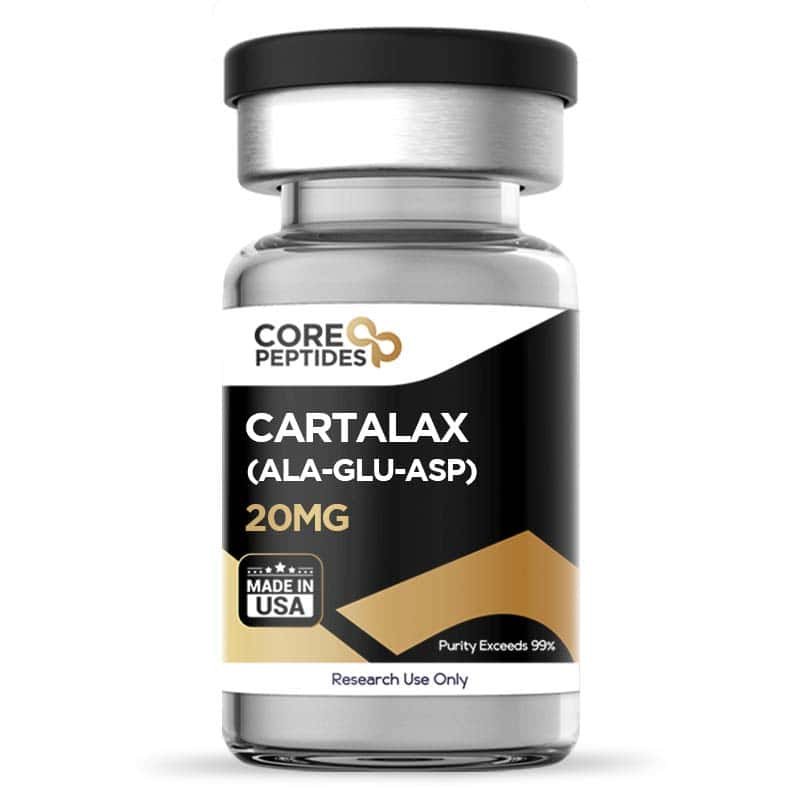

Cartalax (20mg) Peptide – Research-Grade AED Peptide in the United States
Cartalax (20mg) is a synthetic research peptide that has drawn scientific interest for its potential role in cellular aging, tissue regeneration, and gene regulation. Known alternatively as AED peptide or T-31, Cartalax belongs to a class of short peptides commonly referred to as Khavinson peptides, which are studied for their bioregulatory properties at the cellular level.
At Core Peptide, we supply Cartalax (20mg) strictly for laboratory and research purposes, ensuring high purity and quality standards for researchers and institutions across the United States. Learn more about our research peptide standards on our internal page:
👉 https://corepeptide.us
What Is Cartalax Peptide?
Cartalax peptide is composed of a simple yet biologically significant amino acid sequence: Alanine–Glutamate–Aspartate (Ala-Glu-Asp). This tripeptide sequence is derived from the alpha-1 chain of type XI collagen, a structural protein associated with connective tissue and cartilage.
Because of its origin and structure, Cartalax (20mg) has been investigated for its influence on biological pathways related to aging, inflammation, and extracellular matrix maintenance. Researchers classify Cartalax among peptides that may act as bioregulators, meaning they may help regulate gene expression and cellular signaling rather than acting as direct stimulants.
Chemical Profile of Cartalax (20mg)
-
Molecular Formula: C₁₂H₁₉N₃O₈
-
Molecular Weight: 333.29 g/mol
-
Amino Acid Sequence: Ala-Glu-Asp
-
Other Names: AED peptide, T-31, SCHEMBL5324601
This precise and minimal structure is part of what makes Cartalax peptide a compelling subject in molecular biology and gerontology research.
Cartalax (20mg) and Fibroblast Research
Scientific studies exploring Cartalax peptide have examined its interaction with skin fibroblasts, cells responsible for producing collagen and maintaining connective tissue integrity. Research suggests that Cartalax may influence markers associated with cellular proliferation and longevity.
For example, Cartalax has been linked to increased expression of Ki-67, a protein commonly used to assess cell proliferation. Since Ki-67 expression tends to decline as fibroblasts age, this observation has prompted further investigation into Cartalax’s role in cellular aging models.
Additionally, Cartalax has been observed to modulate markers such as CD98hc, which is involved in cellular regeneration, while potentially reducing activity of caspase-3, an enzyme associated with programmed cell death (apoptosis). These findings have positioned Cartalax (20mg) as a peptide of interest in studies of fibroblast aging and extracellular matrix preservation.
Cartalax Peptide and Cartilage-Related Research
Fibroblasts and chondrocytes (cartilage cells) share several functional characteristics. Because of this overlap, findings from fibroblast research have led scientists to examine whether Cartalax peptide may also be relevant in cartilage and osteoarthritis research models.
Cartalax has been associated with inhibition of MMP-9, an enzyme involved in extracellular matrix degradation. Elevated MMP-9 activity is commonly observed in aging tissues, making Cartalax (20mg) a point of interest for researchers studying cartilage degeneration and repair mechanisms.
For broader scientific context on cartilage biology, see this external resource from the National Institutes of Health (NIH):
🔗 https://www.ncbi.nlm.nih.gov/books/NBK538327/
Kidney Cell and Renal Aging Studies
Beyond connective tissue research, Cartalax (20mg) has also been studied in kidney tissue cultures. In both young and aged renal cell models, Cartalax has been associated with increased cellular proliferation and reduced expression of aging-related markers.
Research suggests that Cartalax peptide may downregulate proteins such as p53, p16, and p21, all of which are linked to cellular senescence. At the same time, it has been associated with increased expression of SIRT-6, a protein involved in DNA repair and genomic stability.
Some studies propose that Cartalax may interact directly with DNA sequences, potentially influencing gene expression through energetically favorable binding in the minor groove of DNA. This proposed mechanism has expanded interest in Cartalax as a peptide for advanced molecular and genetic research.
For more on SIRT proteins and aging, reference:
🔗 https://www.ncbi.nlm.nih.gov/pmc/articles/PMC5452220/
Cartalax (20mg) and Cellular Aging Research
Research involving bone marrow mesenchymal stem cells has further explored Cartalax’s potential influence on aging-related gene expression. Studies suggest that Cartalax may upregulate genes such as IGF-1, which plays a role in cellular growth and development.
Additionally, modulation of genes involved in telomere maintenance, inflammatory signaling (NF-κB), and cellular stress responses has been observed in experimental settings. While these findings are strictly preclinical, they reinforce why Cartalax peptide remains a significant subject of interest in aging and regenerative biology research.
Why Buy Cartalax (20mg) from Core Peptide?
At CorePeptide.us, we specialize in providing high-purity research peptides for laboratories and research professionals in the United States.
Why researchers choose Core Peptide:
-
USA-focused distribution and fast domestic shipping
-
High-purity, research-grade peptides
-
Transparent labeling and quality standards
-
Dedicated peptide research supplier
Explore our full peptide catalog here:
👉 https://corepeptide.us/shop
Important Research Disclaimer
Cartalax (20mg) is not approved for human or veterinary use. This peptide is sold for research and laboratory purposes only. No statements on this page are intended to diagnose, treat, cure, or prevent any disease. Always review and comply with our Terms and Conditions before ordering.
Final Thoughts on Cartalax (20mg)
With a growing body of preclinical research examining its role in cellular aging, cartilage biology, and gene regulation, Cartalax (20mg) continues to attract attention in scientific and academic settings. Its simple structure, classification as a Khavinson peptide, and potential bioregulatory properties make it a valuable tool for controlled laboratory studies.
For researchers in the United States seeking a reliable source of Cartalax peptide, CorePeptide.us remains a trusted destination for quality and consistency.
👉 Learn more or order today at https://corepeptide.us
Be the first to review “Cartalax (20mg)”
Related products
Peptides for sale
Peptides for sale
Peptides for sale
Peptides for sale
Peptides for sale
Peptides for sale
Peptides for sale
Reviews
There are no reviews yet.