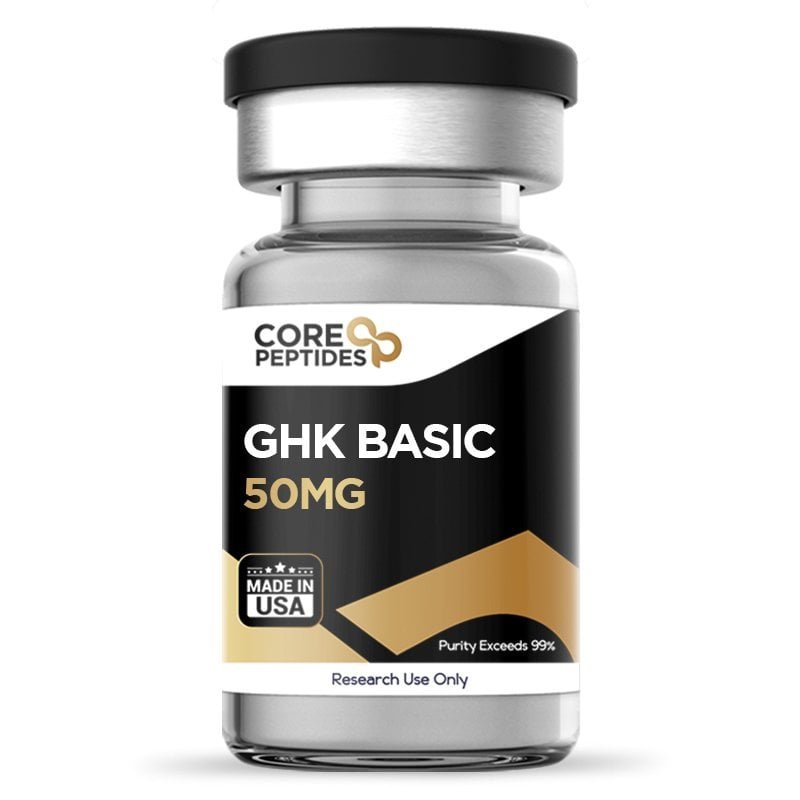
GHK Basic (50mg) Research Peptide
GHK Basic (50mg) is a well-documented tripeptide widely studied in biochemical and cellular research for its role in tissue signaling, regeneration, and inflammation-related pathways. Available from Core Peptide USA, this peptide is manufactured for laboratory and research use only and is distributed to qualified researchers across the United States.
GHK Basic is composed of the amino acid sequence glycyl-histidyl-lysine, a naturally occurring peptide fragment found in human plasma, saliva, and urine. Due to its small molecular size and signaling capacity, GHK has been extensively researched for its interactions with fibroblasts, extracellular matrix proteins, inflammatory mediators, and antioxidant systems.
What Is GHK Basic?
GHK Basic is a short-chain tripeptide that functions primarily as a signaling molecule. It has been studied for its ability to influence cell communication and gene expression related to tissue repair and maintenance. Research suggests that GHK may regulate multiple biological pathways simultaneously, making it a peptide of interest in regenerative and molecular biology research.
Unlike longer peptide chains, GHK’s compact structure allows it to interact efficiently with cellular receptors and metal ions, particularly copper, forming GHK-Cu complexes that have been studied extensively in scientific literature.
Chemical Makeup
Molecular Formula: C₁₄H₂₄N₆O₄
Molecular Weight: 340.4 g/mol
This defined molecular profile makes GHK Basic (50mg) suitable for reproducible laboratory research, biochemical assays, and controlled experimental environments.
Research & Scientific Applications
GHK Basic and Skin Cell Regeneration
Research indicates that GHK may play a regulatory role in dermal fibroblast activity and extracellular matrix production. Several studies suggest that GHK exposure is associated with increased synthesis of collagen, elastin, glycosaminoglycans, and proteoglycans such as decorin. These components are critical to maintaining structural integrity and elasticity in connective tissue.
Additional research suggests GHK may influence metalloproteinase activity, enzymes responsible for extracellular matrix breakdown. By modulating both protein synthesis and degradation, GHK may help regulate tissue remodeling and prevent excessive proteolysis in aging or damaged tissue models.
GHK Basic and Wound Healing Research
Animal and in vitro studies suggest GHK may influence wound healing through multiple pathways. One proposed mechanism involves enhanced angiogenesis and antioxidant enzyme activity when GHK is combined with specific photobiomodulation techniques, such as helium-neon laser exposure.
In diabetic and non-diabetic murine models, collagen matrices infused with GHK were associated with significantly improved wound closure rates, increased epithelialization, and elevated levels of collagen synthesis. Researchers also observed higher concentrations of endogenous antioxidants such as glutathione and ascorbic acid in treated tissues.
GHK and its analogs have also been studied for their potential influence on follicular and vascular signaling. Research involving copper-bound GHK suggests increased vascular endothelial growth factor (VEGF) expression, which may contribute to neovascularization and tissue repair pathways.
Anti-Inflammatory and Antioxidant Pathways
GHK Basic has been investigated for its potential antioxidant properties, particularly in relation to lipid peroxidation byproducts such as malondialdehyde and 4-hydroxynonenal. These reactive aldehydes are known contributors to cellular damage and oxidative stress.
Studies suggest that GHK may bind to and neutralize these byproducts, thereby limiting their ability to damage proteins, DNA, and cellular membranes. Additionally, GHK may influence iron metabolism by interacting with ferritin, potentially reducing free iron release that catalyzes oxidative reactions.
GHK Basic and Lung Tissue Research
In pulmonary research models, GHK has been evaluated for its role in inflammatory modulation. Murine studies involving lipopolysaccharide-induced lung injury suggest that GHK may reduce inflammatory cytokines such as TNF-α and IL-6 while enhancing antioxidant enzyme activity.
Researchers propose that GHK may exert these effects through inhibition of NF-κB and p38 MAPK signaling pathways. Additional findings indicate potential upregulation of Nrf2 expression, a key transcription factor involved in cellular antioxidant defense mechanisms.
GHK Basic and Fibrinogen Regulation
Elevated fibrinogen levels are associated with increased blood viscosity and cardiovascular risk. Research suggests that GHK may inhibit fibrinogen synthesis, potentially influencing blood rheology and reducing rouleaux formation. While these findings are preliminary, they contribute to ongoing interest in GHK’s broader systemic regulatory roles.
Why Order GHK Basic from Core Peptide USA?
At CorePeptide.us, we support peptide research throughout the United States by offering:
-
High-purity research peptides
-
Transparent sourcing and documentation
-
U.S.-based shipping and support
-
Strict research-use-only compliance
You can learn more about our quality standards on our About Us page or review our Terms and Conditions prior to ordering.
External Scientific References
For peer-reviewed research related to GHK Basic (50mg), visit:
-
National Center for Biotechnology Information (NCBI): https://pubchem.ncbi.nlm.nih.gov/compound/Cu-GHK
-
Pickart & Margolina, International Journal of Molecular Sciences: https://www.ncbi.nlm.nih.gov/pmc/articles/PMC6073419/


Reviews
There are no reviews yet.