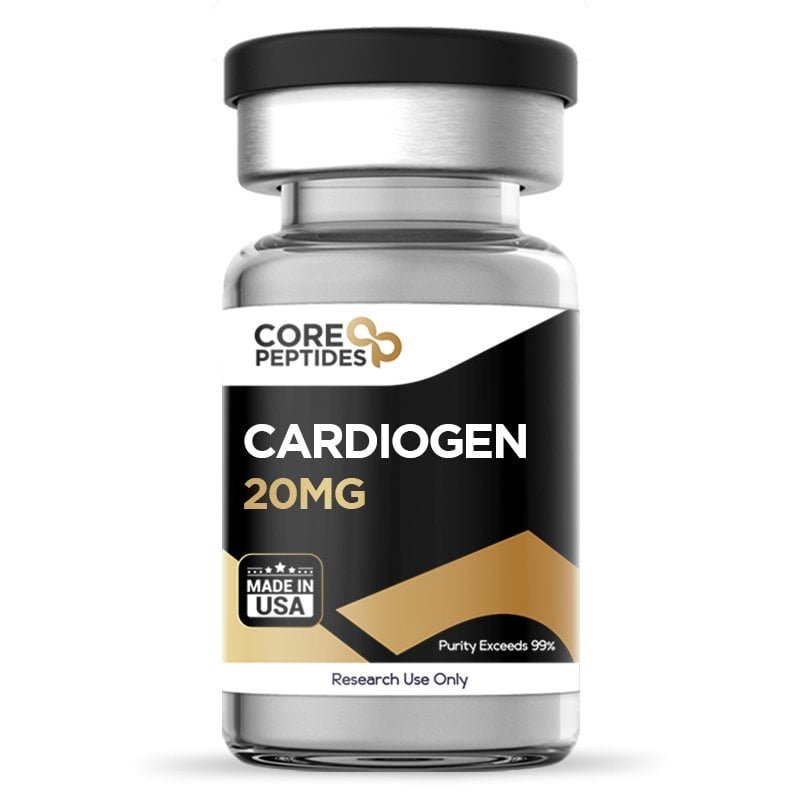
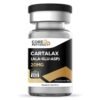
Cardiogen (20mg) Research Peptide – USA Supplier
Cardiogen (20mg) is a well-studied peptide bioregulator primarily investigated for its interactions with fibroblasts and tissues of the cardiovascular system. Due to its compact tetrapeptide structure and targeted biological signaling, Cardiogen has become an important research compound in studies involving cardiac tissue repair, fibroblast regulation, apoptosis signaling, and age-related cellular changes.
At Core Peptide, we supply Cardiogen (20mg) exclusively for laboratory and research purposes to customers across the United States, ensuring quality control, documentation, and responsible distribution.
What Is Cardiogen Peptide?
Cardiogen is a synthetic tetrapeptide with the amino acid sequence H-Ala-Glu-Asp-Arg-OH. It is commonly categorized as a peptide bioregulator, a class of short peptides believed to influence cellular activity by interacting with DNA-associated proteins and transcriptional machinery.
Early and ongoing research suggests Cardiogen may influence:
-
Fibroblast activity and differentiation
-
Cardiomyocyte proliferation
-
Scar formation and tissue remodeling
-
Apoptosis signaling pathways
-
Cellular aging mechanisms
Although originally studied for cardiovascular tissue models, newer research indicates Cardiogen may exert effects in other tissues where fibroblasts play a regulatory role.
Chemical Makeup of Cardiogen (20mg)
-
Molecular Formula: C18H31N7O9
-
Molecular Weight: 489.5 g/mol
-
Structure: H-Ala-Glu-Asp-Arg-OH
-
Other Identifiers: SCHEMBL3194515
Its small molecular size allows Cardiogen to interact with intracellular structures, including the cytoplasm, nucleus, and nucleolus—an uncommon characteristic among peptides.
Cardiogen Peptide and Cancer Research
One area of interest in Cardiogen research involves its differential effects on apoptosis in normal versus tumor cells. Studies suggest Cardiogen may act as an apoptotic reductant in cardiac cells, potentially by decreasing the expression of the p53 protein, while exerting opposite effects in certain tumor cells.
In murine models involving metastatic M-1 sarcoma, researchers observed that Cardiogen exposure resulted in:
-
Increased tumor cell apoptosis
-
Development of hemorrhagic necrosis
-
Inhibition of tumor growth without direct cytostatic effects
Importantly, the observed tumor growth inhibition appeared to be mediated through vascular network alterations, rather than direct suppression of tumor cell division. This mechanism highlights Cardiogen’s potential relevance in studies exploring tumor microenvironments and vascular signaling pathways.
External reference:
👉 https://pubmed.ncbi.nlm.nih.gov
Cardiogen and Prostate Fibroblast Aging
Research has also examined Cardiogen’s effects on aging fibroblasts, particularly in prostate tissue models. Senescent fibroblast cultures typically show reduced expression of differentiation signaling factors. Studies suggest Cardiogen may restore or increase the expression of these signaling molecules, especially in aged or senescent cells.
Because fibroblast signaling is central to tissue integrity and cellular communication, Cardiogen has been proposed as a promising research candidate for exploring age-related dysfunctions and regenerative signaling pathways in prostate and connective tissues.
Cardiogen Peptide and Cardiomyocyte Proliferation
Cardiogen’s interaction with cardiomyocytes is one of its most extensively studied areas. Experimental data suggest that Cardiogen may:
-
Enter cytoplasmic and nuclear compartments
-
Influence DNA-associated proteins
-
Enhance expression of cytoskeletal proteins
In murine embryonic fibroblast studies, Cardiogen exposure led to 2x–5x increases in key proteins such as:
-
Actin (cell structure and movement)
-
Vimentin (mechanical resilience)
-
Tubulin (microtubule formation)
-
Lamin A/C (nuclear structural integrity)
These proteins play essential roles in maintaining cell shape, intracellular transport, gene expression, and cell division. Researchers hypothesize that Cardiogen may facilitate improved gene accessibility for transcription, thereby supporting increased cellular metabolism and differentiation.
Cardiogen and Apoptosis in Cardiac Tissue
Multiple studies indicate Cardiogen may reduce cardiomyocyte apoptosis, particularly following injury. A recurring observation is the peptide’s ability to decrease p53 protein expression, a critical regulator of programmed cell death.
Experimental findings suggest that Cardiogen:
-
Stimulates cardiomyocyte proliferation
-
Reduces fibroblast overgrowth and scar formation
-
Supports improved myocardial remodeling
In murine models of myocardial injury induced by coronary artery ligation, Cardiogen administration was associated with:
-
A threefold reduction in mortality
-
Smaller necrotic zones within cardiac tissue
-
Preservation of myocardial glycogen content
-
Improved mitochondrial integrity
These outcomes suggest Cardiogen may support cellular survival pathways and reparative mechanisms in cardiac research models.
Cardiogen’s Role in Fibroblast Regulation
Fibroblasts play a central role in scar formation, extracellular matrix remodeling, and tissue repair. Excessive fibroblast proliferation can lead to fibrosis, while insufficient activity can impair healing.
Research suggests Cardiogen may help regulate fibroblast behavior by:
-
Modulating differentiation signals
-
Limiting excessive fibroblast growth
-
Supporting balanced tissue repair processes
This regulatory effect is one reason Cardiogen is studied beyond cardiovascular systems, including connective tissue and aging research models.
Why Buy Cardiogen (20mg) from Core Peptide?
When sourcing Cardiogen (20mg) in the USA, quality, consistency, and documentation are essential. Core Peptide provides:
-
Research-grade peptide purity
-
Transparent batch documentation
-
Secure U.S.-based shipping
-
Strict research-only compliance
We support reproducible laboratory research by maintaining high sourcing and handling standards.
Explore related peptides for research:
👉 Cagrilintide Research Peptides
👉 Retatrutide Peptides
👉 Tirzepatide Research Compounds


Reviews
There are no reviews yet.