
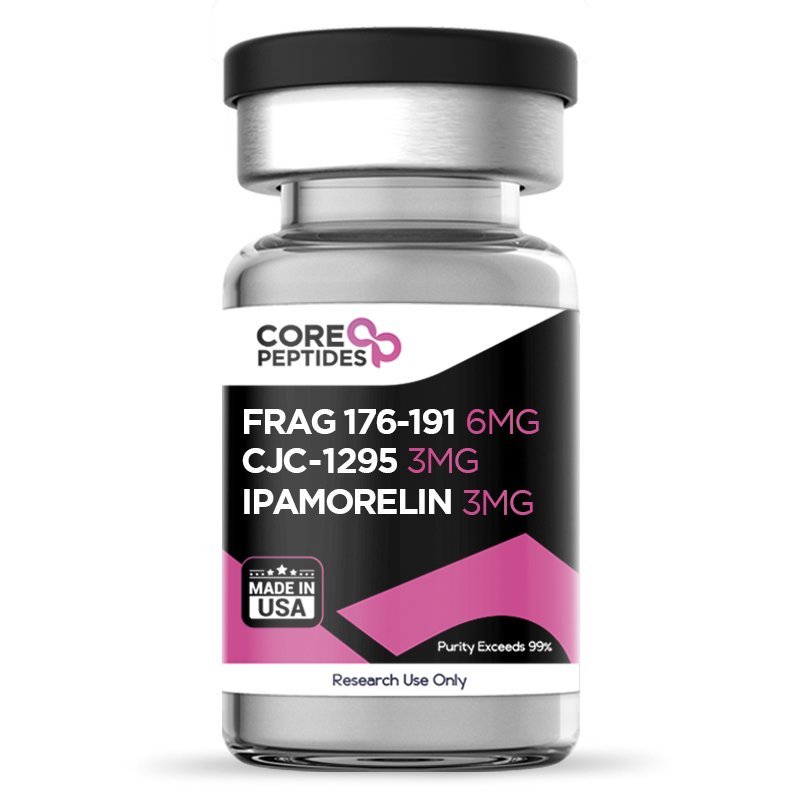
Fragment 176-191 & CJC-1295 & Ipamorelin Blend (12mg)
The Fragment 176-191 & CJC-1295 & Ipamorelin Blend (12mg) is a multi-peptide research formulation developed to support advanced laboratory investigations involving growth hormone signaling, fat metabolism, tissue regeneration, and body composition pathways. This peptide blend combines three extensively researched compounds—each contributing a unique mechanistic role—into a single formulation designed for controlled experimental environments.
Available exclusively for research and laboratory purposes, this peptide blend is supplied by Core Peptide USA and intended for qualified researchers across the United States seeking high-purity peptide compounds. Learn more about our full catalog on the Core Peptide USA research peptides page.
Overview of the Peptide Components
Fragment 176-191 (AOD-9604)
Fragment 176-191 is a synthetic segment of human growth hormone (hGH), consisting of the final amino acids responsible for the hormone’s lipolytic activity. Unlike full-length hGH, this fragment is studied primarily for its potential to influence fat metabolism without activating growth-related pathways.
Researchers have posited that Fragment 176-191 may interact with beta-3 adrenergic receptors (ADRB3), which are associated with lipolysis and thermogenesis in adipose tissue. Studies suggest this interaction may encourage fatty acid mobilization while minimizing effects on blood glucose and IGF-1 signaling.
CJC-1295 (Mod GRF 1-29)
CJC-1295 is a synthetic analog of Growth Hormone-Releasing Hormone (GHRH). It contains the first 29 amino acids of endogenous GHRH, modified to enhance receptor binding and biological stability.
CJC-1295 is studied for its ability to stimulate pulsatile growth hormone release by activating GHRH receptors in the anterior pituitary gland. Clinical research has shown that CJC-1295 may significantly elevate circulating growth hormone and IGF-1 levels over extended periods, making it a foundational peptide in growth hormone research.
More information on the molecular structure of CJC-1295 can be found via the National Center for Biotechnology Information (NCBI).
Ipamorelin
Ipamorelin is a selective growth hormone secretagogue (GHS) and ghrelin mimetic peptide. It is composed of five amino acids and is studied for its ability to stimulate growth hormone release through activation of the GHS-R1a receptor, without significantly influencing cortisol or prolactin levels.
Ipamorelin is unique in that it may stimulate growth hormone secretion while maintaining receptor selectivity, making it a valuable compound for research into growth hormone pulsatility, appetite signaling, and metabolic balance.
Additional compound data is available via PubChem’s Ipamorelin record.
Synergistic Research Potential of the Blend
When combined, Fragment 176-191 & CJC-1295 & Ipamorelin Blend (12mg) may offer a synergistic research platform by targeting multiple nodes of the growth hormone axis:
-
Fragment 176-191 may influence fat metabolism and lipid mobilization
-
CJC-1295 may enhance endogenous growth hormone synthesis
-
Ipamorelin may amplify ghrelin-mediated GH release
Researchers theorize that this complementary interaction may help maintain equilibrium growth hormone levels while simultaneously influencing adipose tissue, lean mass pathways, and regenerative signaling.
Research & Clinical Insights
Growth Hormone Secretion
Multiple phase-1 studies suggest that CJC-1295 alone may elevate growth hormone levels by up to 7- to 10-fold, with prolonged elevation lasting several days after administration. Ipamorelin, in separate investigations, has been reported to stimulate acute growth hormone release exceeding 60-fold compared to placebo.
When studied together, these compounds may promote a sustained yet pulsatile growth hormone profile—an important consideration in endocrine and metabolic research.
Lipolytic & Metabolic Research
Fragment 176-191 has been evaluated in large-scale clinical trials involving over 300 participants, where it was associated with reductions in body fat and improvements in cholesterol and glucose tolerance markers. Researchers have suggested that its fat-reducing effects may occur independently of traditional growth hormone pathways.
This has made Fragment 176-191 a key compound in studies involving energy expenditure, fat oxidation, and metabolic efficiency.
Tissue & Cartilage Regeneration
Animal studies exploring cartilage injury models have suggested that Fragment 176-191—particularly when combined with hyaluronic acid—may support cartilage repair and regeneration. These findings have sparked interest in peptide-based regenerative research.
Body Composition & Bone Density
Ipamorelin and CJC-1295 have both been studied for their potential influence on lean mass retention and bone mineral content. DXA and pQCT imaging in murine models suggested increases in tibial and vertebral bone mineral density, possibly due to enhanced mechanical loading from increased lean mass.
Researchers hypothesize that Fragment 176-191 may counterbalance any adipogenic effects observed with ghrelin-mimetic compounds, making the blend particularly interesting for body composition studies.
Chemical Makeup
Fragment 176-191
-
Molecular Formula: C78H125N23O23S2
-
Molecular Weight: 1817.12 g/mol
CJC-1295 (Mod GRF 1-29)
-
Molecular Formula: C152H252N44O42
-
Molecular Weight: 3367.9 g/mol
Ipamorelin
-
Molecular Formula: C38H49N9O5
-
Molecular Weight: 711.8 g/mol
Why Choose Core Peptide USA?
-
USA-based supplier
-
High-purity research peptides
-
Accurate labeling & batch consistency
-
Reliable shipping throughout the United States
Explore additional peptide formulations at
https://corepeptide.us
Be the first to review “Fragment 176-191 & CJC-1295 & Ipamorelin Blend (12mg)”
Related products
Peptides for sale
Peptides for sale
Peptides for sale
Peptides for sale
Peptides for sale
Peptides for sale
Peptides for sale
Reviews
There are no reviews yet.