
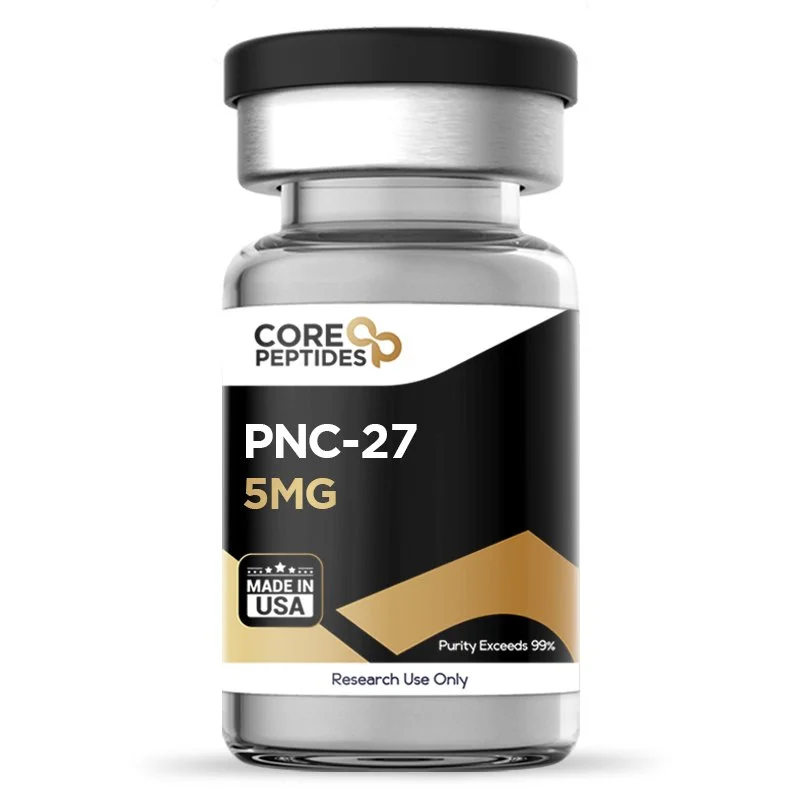

PNC-27 (5mg) Peptide
PNC-27 peptide
PNC-27 (5mg) is a synthetic 27-amino-acid research peptide derived from the α-helical segment of the tumor suppressor protein p53, specifically associated with the ASPP2 domain. This peptide has been widely studied in laboratory research for its potential to selectively target and induce death in cancer cells while leaving non-cancerous cells largely unaffected.
Unlike many anticancer research compounds that rely on apoptosis, PNC-27 has been reported to induce necrosis through direct membrane disruption, a mechanism that has drawn interest in oncology and molecular biology research. At Core Peptide, PNC-27 (5mg) is supplied strictly for research and laboratory purposes only to qualified institutions within the United States.
Explore additional oncology-related research compounds in our Peptides Collection.
What Is the PNC-27 Peptide?
PNC-27 is engineered from a segment of the p53 protein, a key regulator of cell cycle control and tumor suppression. Researchers initially synthesized PNC-27 in the early 2000s during investigations related to immunodeficiency research. During these studies, the peptide demonstrated a notable affinity for HDM-2 (human double minute-2), a protein that is often overexpressed on the plasma membranes of cancer cells.
Research suggests that PNC-27 may bind to HDM-2 on cancer cell membranes and form transmembrane pores, leading to membrane destabilization, ion imbalance, and eventual cell death through necrosis. Importantly, HDM-2 is typically absent from the membranes of healthy cells, which may explain the peptide’s observed selectivity.
Chemical Makeup of PNC-27
-
Molecular Formula: C₁₈₈H₂₉₃N₅₃O₄₄S
-
Molecular Weight: 4031.7 g/mol
The peptide’s relatively large size and α-helical structure are believed to play a crucial role in its interaction with HDM-2 and membrane pore formation.
PubChem & NCBI – p53-Derived Peptides
PNC-27 and Selective Cancer Cell Death
One of the most studied aspects of PNC-27 peptide research is its potential selectivity for cancer cells. A 2009 investigation examined whether PNC-27 would interact with non-cancerous cells. Researchers hypothesized that the peptide’s specificity depended on the presence of HDM-2 within the cell membrane.
Using immuno-electron microscopy and structural modeling, researchers observed ring-shaped pore structures forming exclusively on cancer cell membranes after exposure to PNC-27. These pores were not detected in healthy cells unless HDM-2 was artificially introduced, further supporting the hypothesis that HDM-2 is essential for PNC-27 activity.
This selective interaction has made PNC-27 a compelling subject in cancer membrane biology research.
Membranolysis and Intact Peptide Activity
Subsequent studies sought to determine whether PNC-27 acts as an intact peptide or through degraded fragments. In a 2010 study, researchers labeled both ends of the peptide with fluorescent markers to track its structural integrity during membrane interaction.
Results showed a distinct yellow fluorescence during cancer cell membrane lysis, indicating that PNC-27 remained intact while inducing membranolysis. This observation suggested that the full peptide structure is necessary for pore formation and cytotoxic activity.
Control (non-cancerous) cells did not exhibit membrane lysis and showed rapid degradation of the peptide, reinforcing its selective action.
PNC-27 and Non-Solid Tumor Research
In 2014, researchers expanded PNC-27 investigations to non-solid tumor cells, including leukemia cell lines. The study aimed to determine whether HDM-2 was also present on the membranes of these cells and whether PNC-27 could induce necrosis in a similar manner.
The results indicated that non-solid tumor cells expressing HDM-2 were susceptible to PNC-27-induced membrane disruption. Notably, this activity appeared to occur through a p53-independent pathway, as some leukemia cell lines lacked functional p53 expression.
These findings broadened the scope of PNC-27 research beyond solid tumors.
Related Peptide Research and Comparative Studies
Closely related peptides such as PNC-28 have also been evaluated in cancer research. Studies involving ovarian cancer cell lines and mouse xenograft models suggested reduced tumor growth following exposure to p53-derived peptides similar to PNC-27.
More recent studies have examined PNC-27’s activity across various leukemia cell lines, including acute myelogenous and promyelocytic leukemia models. Researchers reported consistent targeting of cells with high HDM-2 membrane expression, suggesting a shared mechanism across multiple cancer phenotypes.
Why Choose PNC-27 (5mg) from Core Peptide?
Core Peptide supplies high-purity research peptides designed to support advanced scientific investigation.
Product highlights:
-
5mg vial for precise research applications
-
High-purity synthetic peptide
-
Suitable for oncology, membrane biology, and molecular research
-
Distributed for U.S. research institutions
Explore related research compounds like Pinealon and NAD+ peptides in our catalog.
References
-
Davitt K. et al. PNC-27 Induces Tumor Cell Necrosis Dependent on HDM-2. Ann Clin Lab Sci, 2014.
-
Sookraj K.A. et al. PNC-27 Induces Cancer Cell Lysis as the Intact Peptide. Cancer Chemother Pharmacol, 2010.
-
Sarafraz-Yazdi E. et al. Selective Membrane-Pore Formation by PNC-27. Biomedicines, 2022.
Be the first to review “PNC-27 (5mg)”
Related products

Peptides for sale
Peptides for sale
Peptides for sale
Peptides for sale
Peptides for sale
Peptides for sale
Peptides for sale
Peptides for sale
Reviews
There are no reviews yet.