
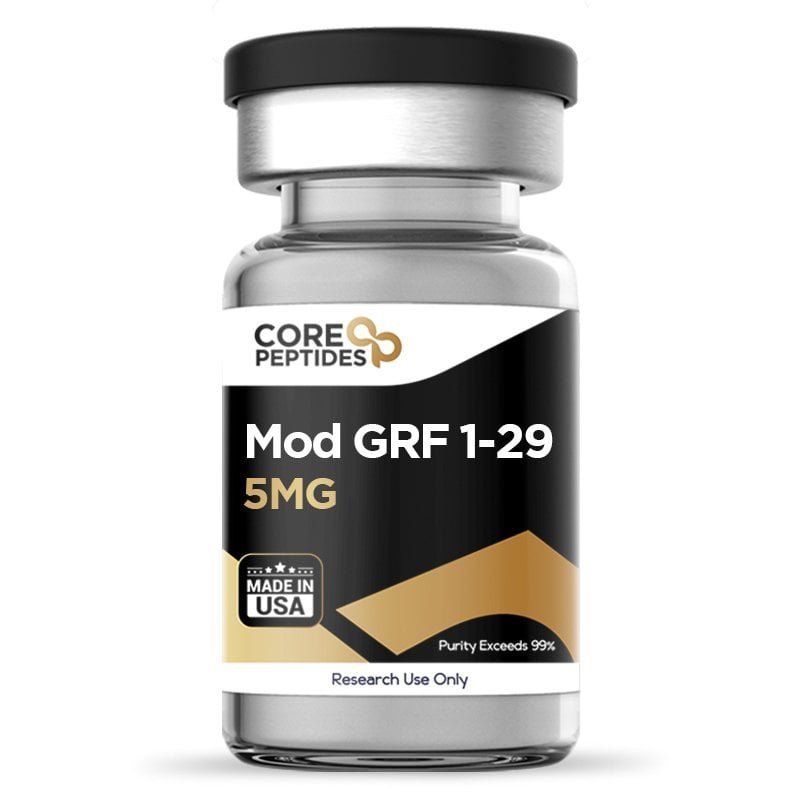
CJC-1295 NO DAC (Mod GRF 1-29) (5mg) – Research Peptide for Laboratory Use in the United States
Core Peptide USA provides research-grade peptide compounds designed exclusively for laboratory and scientific research purposes. One of the most studied growth hormone–related compounds in this category is CJC-1295 NO DAC (Mod GRF 1-29) (5mg), a synthetic analog of the naturally occurring growth hormone-releasing hormone (GHRH).
Researchers across the United States rely on Core Peptide for consistent quality, accurate labeling, and dependable domestic shipping. Each vial of CJC-1295 NO DAC (Mod GRF 1-29) (5mg) is produced with a focus on purity and stability to support non-clinical experimental models.
👉 Learn more about our manufacturing and testing standards on the Quality Assurance page.
Overview of CJC-1295 NO DAC (Mod GRF 1-29) (5mg)
CJC-1295 NO DAC, also known as Modified GRF (1-29), is a synthetic peptide composed of the first 29 amino acids of endogenous GHRH. Research dating back to the early 1980s suggested that this 29–amino-acid fragment retained the functional properties of the full 44–amino-acid GHRH peptide.
Unlike its DAC-enhanced counterpart, CJC-1295 NO DAC (Mod GRF 1-29) (5mg) does not include a Drug Affinity Complex. Instead, its structure relies on four strategic amino acid substitutions intended to improve resistance to enzymatic degradation while maintaining receptor affinity.
This peptide has been widely examined for its potential to stimulate growth hormone secretion by interacting directly with GHRH receptors located on somatotroph cells in the anterior pituitary gland.
For general scientific context, researchers often reference:
(External links are for educational reference only.)
Structural Modifications and Stability
CJC-1295 NO DAC differs from unmodified GRF (1-29) due to four amino acid substitutions designed to enhance peptide stability:
-
Position 2: L-alanine replaced with D-alanine, which may increase resistance to enzymatic cleavage
-
Position 8: Asparagine replaced with glutamine, potentially reducing amide hydrolysis
-
Position 15: Glycine replaced with alanine, speculated to enhance bioactivity
-
Position 27: Methionine replaced with leucine, possibly reducing oxidation risk
These modifications are thought to improve resistance to degradation by enzymes such as dipeptidyl peptidase-4 (DPP-4), resulting in a longer functional half-life compared to native GHRH.
Mechanism of Action in Research Models
Researchers propose that CJC-1295 NO DAC (Mod GRF 1-29) (5mg) binds to GHRH receptors on pituitary somatotroph cells, triggering conformational changes in the receptor. These changes may activate intracellular G-proteins associated with the receptor’s cytoplasmic domain.
Once activated, these G-proteins are believed to stimulate secondary messenger systems, particularly cyclic adenosine monophosphate (cAMP) and inositol trisphosphate (IP3). cAMP may activate protein kinases that phosphorylate transcription regulators, which could then migrate into the nucleus and influence gene expression related to growth hormone synthesis.
This signaling cascade may ultimately result in the fusion of growth hormone–containing vesicles with the cell membrane, allowing for the release of growth hormone into circulation in experimental models.
Growth Hormone Pulsatility and IGF-1 Research
Although direct studies on fully tetrasubstituted CJC-1295 NO DAC are limited, research involving modified GRF (1-29) peptides has provided insight into potential outcomes. Studies have suggested:
-
Increased growth hormone pulsatility over 12-hour observation periods
-
Mean growth hormone increases of approximately 70–107% in experimental models
-
IGF-1 elevations of roughly 28%, indicating modulation of the GH–IGF-1 axis
Additional observations in research models have included increases in skin thickness and muscle tissue hypertrophy, potentially linked to anabolic signaling associated with growth hormone and IGF-1 activity.
Additional Research Areas
Gastrointestinal Research
Experimental studies have suggested potential interactions between GHRH analogs and VPAC1 receptors in gastrointestinal smooth muscle. This interaction may influence bowel motility, though the precise mechanisms remain under investigation.
Cardiovascular Research
Preliminary murine studies examining GHRH agonists, including Modified GRF (1-29), have suggested possible roles in cardiac tissue repair and improvements in heart rate and ejection fraction following cardiac injury. These findings remain an area of ongoing research interest.
Combination Research Applications
Because CJC-1295 NO DAC (Mod GRF 1-29) (5mg) has a relatively short half-life compared to DAC-modified variants, researchers often explore its use in combination studies. One of the most commonly studied combinations is with Ipamorelin, a growth hormone secretagogue that interacts with ghrelin receptors.
Researchers suggest that simultaneous activation of GHRH receptors and ghrelin receptors on somatotroph cells may produce synergistic growth hormone release, making combination studies a frequent focus in endocrine research.
Explore related compounds in our Research Peptides Collection.
Chemical Makeup
Molecular Formula:
C₁₅₂H₂₅₂N₄₄O₄₂
Molecular Weight:
3367.9 g/mol
Other Known Names:
CJC-1295 Without DAC, Modified GRF (1-29), Tetrasubstituted GRF 1-29
Quality Standards and U.S. Shipping
Every vial of CJC-1295 NO DAC (Mod GRF 1-29) (5mg) from Core Peptide USA is produced under strict quality control procedures. Products are clearly labeled for research use only and are shipped from within the United States to ensure fast delivery and reliable tracking.
Please review our Terms and Conditions and Research Disclaimer before ordering.
Order CJC-1295 NO DAC (Mod GRF 1-29) (5mg) from Core Peptide USA
For researchers seeking a trusted U.S. supplier of CJC-1295 NO DAC (Mod GRF 1-29) (5mg), Core Peptide USA delivers quality, transparency, and responsive support. Our commitment to responsible peptide research makes us a reliable partner for laboratories nationwide.
Be the first to review “CJC-1295 NO DAC (Mod GRF 1-29) (5mg)”
Related products
Peptides for sale
Peptides for sale
Peptides for sale
Peptides for sale
Peptides for sale
Peptides for sale
Peptides for sale
Peptides for sale
Reviews
There are no reviews yet.