
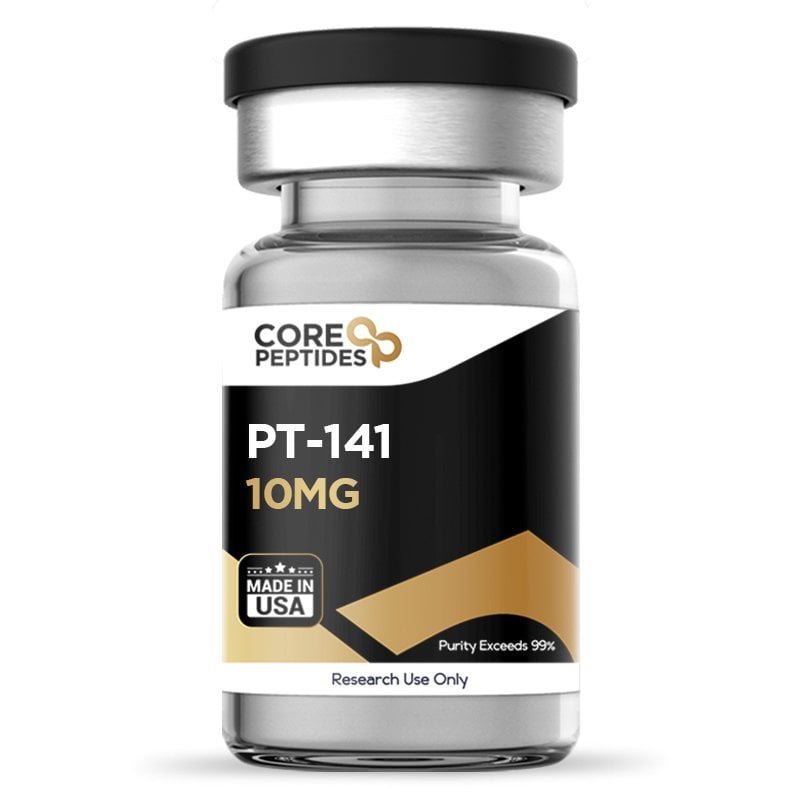
PT-141 (Bremelanotide) (10mg) Peptide – Research Overview
PT-141 (Bremelanotide) (10mg) is a synthetic cyclic peptide widely studied for its interaction with melanocortin receptors in the central nervous system. Originally developed as a metabolite of Melanotan II, PT-141 has become a distinct area of interest in peptide research due to its apparent ability to activate melanocortin receptor pathways that may influence neurological and behavioral signaling.
At Core Peptide, we provide PT-141 (Bremelanotide) 10mg strictly for research and laboratory use only, with quality-focused handling and reliable shipping across the United States. Researchers continue to examine PT-141 for its unique CNS-focused mechanism, which differentiates it from peripheral peptide compounds.
Related research peptides available at Core Peptide:
What Is PT-141 (Bremelanotide)?
Bremelanotide, commonly referred to as PT-141, is a seven–amino acid cyclic synthetic peptide. Structurally, it is derived from melanocortin analogs and is known for its agonistic activity at melanocortin receptors, particularly MC3R and MC4R.
Unlike some peptide compounds that act primarily on peripheral tissues, PT-141 appears to exert its primary effects through central nervous system signaling, making it a compelling subject for neurological and behavioral research models.
PT-141 Chemical Profile
-
Molecular Formula: C₅₀H₆₈N₁₄O₁₀
-
Molecular Weight: 1025.18 g/mol
-
Alternate Name: Bremelanotide
Additional compound data is available via the National Center for Biotechnology Information (NCBI):
https://pubchem.ncbi.nlm.nih.gov/compound/Bremelanotide
Mechanism of Action: Melanocortin Receptor Activity
Research suggests that PT-141 (Bremelanotide) (10mg) demonstrates affinity for MC3R and MC4R, two melanocortin receptors expressed predominantly in the brain.
MC3R (Melanocortin-3 Receptor)
MC3R is primarily expressed in the hypothalamus, an area associated with:
-
Energy homeostasis
-
Metabolic signaling
-
Feeding behavior modulation
Studies hypothesize that MC3R may act as a regulatory modulator for other melanocortin receptors, influencing downstream neurological signaling related to metabolic balance.
MC4R (Melanocortin-4 Receptor)
MC4R is one of the most studied melanocortin receptors and is believed to play a role in:
-
Appetite regulation
-
Energy expenditure
-
Neuroendocrine signaling
PT-141’s activity at MC4R has been a central focus of ongoing investigations, especially regarding CNS-mediated responses rather than direct peripheral action.
For more on melanocortin pathways, see:
https://www.ncbi.nlm.nih.gov/pmc/articles/PMC2775444/
PT-141 Peptide and Central Nervous System Research
One of the defining characteristics of PT-141 peptide research is its apparent central nervous system specificity. In multiple murine studies, PT-141 was observed to activate neurons within the hypothalamus and associated limbic regions.
Hypothalamic Activation
Following administration in animal models, PT-141 appeared to:
-
Increase neuronal immunoreactivity
-
Activate regions associated with motivational and behavioral signaling
-
Influence CNS pathways without generalized motor stimulation
Researchers noted that the peptide’s activity may be localized, selective, and stable—qualities that make it particularly valuable for controlled experimental designs.
Behavioral and Neurochemical Observations
Early-stage studies in the 2000s evaluated PT-141’s effects on behavior in murine models. In these controlled environments, researchers reported:
-
Increased appetitive behaviors
-
No significant change in motor activity
-
No disruption of baseline neurological function
These findings led investigators to suggest that PT-141 may exert selective pharmacological activity through melanocortin systems rather than broad neurological stimulation.
A foundational review on these findings can be found in The Journal of Sexual Medicine:
https://doi.org/10.1111/j.1743-6109.2007.00610.x
Nitric Oxide Pathway and Neurological Signaling
Additional studies explored the hypothesis that melanocortin receptor activation by PT-141 might influence nitric oxide (NO)–mediated pathways within neural circuits. Experimental data suggested:
-
Activation of central melanocortin receptors may trigger neuronal NO release
-
Disruption of NO synthesis reduced observed physiological responses
-
Peripheral nerve transection negated peptide-related signaling
While these findings remain under investigation, they highlight the complex neurochemical interactions associated with Bremelanotide research peptides.
Neuroimaging and Clinical-Style Research Models
More advanced investigations have incorporated functional neuroimaging and psychometric analysis to evaluate melanocortin receptor agonism. In controlled crossover studies, MC4R agonists like PT-141 were associated with:
-
Increased neural activity in cerebellar and motor regions
-
Altered connectivity between the amygdala and insula
-
CNS-specific responses when exposed to targeted stimuli
These findings contribute to the broader understanding of how melanocortin pathways may influence brain processing mechanisms.
PT-141 (Bremelanotide) 10mg From Core Peptide
At CorePeptide.us, our PT-141 (Bremelanotide) 10mg is supplied with:
-
High-purity research standards
-
Secure packaging
-
Fast domestic shipping within the United States
All peptides sold by Core Peptide are intended strictly for laboratory research use and are not approved for human or veterinary consumption.
View PT-141 and related compounds:
https://corepeptide.us
Be the first to review “PT-141 (Bremelanotide) (10mg)”
Related products
Peptides for sale

Peptides for sale
Peptides for sale
Peptides for sale
Peptides for sale

Peptides for sale
Peptides for sale
Peptides for sale
Reviews
There are no reviews yet.