
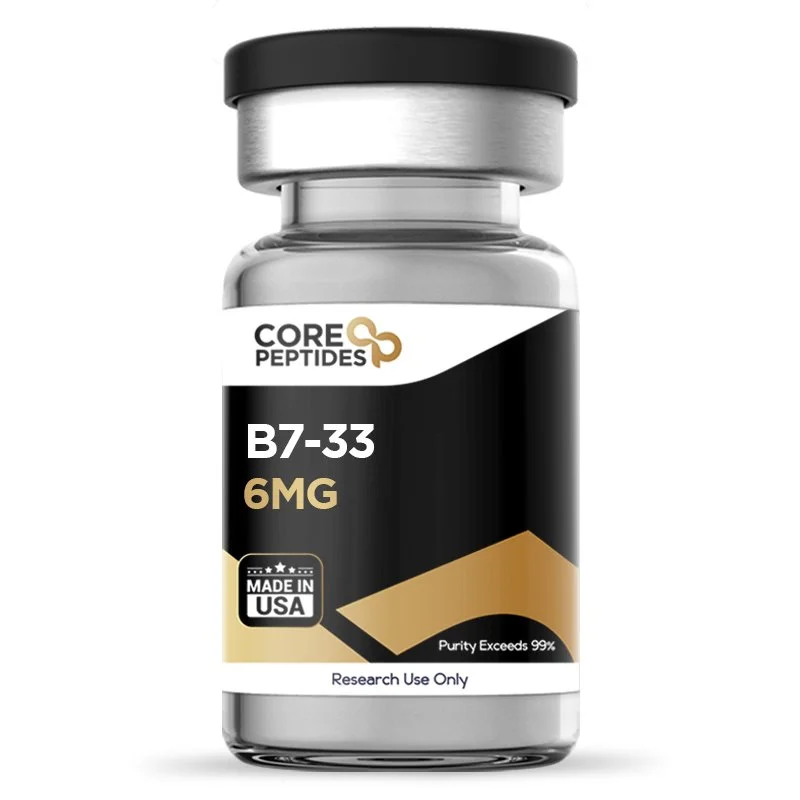
B7-33 (6mg) Peptide – Overview
B7-33 (6mg) is a synthetic peptide derived from H2-relaxin, a naturally occurring protein involved in multiple biological processes, including cardiovascular, reproductive, and musculoskeletal systems. Researchers have developed B7-33 to mimic H2-relaxin while enhancing solubility and specificity for research purposes. Unlike the natural H2-relaxin protein, B7-33 acts predominantly via the pERK signaling pathway, which may reduce fibrosis without stimulating pathways that could promote tumor growth.
Structurally, B7-33 is a single-chain peptide optimized from the B chain of relaxin and an extended COOH terminal, creating the first soluble analog suitable for in vitro and in vivo studies. This peptide is particularly noted for its anti-fibrotic, vasoprotective, and tissue-regenerative potential, making it highly relevant for research in cardiovascular health, endothelial function, and organ fibrosis.
Learn more about relaxin proteins and their receptor interactions.
Chemical Structure and Properties
-
Molecular Formula: C131H228N40O37S
-
Molecular Weight: 2987.75 g/mol
-
Other Names: (B7-33)H2, GTPL9321
B7-33 exhibits a high affinity for RXFP-1 receptors, which are involved in tissue remodeling and vascular relaxation. By targeting these receptors, B7-33 may increase MMP-2 (matrix metalloproteinase) synthesis, which plays a crucial role in breaking down fibrotic tissue and preventing scarring.
Mechanism of Action
Unlike H2-relaxin, which primarily activates the cAMP pathway, B7-33 operates through pERK-mediated signaling. This selective activation allows researchers to study anti-fibrotic effects without triggering cAMP-associated pathways, which may contribute to unwanted proliferative activity.
B7-33’s interaction with RXFP-1 has been shown to:
-
Stimulate matrix metalloproteinases (MMPs) for tissue remodeling
-
Reduce fibrosis formation in cardiac and prostate tissue models
-
Promote vascular relaxation in endothelial dysfunction studies
For a deeper dive into RXFP-1 receptor research, see Recent studies on relaxin receptors.
Research Highlights
1. Vasoprotective Effects
A 2017 study demonstrated that B7-33 (6mg) replicated the vasoprotective properties of H2-relaxin in male and female Wistar murine models. Researchers noted enhanced endothelium-dependent relaxation, particularly in the mesenteric artery, suggesting potential applications for vascular dysfunction research.
Key Findings:
-
Improved bradykinin-induced relaxation
-
Reduced endothelial dysfunction
-
Potential model for cardiovascular research
Read the full study for detailed methodology.
2. Anti-Fibrotic Potential
Fibrosis is the formation of excess connective tissue, often resulting in loss of organ function. Studies indicate that B7-33 can reduce fibrosis by nearly 50% in cardiac tissue models without activating cAMP pathways.
Applications for Research:
-
Cardiac fibrosis post-myocardial infarction
-
Prostate tissue fibrosis models
-
General organ tissue remodeling
By using B7-33, researchers can explore anti-fibrotic therapies without the proliferative risks associated with H2-relaxin.
3. Preeclampsia Studies
In cellular models of preeclampsia, B7-33 peptide increased vascular endothelial growth factor (VEGF) levels in cytotrophoblast cells. VEGF is essential for endothelial proliferation and vascular repair, indicating that B7-33 may have potential applications in reproductive health research.
-
Enhances endothelial cell proliferation and migration
-
Supports studies on fetal development and maternal health
For more on VEGF in vascular research, refer to VEGF signaling pathways.
4. Anti-Fibrotic Coating Applications
B7-33 has also been tested as a coating material on experimental implants, demonstrating a 49.2% reduction in fibrotic device thickness over six weeks. This application suggests a potential for material science and bioengineering research.
Why Choose B7-33 (6mg) Peptide from CorePeptide.us?
CorePeptide.us provides high-purity B7-33 (6mg) peptide designed specifically for research and laboratory applications. Our peptides are suitable for:
-
In vitro and in vivo studies
-
Cardiovascular research
-
Fibrosis modeling
-
Tissue regeneration and endothelial function experiments
All products comply with strict laboratory standards to ensure reproducibility, stability, and purity.
Explore our full peptide catalog for complementary research peptides like AOD 9604 and ARA-290.
How to Use B7-33 for Research
-
Store peptide under recommended conditions to maintain stability
-
Reconstitute in sterile water or appropriate buffer before experiments
-
Follow institutional guidelines for handling and disposal
-
Use only for research purposes; not for human consumption
For safety data sheets and laboratory protocols, visit CorePeptide.us Terms & Conditions.
External References for Further Research
-
Mohammed Akhter Hossain et al., Drug Discovery Biology, Monash Biomedicine Discovery Institute, 2016.
-
R J Summers, British Journal of Pharmacology, 2016. https://doi.org/10.1111/bph.13778
-
Marshall SA et al., Eur J Pharmacol, 2017. https://pubmed.ncbi.nlm.nih.gov/28478069/
-
S.H. Afroze et al., 2019. https://doi.org/10.1161/hyp.74.suppl_1.P3042
Conclusion
B7-33 (6mg) peptide is a cutting-edge research compound that mimics the biological effects of H2-relaxin while minimizing undesired side effects. Its anti-fibrotic, vasoprotective, and tissue-regenerative properties make it ideal for cardiovascular, fibrosis, and reproductive system research in US laboratories.
Order your B7-33 (6mg) peptide today at CorePepptide.us to explore the latest frontiers in peptide research
Be the first to review “B7-33 (6mg)”
Related products
Peptides for sale
Peptides for sale
Peptides for sale
Peptides for sale
Peptides for sale
Peptides for sale
Peptides for sale
Peptides for sale
Reviews
There are no reviews yet.