
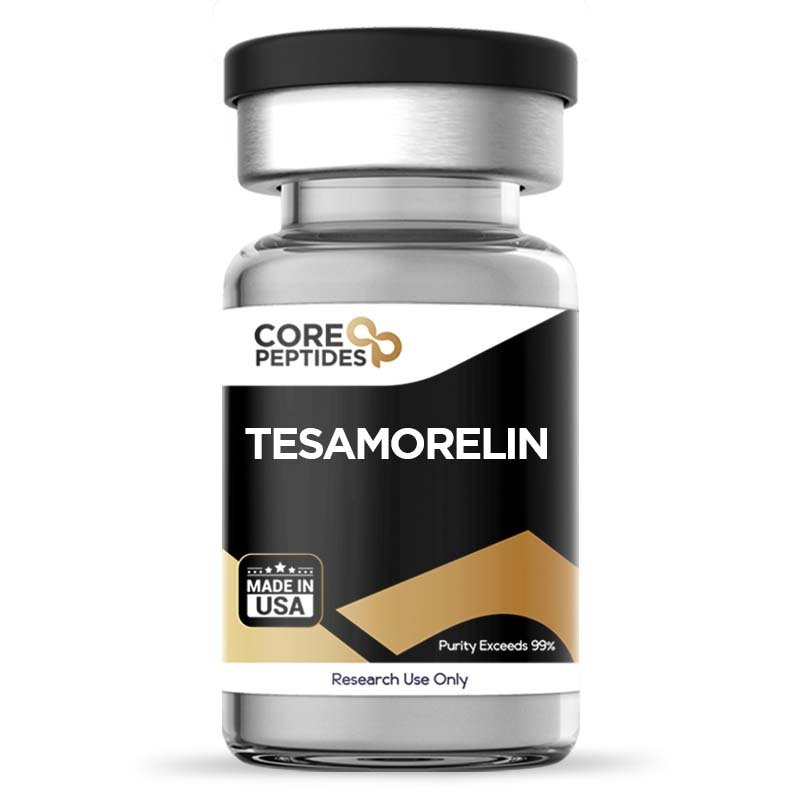
Tesamorelin is a synthetic polypeptide composed of 44 amino acids and is structurally analogous to growth hormone–releasing hormone (GHRH). It has been modified at both the N-terminus and C-terminus compared to endogenous GHRH, a feature researchers suggest may significantly improve its stability and resistance to enzymatic degradation.
At Core Peptide USA, Tesamorelin (5mg and 10mg) is supplied strictly for research and laboratory purposes only, offering U.S.-based researchers a reliable, high-purity peptide suitable for controlled experimental environments.
👉 Browse additional research peptides here: https://corepeptide.us
What Is Tesamorelin Peptide?
Tesamorelin is a synthetic growth hormone–releasing factor (GHRF) designed to interact with GHRH receptors located on somatotroph cells within the anterior pituitary gland. Through this interaction, Tesamorelin may stimulate the production and secretion of human growth hormone (hGH).
Growth hormone subsequently acts on multiple tissues throughout the body, including hepatocytes, where it may stimulate the systemic and local synthesis of insulin-like growth factor-1 (IGF-1). IGF-1 is widely recognized as a principal anabolic mediator of growth hormone activity and is involved in processes related to cellular growth, differentiation, and survival.
Overview of Tesamorelin’s Proposed Mechanism
When Tesamorelin binds to the GHRH receptor, researchers hypothesize that it induces conformational changes in the receptor structure. This interaction may activate intracellular signaling pathways involving adenylate cyclase, an enzyme responsible for converting adenosine triphosphate (ATP) into cyclic adenosine monophosphate (cAMP).
Elevated cAMP levels may then activate protein kinase A (PKA), a key signaling enzyme responsible for phosphorylating target proteins and transmitting cellular signals. This signaling cascade is believed to promote the synthesis and pulsatile release of growth hormone from pituitary cells.
Research suggests that Tesamorelin may:
-
Increase overall growth hormone exposure (AUC) by approximately 69%
-
Increase mean growth hormone pulse area by roughly 55%
-
Elevate circulating IGF-1 levels by up to 122%
Importantly, these changes do not appear to alter growth hormone pulse frequency or peak amplitude, suggesting a modulation of hormone output rather than overstimulation.
Structural Modifications and Stability
Tesamorelin differs from native GHRH through precise structural enhancements:
-
N-terminus acetylation (CH₃CO-), which may improve biological activity and molecular stability
-
C-terminus modification with trans-3-hexenoic acid, an omega-amino acid believed to increase resistance to enzymatic degradation
Due to these modifications, Tesamorelin is chemically designated as:
N-(trans-3-hexenoyl)-[Tyr¹]hGRF(1–44)NH₂ acetate
These enhancements may contribute to Tesamorelin’s extended functional lifespan in research settings when compared to natural GHRH.
Chemical Makeup of Tesamorelin
-
Molecular Formula: C₂₂₁H₃₆₆N₇₂O₆₇S
-
Molecular Weight: ~5136 g/mol
-
Amino Acid Length: 44 residues
-
Alternate Name: (3E)-hex-3-enoylsomatoliberin
Tesamorelin is available from Core Peptide in 5mg and 10mg research vials, supporting flexible experimental designs.
Tesamorelin Research and Clinical Studies
Tesamorelin and Lipodystrophy Research
Lipodystrophy is characterized by abnormal fat distribution and metabolic disturbances such as insulin resistance and dyslipidemia. Test models exhibiting lipodystrophy often demonstrate reduced levels of growth hormone and IGF-1.
Two large Phase III studies involving 806 immunodeficient test subjects examined Tesamorelin over a 26-week period, followed by a 26-week extension. Researchers reported:
-
A 15.4% reduction in visceral adipose tissue
-
Significant reductions in triglycerides and cholesterol compared to placebo
These findings suggest Tesamorelin may influence lipid metabolism and fat distribution in lipodystrophy research models.
Tesamorelin and Hepatic Fat Fraction
Non-alcoholic fatty liver disease (NAFLD) is frequently observed in immunodeficient models. In a 12-month study involving subjects with elevated hepatic fat fraction (HFF), Tesamorelin exposure resulted in:
-
35% of subjects achieving a clinically relevant reduction in liver fat
-
Only 4% improvement observed in placebo models
-
No reported changes in glucose levels
These outcomes highlight Tesamorelin’s relevance in hepatic fat metabolism research.
Tesamorelin and Cognitive Function
Ongoing research is examining Tesamorelin’s possible influence on neurological performance in immunodeficient models with mild cognitive impairment. Neurocognitive outcomes are being measured using the Global Deficit Score (GDS). Final results from these investigations have not yet been published.
Tesamorelin and Insulin Sensitivity
A randomized 12-week study involving Type II diabetes models evaluated Tesamorelin’s effect on insulin sensitivity. Measurements of fasting glucose and glycosylated hemoglobin showed no statistically significant changes, suggesting neutral metabolic effects on glucose control within the study parameters.
Tesamorelin and Muscle Tissue Research
Computed tomography (CT) imaging studies have examined Tesamorelin’s potential influence on muscle quality. Results indicated possible improvements in:
-
Muscle density
-
Muscle volume
-
Reduced intramuscular fat
Notable changes were observed in the rectus abdominis, psoas major, and paraspinal muscles compared to placebo models.
Tesamorelin and Visceral Fat
Visceral fat accumulation is closely associated with insulin resistance, dyslipidemia, and cardiovascular risk. Research suggests Tesamorelin may reduce visceral fat levels by up to 25% in lipodystrophy models, positioning it as a compound of interest in metabolic research.
Tesamorelin (5mg / 10mg) from Core Peptide USA
When sourcing Tesamorelin in the United States, Core Peptide provides:
-
High-purity research peptides
-
Accurate 5mg and 10mg dosing
-
Reliable U.S.-based shipping
-
Clear research-only labeling
-
Secure packaging and quality control
Research Use Disclaimer
Tesamorelin is intended strictly for laboratory and research purposes only.
Not for human or veterinary use. Please review our Terms & Conditions prior to ordering.
References
National Institute of Diabetes and Digestive and Kidney Diseases. Tesamorelin.
Spooner LM, Olin JL. Tesamorelin: a growth hormone-releasing factor analogue. Ann Pharmacother.
Be the first to review “Tesamorelin (5mg / 10mg)”
Related products
Peptides for sale
Peptides for sale
Peptides for sale
Peptides for sale
Peptides for sale
Peptides for sale
Peptides for sale
Reviews
There are no reviews yet.