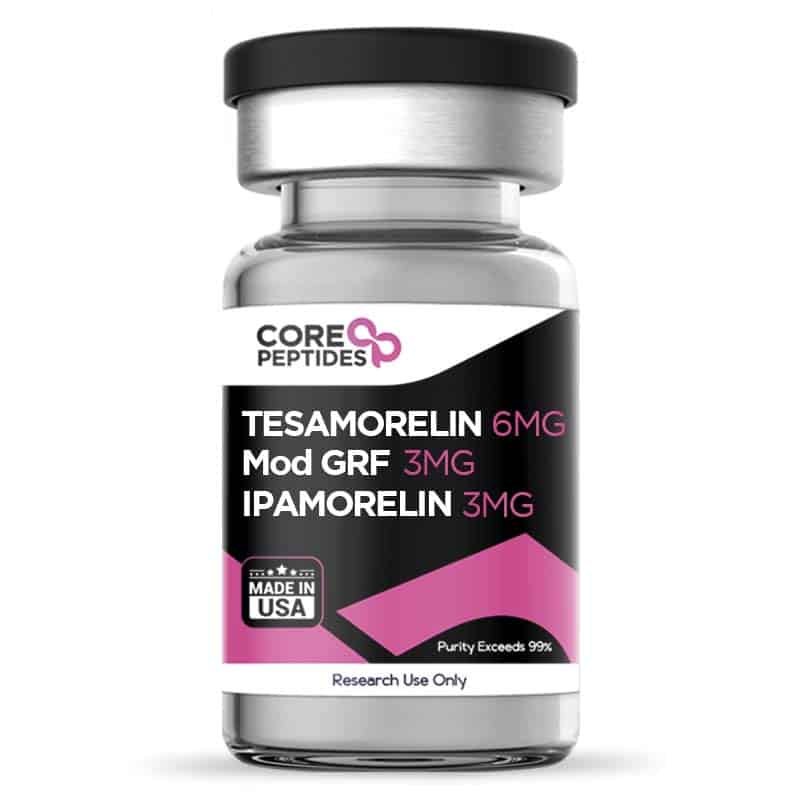
Tesamorelin & CJC-1295 (Mod GRF 1-29) & Ipamorelin Blend (12mg)
Tesamorelin & CJC-1295 (Mod GRF 1-29) & Ipamorelin Blend (12mg) is a multi-peptide research formulation developed to support laboratory investigations into growth hormone (GH) secretion, pituitary signaling, and IGF-1–related pathways. Each peptide within this blend is synthetic and has been studied independently for its potential role in stimulating endogenous GH release through distinct yet complementary mechanisms.
At Core Peptide USA, this peptide blend is supplied strictly for research and laboratory use only, providing U.S.-based researchers access to high-purity, accurately dosed peptide compounds.
Overview of the Peptide Components
Tesamorelin
Tesamorelin is a 44-amino-acid synthetic analog of growth hormone–releasing hormone (GHRH). It has been structurally modified at both the N-terminus and C-terminus to potentially improve stability and resistance to enzymatic degradation.
-
N-terminus acetylation (CH₃CO-) may enhance biological activity
-
C-terminus trans-3-hexenoic acid modification may improve resistance to proteolysis
When interacting with GHRH receptors located in the pituitary and hypothalamus, Tesamorelin is theorized to stimulate the release of endogenous growth hormone from somatotroph cells.
CJC-1295 (Mod GRF 1-29)
CJC-1295 (Mod GRF 1-29)—often referred to as CJC-1295 without DAC—is a tetrasubstituted synthetic analog of GRF (1-29), the shortest fully active sequence of natural GHRH. This peptide has been modified to enhance potency and enzymatic stability.
Research suggests that CJC-1295 (Mod GRF 1-29):
-
Binds to GHRH receptors on pituitary cells
-
Promotes sustained GH secretion
-
May elevate IGF-1, IGFBP-3, and GH binding protein levels
Certain studies indicate that a large proportion of the peptide may bind to circulating albumin, thereby extending its functional half-life in research models.
Ipamorelin
Ipamorelin is a synthetic pentapeptide that functions as a selective agonist of the ghrelin (GHS) receptor. Unlike GHRH analogs, Ipamorelin stimulates GH release through growth hormone secretagogue pathways, offering a complementary mechanism.
Key characteristics of Ipamorelin include:
-
High specificity for GH secretion
-
Minimal influence on prolactin, cortisol, or ACTH levels
-
Interaction with phospholipase C (PLC), IP₃, DAG, and intracellular calcium signaling
This selectivity makes Ipamorelin a frequent subject of GH-related research.
Chemical Makeup of the Blend
Molecular Formula
-
Tesamorelin: C₂₂₁H₃₆₆N₇₂O₆₇S
-
CJC-1295 (Mod GRF 1-29): C₁₅₂H₂₅₂N₄₄O₄₂
-
Ipamorelin: C₃₈H₄₉N₉O₅
Molecular Weight
-
Tesamorelin: 5136 g/mol
-
CJC-1295 (Mod GRF 1-29): 3367.9 g/mol
-
Ipamorelin: 711.8 g/mol
Mechanisms of Action: Pituitary Signaling
GHRH Receptor Pathways
Tesamorelin and CJC-1295 (Mod GRF 1-29) are believed to interact with GHRH receptors on pituitary somatotrophs. Upon receptor engagement, these peptides may initiate intracellular signaling cascades involving:
-
Adenylate cyclase activation
-
Increased cyclic AMP (cAMP)
-
Activation of protein kinase A (PKA)
-
Phosphorylation of downstream targets leading to GH secretion
The GH released may subsequently stimulate the synthesis of insulin-like growth factor-1 (IGF-1) in hepatic and peripheral tissues.
Ghrelin Receptor Pathways
Ipamorelin binds to growth hormone secretagogue (GHS) receptors, activating a separate signaling pathway involving:
-
Phospholipase C (PLC)
-
Inositol triphosphate (IP₃)
-
Diacylglycerol (DAG)
-
Intracellular calcium release
-
Protein kinase C (PKC) activation
These events are believed to culminate in GH vesicle exocytosis from pituitary cells.
Research on the Gastrointestinal Tract
Ipamorelin has also been studied for its interaction with ghrelin receptors in the gastrointestinal tract. Research models suggest it may:
-
Influence gastric motility
-
Accelerate gastric emptying
-
Modulate smooth muscle contractility
-
Support tissue repair following GI injury
Some investigations indicate that Ipamorelin may counteract surgery-induced delays in gastric emptying and restore contractile responsiveness in intestinal tissues.
Synergistic Research Potential of the Blend
The rationale for combining Tesamorelin, CJC-1295 (Mod GRF 1-29), and Ipamorelin lies in their complementary pathways for GH stimulation. Together, the blend is theorized to:
-
Promote sustained and pulsatile GH secretion
-
Elevate IGF-1 availability
-
Support lean mass and muscle tissue research
-
Influence body composition and metabolic pathways
Muscle and Lean Mass Research
Computed tomography (CT) studies examining Tesamorelin suggest possible improvements in muscle density and volume, particularly in the rectus abdominis, psoas major, and paraspinal muscles. Meanwhile, CJC-1295 research indicates potential increases in lean body mass and skin thickness over extended exposure periods.
Ipamorelin has also been studied for its possible influence on skeletal muscle fibers and IGF-1 signaling, though further validation is required.
Tesamorelin & CJC-1295 & Ipamorelin Blend (12mg) from Core Peptide USA
When sourcing Tesamorelin & CJC-1295 (Mod GRF 1-29) & Ipamorelin Blend in the United States, Core Peptide offers:
-
High-purity, research-grade peptides
-
Accurate 12mg blended dosing
-
U.S.-based shipping
-
Secure packaging and quality assurance
-
Clear labeling for laboratory research only
References
National Center for Biotechnology Information (2023). PubChem Compound Summary for Ipamorelin.
Additional peer-reviewed GH and GHRH research studies.


Reviews
There are no reviews yet.