
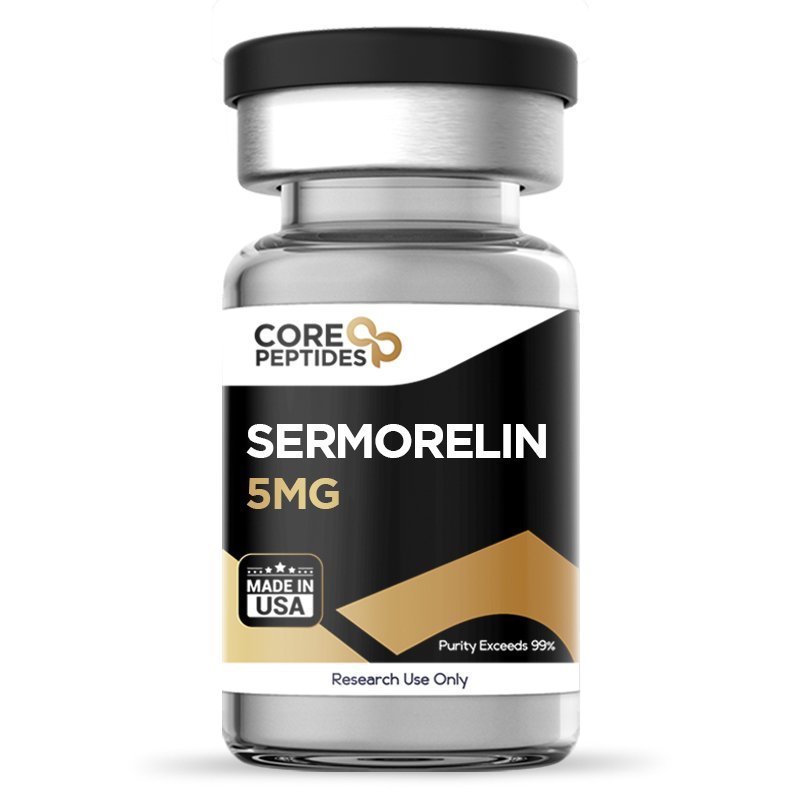
Sermorelin (5mg) Peptide – Research-Grade GHRH Analog
Sermorelin (5mg) is a synthetically developed peptide composed of 29 amino acids and classified as a growth hormone-releasing hormone (GHRH) analog. It is structurally derived from the first 29 amino acids of endogenous GHRH, making it the shortest biologically active fragment known to interact with GHRH receptors. Due to this selective receptor affinity, Sermorelin (5mg) has been extensively studied in laboratory and preclinical research involving growth hormone (GH) secretion, IGF-1 regulation, anabolic signaling pathways, and age-related hormone decline models.
At Core Peptide, we supply Sermorelin (5mg) strictly for research and laboratory use, providing U.S. researchers with high-purity peptide compounds backed by quality control and fast domestic shipping.
Related research peptides can be found in our Peptides Collection.
Scientific Background of Sermorelin
Sermorelin is formally identified as GHRH (1-29) amide, a truncated analog of the native 44-amino-acid GHRH molecule. Early investigations in the 1980s demonstrated that this shortened peptide retained biological activity capable of stimulating the pituitary gland when introduced into animal models. These findings positioned Sermorelin (5mg) as a valuable compound for growth hormone deficiency research and endocrine system modeling.
Unlike direct growth hormone analogs, Sermorelin is theorized to function upstream by binding to GHRH receptors on pituitary somatotroph cells, thereby encouraging pulsatile and physiologic GH secretion rather than exogenous hormone replacement.
Mechanism of Action (Research Hypothesis)
Researchers propose that Sermorelin (5mg) interacts with GHRH receptors to initiate intracellular signaling cascades, primarily involving:
-
Activation of adenylate cyclase
-
Increased production of cyclic adenosine monophosphate (cAMP)
-
Stimulation of protein kinase A (PKA)
-
Enhanced secretion of human growth hormone (hGH)
-
Secondary elevation of insulin-like growth factor-1 (IGF-1)
This signaling pathway is widely studied due to IGF-1’s recognized role in anabolic signaling, cellular growth, and tissue regeneration research. The estimated half-life of Sermorelin is approximately 11–12 minutes, supporting its use in pulsatile secretion studies.
Importantly, research suggests that Sermorelin may demonstrate high receptor specificity, showing minimal influence on other endocrine markers such as cortisol, insulin, glucose, prolactin, or thyroid hormones.
Chemical Profile of Sermorelin (5mg)
-
Molecular Formula: C₁₄₉H₂₄₆N₄₄O₄₂S
-
Molecular Weight: 3357.93 g/mol
-
Alternate Name: GRF 1-29
-
Peptide Class: GHRH analog
For molecular reference data, researchers may consult the PubChem Compound Summary for Sermorelin via the National Center for Biotechnology Information (NCBI).
Research Areas Involving Sermorelin (5mg)
Growth Hormone Deficiency Models
Animal studies investigating idiopathic growth hormone deficiency have reported increased growth velocity and sustained height development following continuous exposure to Sermorelin analogs. Some findings suggested maintained outcomes even after discontinuation periods, making Sermorelin (5mg) a compound of interest in long-term GH regulation research.
Anabolic and Lean Mass Research
Multiple investigations hypothesize that Sermorelin may increase mean growth hormone levels by over 80%, with downstream increases in IGF-1. These elevations have been associated with lean body mass gains without significant fat mass changes in controlled research environments.
Lipodystrophy and Fat Distribution Studies
Clinical research involving HIV-associated lipodystrophy models suggested that Sermorelin exposure correlated with reduced visceral abdominal fat and improved trunk-to-limb fat ratios, while maintaining stable glucose and insulin markers.
Cognitive Function Research
Age-related decline in growth hormone has been studied for its potential relationship with cognitive impairment. Research involving elderly subjects reported improvements in standardized cognitive performance metrics, including memory and verbal reasoning, following Sermorelin administration.
Oncology-Related Investigations
In vitro screening of over 4,000 compounds across glioma cell models identified Sermorelin as a peptide demonstrating notable tumor cell sensitivity. Researchers hypothesized this may relate to cell cycle modulation mechanisms, though further research is required.
Hypogonadism and Endocrine Interaction Studies
Preliminary investigations explored whether Sermorelin-induced GH elevation might influence LH and FSH secretion, potentially impacting testosterone regulation. While results varied, nighttime GH secretion peaks were consistently observed across age groups.
Why Choose Core Peptide for Sermorelin (5mg)?
-
USA-Based Supplier
-
Research-Grade Purity Standards
-
Fast Domestic Shipping
-
Transparent Documentation
-
Strictly for Laboratory & Research Use
Explore additional GH-related compounds such as Mod GRF 1-29 and GHRP peptides within our catalog.
Research-Only Disclaimer
Sermorelin (5mg) is sold strictly for research and laboratory purposes only.
Not for human consumption, medical use, or diagnostic application. Buyers are responsible for ensuring compliance with all applicable federal and state regulations. Please review our Terms and Conditions prior to ordering.
Authoritative External References
-
National Center for Biotechnology Information (NCBI) – Sermorelin Compound Summary
-
Endotext: Growth Hormone in Aging – MDText
-
Nature Journal – Clark & Robinson (1985)
-
PubMed – Sermorelin clinical and mechanistic studies
-
FDA Drug Database (historical reference data)
Be the first to review “Sermorelin (5mg)”
Related products
Peptides for sale
Peptides for sale
Peptides for sale
Peptides for sale
Peptides for sale
Peptides for sale
Peptides for sale
Peptides for sale
Reviews
There are no reviews yet.