
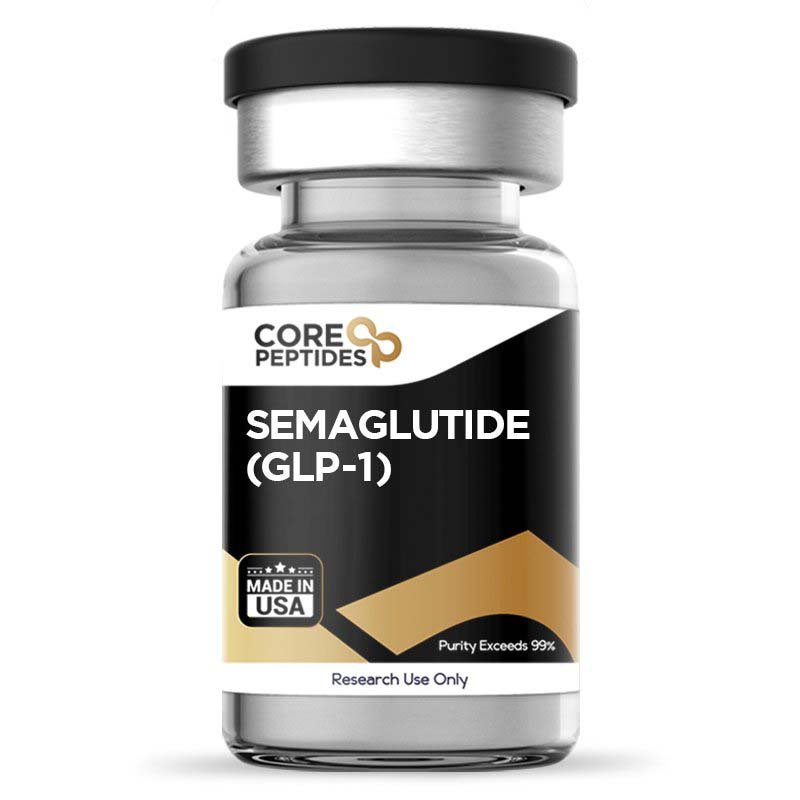
Semaglutide (3mg / 5mg / 10mg) – Receptor-Grade Research Peptide
Semaglutide (3mg / 5mg / 10mg) is a synthetic glucagon-like peptide-1 (GLP-1) receptor agonist widely studied in metabolic, endocrine, and receptor-signaling research. Engineered for enhanced stability and prolonged receptor interaction, Semaglutide has become an important tool for laboratory investigations involving glucose regulation, appetite signaling, and energy balance pathways.
At Core Peptide, we supply Semaglutide (3mg / 5mg / 10mg) in receptor-grade purity, manufactured to strict quality standards and offered exclusively for research and laboratory use within the United States.
Background and Development of Semaglutide
GLP-1 is a naturally occurring incretin hormone secreted by intestinal L-cells in response to nutrient intake. It plays a significant role in glucose-dependent insulin signaling, appetite regulation, and gastric emptying. Due to its rapid enzymatic degradation by dipeptidyl peptidase-4 (DPP-4), native GLP-1 has a very short half-life.
To overcome this limitation, researchers developed synthetic GLP-1 analogs with enhanced stability. Semaglutide was engineered through specific amino acid substitutions and fatty-acid acylation, allowing it to bind to albumin and resist enzymatic breakdown. These structural modifications result in prolonged receptor engagement and sustained signaling in experimental models.
Mechanism of Action (Research Context)
In research settings, Semaglutide (3mg / 5mg / 10mg) is studied for its ability to selectively activate the GLP-1 receptor (GLP-1R). Upon receptor binding, GLP-1R activation is associated with intracellular signaling cascades involving:
-
cAMP production
-
Protein kinase A (PKA) activation
-
Modulation of insulin and glucagon signaling pathways
GLP-1 receptors are expressed in multiple tissues, including pancreatic cells, the gastrointestinal tract, and specific brain regions involved in appetite and satiety signaling. This widespread receptor distribution makes Semaglutide valuable for multisystem research models.
Research Applications of Semaglutide (3mg / 5mg / 10mg)
Semaglutide and Metabolic Research
Semaglutide is commonly studied in laboratory models examining glucose homeostasis and metabolic signaling. Researchers investigate how GLP-1 receptor activation influences insulin secretion pathways and glucose utilization under controlled experimental conditions.
Semaglutide and Appetite Signaling
GLP-1 receptors are present in brain regions associated with appetite regulation. Research models suggest that Semaglutide may influence neuroendocrine signaling pathways related to satiety and food intake, making it relevant for studies focused on energy balance and feeding behavior.
Semaglutide and Gastrointestinal Function
GLP-1 signaling is known to impact gastric motility and digestive hormone release. Semaglutide has been utilized in experimental settings to evaluate gut-brain axis communication and gastrointestinal peptide signaling mechanisms.
Semaglutide and Cardiometabolic Pathways
GLP-1 receptors are also expressed in cardiovascular tissues. Research studies examine Semaglutide’s potential influence on vascular signaling, lipid metabolism, and inflammatory markers in preclinical models.
Chemical Characteristics
-
Peptide Name: Semaglutide
-
Available Sizes: 3mg / 5mg / 10mg
-
Peptide Class: GLP-1 receptor agonist
-
Molecular Formula: C₁₈₇H₂₉₁N₄₅O₅₉
-
Molecular Weight: ~4113 g/mol
-
Form: Lyophilized powder
-
Grade: Receptor Grade
Each vial of Semaglutide (3mg / 5mg / 10mg) from Core Peptide is quality-tested for purity and consistency to support reliable research outcomes.
Receptor-Grade Quality at Core Peptide
The receptor-grade designation indicates a high level of purity suitable for receptor-binding and signaling studies, where contaminants may interfere with experimental accuracy.
Explore additional compounds in our
Research Peptides Collection
Storage and Handling (Laboratory Use)
For optimal stability:
-
Store lyophilized Semaglutide at -20°C
-
Reconstitute using sterile, research-grade solvents
-
Avoid repeated freeze-thaw cycles
Always follow institutional and laboratory handling protocols.
External Scientific References
-
Drucker DJ, Mechanisms of action and therapeutic application of GLP-1, Cell Metabolism
-
Holst JJ, The physiology of glucagon-like peptide-1, Physiological Reviews
(These peer-reviewed publications provide foundational insight into GLP-1 receptor biology and Semaglutide-related research.)
Why Choose Core Peptide for Semaglutide?
✔ USA-focused fulfillment
✔ Receptor-grade purity
✔ Research-only compliance
✔ Consistent, high-quality sourcing
Explore Semaglutide (3mg / 5mg / 10mg) and other advanced research peptides today at
https://corepeptide.us
Be the first to review “Semaglutide (3mg / 5mg / 10mg)”
Related products
Peptides for sale
Peptides for sale
Peptides for sale
Peptides for sale
Peptides for sale
Peptides for sale
Peptides for sale
Peptides for sale
Reviews
There are no reviews yet.