
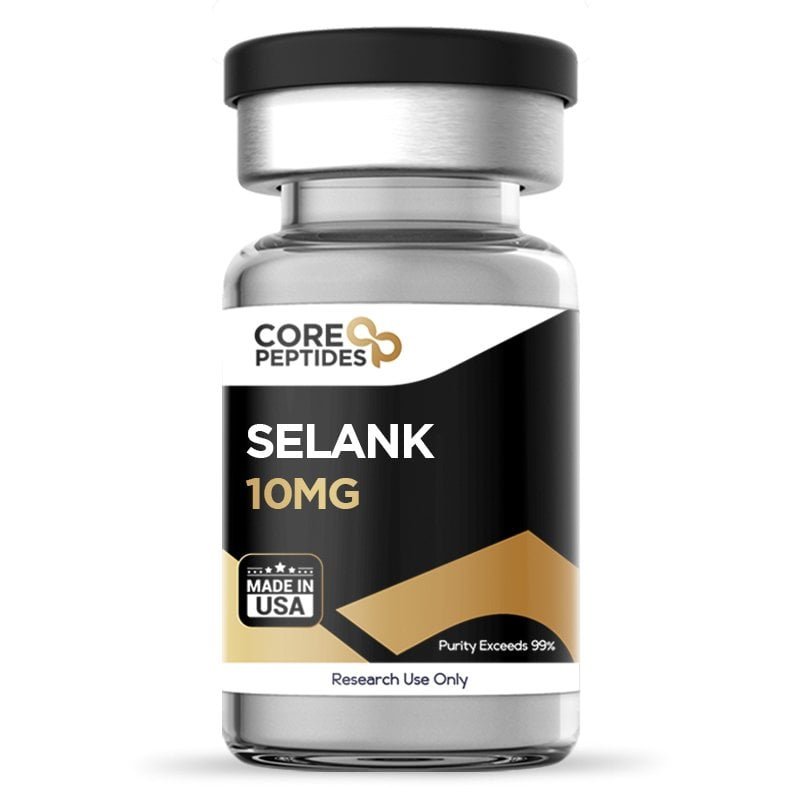
Selank (10mg) Peptide – Receptor-Grade Research Compound
Selank (10mg) is a synthetic heptapeptide developed as a structural and functional analog of tuftsin, a naturally occurring immunomodulatory peptide derived from immunoglobulin G (IgG). Designed to support advanced neuroscience, immunology, and gene-expression research, Selank has gained attention due to its potential interactions with neurotransmitter systems, neurotrophic factors, and immune signaling pathways.
At Core Peptide, our Selank (10mg) is supplied as a receptor-grade research peptide, produced to meet stringent purity standards and distributed exclusively for laboratory and research use in the United States.
Background and Development of Selank
Tuftsin is a naturally occurring tetrapeptide fragment identified within IgG that was initially studied for its role in immune regulation, particularly in phagocytic cell activity, including motility and immune responsiveness. Following its discovery, researchers sought to develop synthetic analogs of tuftsin with improved stability, bioavailability, and expanded research potential.
Selank was engineered by extending the tuftsin sequence and incorporating a Pro-Gly-Pro (PGP) motif at the C-terminal end. This structural modification was designed to enhance the peptide’s resistance to enzymatic degradation and to potentially improve its interaction with biological barriers such as the blood–brain barrier (BBB).
Structural Overview and Mechanistic Considerations
Selank consists of two distinct functional fragments:
-
N-terminal tuftsin sequence, associated with immune and neuroregulatory signaling
-
C-terminal Pro-Gly-Pro (PGP) fragment, which may contribute to enhanced stability and tissue permeability
The inclusion of the PGP sequence has been suggested to influence the peptide’s hydrophilic-lipophilic balance, potentially improving its compatibility with lipid-rich biological membranes. Researchers hypothesize that this modification may facilitate Selank’s interaction with transport systems or receptor-mediated pathways at the BBB, making Selank (10mg) particularly relevant for central nervous system research models.
Chemical Characteristics
-
Peptide Name: Selank
-
Quantity: 10mg
-
Molecular Formula: C₃₃H₅₇N₁₁O₉
-
Molecular Weight: 751.88 g/mol
-
Other Names: TP-7, Selanc
-
Grade: Receptor Grade
-
Form: Lyophilized powder
Each vial of Selank (10mg) from Core Peptide is manufactured to ensure consistency, reproducibility, and stability for research applications.
Research Applications of Selank (10mg)
Selank and BDNF Expression Research
Brain-derived neurotrophic factor (BDNF) is widely studied for its role in neuronal survival, synaptic plasticity, and adaptive responses to stress. Research models suggest that Selank may influence BDNF mRNA expression, particularly within the hippocampus, a region associated with memory and emotional processing.
This makes Selank (10mg) a valuable compound for laboratory investigations focused on neuroplasticity and stress-related signaling pathways.
Selank and Serotonin Signaling
Serotonin pathways play a central role in mood regulation and emotional processing. Experimental studies using models with impaired serotonergic function indicate that Selank may influence serotonin metabolism, particularly in brainstem regions associated with emotional regulation.
Researchers propose that Selank may enhance metabolic processing of serotonin, making it relevant for studies examining neurotransmitter balance and signaling adaptation.
Selank and GABAergic Modulation
Gamma-aminobutyric acid (GABA) is the primary inhibitory neurotransmitter in the central nervous system. Multiple studies suggest that Selank may interact with GABA-related signaling, either directly or through modulation of gene expression linked to GABA receptor activity.
Comparative gene-expression analyses have shown overlap between Selank-exposed and GABA-exposed models, suggesting potential involvement in inhibitory neurotransmission pathways.
Selank and Genome Expression
Selank has been studied for its potential influence on gene expression, particularly in immune and neural tissues. Research involving spleen and hippocampal samples has indicated alterations in genes associated with inflammation, including CX3CR1, a chemokine receptor involved in immune cell signaling.
These findings position Selank (10mg) as a useful research tool for examining peptide-mediated genomic regulation.
Selank and Immunomodulatory Research
Immunological studies suggest Selank may influence cytokine balance, including alterations in IL-6 levels and Th1/Th2 cytokine ratios. These properties support its investigation in immune-response modulation and neuroimmune communication research models.
Selank and Cognitive Research Models
Behavioral studies involving learning and memory paradigms have examined Selank’s potential role in conditioned learning performance. Researchers observed improvements in task accuracy and reduced error rates over repeated exposures, indicating potential relevance for cognitive adaptation research.
Receptor-Grade Quality from Core Peptide
The receptor-grade classification indicates a higher purity threshold, making Selank (10mg) suitable for receptor-binding, signaling, and molecular biology studies where impurities could compromise data integrity.
Explore additional high-purity compounds in our
Research Peptides Collection
Storage and Handling (Research Use)
For optimal laboratory stability:
-
Store lyophilized Selank at -20°C
-
Reconstitute using sterile laboratory-grade solvents
-
Avoid repeated freeze-thaw cycles
Always follow institutional research handling protocols.
External Research References
-
Inozemtseva LS et al., Selank regulates BDNF expression in the rat hippocampus, Doklady Biological Sciences
https://doi.org/10.1134/S0012496608040066 -
Kamensky AA et al., Tuftsin analogs and neuroimmune signaling, Peptides Journal
Be the first to review “Selank (10mg)”
Related products
Peptides for sale
Peptides for sale
Peptides for sale
Peptides for sale
Peptides for sale
Peptides for sale
Peptides for sale
Peptides for sale
Reviews
There are no reviews yet.