
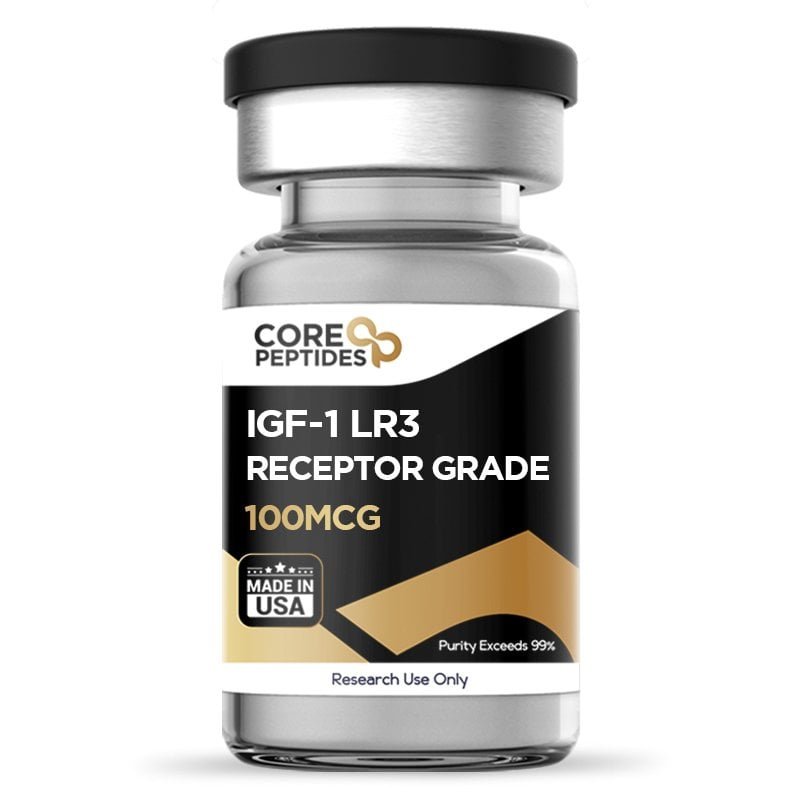
Receptor Grade IGF-1 LR3 (100mcg) – Research Overview
Receptor Grade IGF-1 LR3 (100mcg) is a high-purity synthetic analog of naturally occurring Insulin-Like Growth Factor-1 (IGF-1). IGF-1 is a 70–amino acid protein endogenously produced in response to growth hormone signaling and is widely studied for its role in cell growth, differentiation, and tissue development.
At Core Peptide, Receptor Grade IGF-1 LR3 (100mcg) is supplied strictly for research and laboratory use only. This peptide is frequently utilized in cell culture, receptor binding, and anabolic signaling studies, particularly when higher receptor affinity and reduced binding to IGF-binding proteins are required.
Explore related research peptides at Core Peptide:
What Is Receptor Grade IGF-1 LR3?
IGF-1 LR3, also known as Long-(Arg³) Insulin-Like Growth Factor-1, is a modified form of endogenous IGF-1. Two structural changes distinguish it from native IGF-1:
-
An extended N-terminal chain of 13 amino acids
-
Substitution of arginine for glutamic acid at position 3 (Arg³)
These modifications appear to:
-
Increase receptor affinity
-
Reduce binding to IGF-1 binding proteins (IGF-1BPs)
-
Enhance bioavailability in experimental systems
The term “Receptor Grade” refers to a higher level of purity compared to Media Grade material, making Receptor Grade IGF-1 LR3 (100mcg) particularly suitable for receptor-level and mechanistic research.
Chemical Makeup of Receptor Grade IGF-1 LR3
-
Molecular Formula: C₄₀₀H₆₂₅N₁₁₁O₁₁₅S₉
-
Molecular Weight: 9117.5 g/mol
-
Other Known Names:
-
Long-(Arg3) insulin-like growth factor-I
-
IGF-1 Long R3
-
Structural data related to IGF-1 can be reviewed via the Protein Data Bank in Europe:
https://www.ebi.ac.uk/pdbe/entry/pdb/1gzr
Receptor Grade IGF-1 LR3 and Anabolic Signaling Research
Although Receptor Grade IGF-1 LR3 is primarily intended for cell culture and laboratory studies, several murine investigations have evaluated its anabolic signaling potential.
In dexamethasone-induced catabolic animal models, researchers observed that IGF-1 LR3 appeared to:
-
Promote weight gain more effectively than native IGF-1
-
Increase visceral organ mass
-
Improve feed utilization efficiency
In some metrics, IGF-1 LR3 was reported to be 1.5–2 times more anabolic than IGF-1, particularly under continuous exposure conditions. Additionally, IGF-1 LR3 was associated with a more pronounced reduction in Nτ-methylhistidine excretion, a biochemical marker of muscle protein breakdown.
A foundational study detailing these findings can be accessed here:
https://www.ncbi.nlm.nih.gov/pmc/articles/PMC1130894/
IGF-1 LR3 and Cell Growth Research
IGF-1 and its analogs are well known for their role in cellular growth and development. In research models involving IGF-1 deficiency, exposure to IGF-1 peptides has been associated with:
-
Increased overall length
-
Enhanced tissue growth
-
Improved cellular proliferation
These findings suggest that Receptor Grade IGF-1 LR3 (100mcg) may serve as a valuable comparative tool when studying growth factor signaling and receptor dynamics in vitro.
Receptor Grade IGF-1 LR3 and Insulin Receptor Sensitivity
Studies suggest that IGF-1 peptides interact primarily with IGF-1 receptors, but they may also influence glucose uptake through alternative signaling pathways.
Research has indicated that IGF-1 LR3 may:
-
Stimulate glucose uptake via PI3K-related pathways
-
Improve insulin sensitivity independently of classic IGF-1 receptor binding
-
Influence metabolic signaling beyond traditional mechanisms
These observations have made Receptor Grade IGF-1 LR3 a useful peptide for exploring metabolic cross-talk between growth factor and insulin signaling systems.
For broader insight into IGF-1 signaling and metabolism, see:
https://www.ncbi.nlm.nih.gov/pmc/articles/PMC3683184/
IGF-1 LR3 and Cellular Lifespan Studies
Research conducted in murine models has suggested that IGF-1 signaling may influence cellular aging and functional lifespan. In long-term exposure studies, common indicators of physiological decline—such as muscle degeneration and neurological impairment—appeared delayed.
While these findings remain under investigation, researchers have emphasized that IGF-1 and growth hormone pathways play stage-specific roles throughout the lifespan, rather than exerting uniform effects on aging.
Receptor Grade IGF-1 LR3 and Muscle Cell Research
One area of experimental interest involves myostatin regulation. Myostatin is a protein that limits muscle cell differentiation and growth. In murine studies, IGF-1 analogs, including IGF-1 LR3, were observed to:
-
Reduce myostatin-related signaling
-
Promote muscle cell survival
-
Decrease apoptosis markers
These effects highlight the peptide’s relevance in cellular differentiation and muscle biology research.
Shorter Action and Tissue Distribution
Compared to endogenous IGF-1, IGF-1 LR3 appears to:
-
Clear from serum more rapidly
-
Bind less strongly to IGF-binding proteins
-
Distribute more freely into tissues
Tracer studies in murine models showed higher uptake in organs such as the kidneys, ovaries, and adrenal glands, suggesting differences in tissue localization and bioavailability. Despite its shorter systemic presence, IGF-1 LR3 may exhibit greater receptor-level potency than native IGF-1 due to reduced sequestration by binding proteins.
Receptor Grade IGF-1 LR3 (100mcg) From Core Peptide
At CorePeptide.us, Receptor Grade IGF-1 LR3 (100mcg) is supplied with:
-
High-purity, receptor-grade standards
-
Secure, professional packaging
-
Reliable shipping throughout the United States
Browse available research peptides:
https://corepeptide.us
All products sold by Core Peptide are intended strictly for laboratory and research use only and are not approved for human or veterinary consumption.
Be the first to review “Receptor Grade IGF-1 LR3 (100mcg)”
Related products
Peptides for sale
Peptides for sale
Peptides for sale
Peptides for sale
Peptides for sale
Peptides for sale
Peptides for sale
Peptides for sale
Reviews
There are no reviews yet.