
Palmitoyl Tetrapeptide-7 (200mg) – Research Peptide | Core Peptide USA
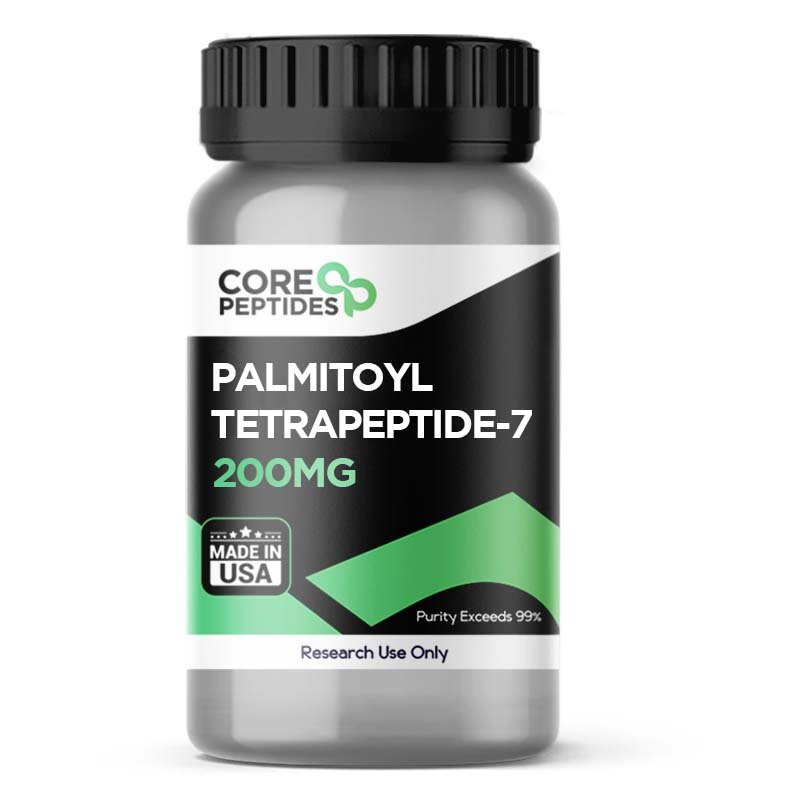
Palmitoyl Tetrapeptide-7 (200mg)
Palmitoyl Tetrapeptide-7 (200mg) is a synthetic peptide extensively studied in cosmetic science, extracellular matrix (ECM) research, and inflammation-related signaling pathways. At Core Peptide, we provide Palmitoyl Tetrapeptide-7 (200mg) in research-grade purity, exclusively for laboratory and investigational use within the United States.
This peptide is structurally modeled after naturally occurring matrikines—small peptide fragments that play a role in regulating ECM turnover, cell communication, and inflammatory responses. Due to its palmitoylated structure, Palmitoyl Tetrapeptide-7 (200mg) is believed to demonstrate enhanced molecular stability and interaction with lipid-rich tissue environments in research models.
Learn more about our quality standards here:
Research Peptide Quality – CorePeptide.us
What Is Palmitoyl Tetrapeptide-7 (200mg)?
Palmitoyl Tetrapeptide-7 (200mg) is composed of four amino acids—glycine, glutamine, proline, and arginine (GQPR)—linked to a palmitoyl fatty acid chain. This modification increases lipophilicity and may enhance compatibility with extracellular matrix components.
The peptide is also known by several alternative names, including Palmitoyl-GQPR, Rigin, and N-Palmitoylarginine. It is frequently studied for its potential role in ECM remodeling, cytokine modulation, and skin tissue resilience.
Chemical Profile of Palmitoyl Tetrapeptide-7 (200mg)
-
Molecular Formula: C₃₄H₆₂N₈O₇
-
Molecular Weight: 694.9 g/mol
-
Other Names:
-
Pal-Gly-Gln-Pro-Arg-OH
-
Palmitoyl-GQPR
-
Rigin
-
This precise molecular configuration makes Palmitoyl Tetrapeptide-7 (200mg) a consistent subject of interest in peptide-based ECM research.
Mechanism of Action in ECM Research
Research using animal and in vitro models suggests that Palmitoyl Tetrapeptide-7 may influence extracellular matrix dynamics by modulating enzyme activity and cytokine signaling. Specifically, studies propose that the peptide may inhibit matrix metalloproteinases (MMPs)—enzymes responsible for ECM protein degradation during both normal tissue remodeling and pathological processes.
By potentially downregulating excessive MMP activity, Palmitoyl Tetrapeptide-7 (200mg) may help preserve ECM components such as collagen and laminins. Researchers have also suggested that the peptide may stimulate the production of laminin IV, laminin V, and collagen VII, molecules critical for basement membrane stability and dermal-epidermal junction integrity.
PubChem – Palmitoyl Tetrapeptide-7
https://pubchem.ncbi.nlm.nih.gov/compound/10078408
IL-6 Modulation and Inflammation Research
One of the most discussed research pathways associated with Palmitoyl Tetrapeptide-7 (200mg) involves its proposed ability to suppress interleukin-6 (IL-6) secretion. IL-6 is a pro-inflammatory cytokine that tends to increase with age and environmental stressors, contributing to ECM degradation and tissue inflammation.
Studies suggest that reducing IL-6 activity may help limit inflammation following UVB exposure and other stress signals. In laboratory models, Palmitoyl Tetrapeptide-7 has been observed to reduce inflammatory markers, making it a compound of interest in inflammation-modulating peptide research.
Research Applications Beyond Skin Models
In addition to dermatological research, Palmitoyl Tetrapeptide-7 (200mg) has been investigated for its potential role in oral tissue research. Elevated MMP activity has been associated with oral conditions such as periodontitis, caries, and inflammatory degradation of connective tissue.
Because Palmitoyl Tetrapeptide-7 may inhibit MMP activity, researchers have explored its potential to preserve ECM integrity in oral tissue models. These exploratory studies aim to better understand how matrikine-based peptides interact with connective tissue environments beyond the skin.
Palmitoyl Tetrapeptide-7 and Collagen VII Research
A particularly notable research focus is the peptide’s association with collagen type VII. This form of collagen is essential for anchoring fibrils that bind the epidermis to the dermis. Collagen VII plays a vital role in maintaining skin structure, wound recovery, and tissue cohesion.
Research suggests that Palmitoyl Tetrapeptide-7 (200mg) may selectively support collagen VII synthesis, potentially improving dermal-epidermal junction stability in compromised tissue models. This mechanism has drawn attention in studies related to aging, barrier integrity, and tissue repair.
Clinical Observations on Wrinkle Depth and Elasticity
In a randomized, double-blind, placebo-controlled study, topical formulations containing Palmitoyl Tetrapeptide-7 were applied twice daily for 12 weeks. Researchers reported an apparent reduction in wrinkle depth and length, along with increased skin elasticity, compared to placebo formulations.
Another controlled study observed measurable improvements in dermal density, fine wrinkle reduction, and elasticity after four weeks of peptide exposure. These findings are frequently cited in cosmetic science literature, though researchers emphasize the need for continued independent validation.
Journal of Cosmetic Dermatology – ECM Peptide Research
https://pubmed.ncbi.nlm.nih.gov/25817264/
Availability in the United States
At Core Peptide, Palmitoyl Tetrapeptide-7 (200mg) is supplied exclusively for research and laboratory purposes. We proudly support peptide researchers across the United States by offering:
-
Verified batch purity
-
Secure, research-grade packaging
-
Fast domestic shipping
-
Transparent documentation
Please review our ordering policies before purchase:
Core Peptide Terms & Conditions
Important Research Disclaimer
Palmitoyl Tetrapeptide-7 (200mg) is not intended for human or veterinary use. All information provided is for educational and research reference only and does not constitute medical claims.
References
National Center for Biotechnology Information – PubChem
Mondon et al. (2015). Journal of Cosmetic Dermatology
Be the first to review “Palmitoyl Tetrapeptide-7 (200mg)”
Related products
Peptides for sale
Peptides for sale
Peptides for sale
Peptides for sale
Peptides for sale
Peptides for sale
Peptides for sale
Reviews
There are no reviews yet.