
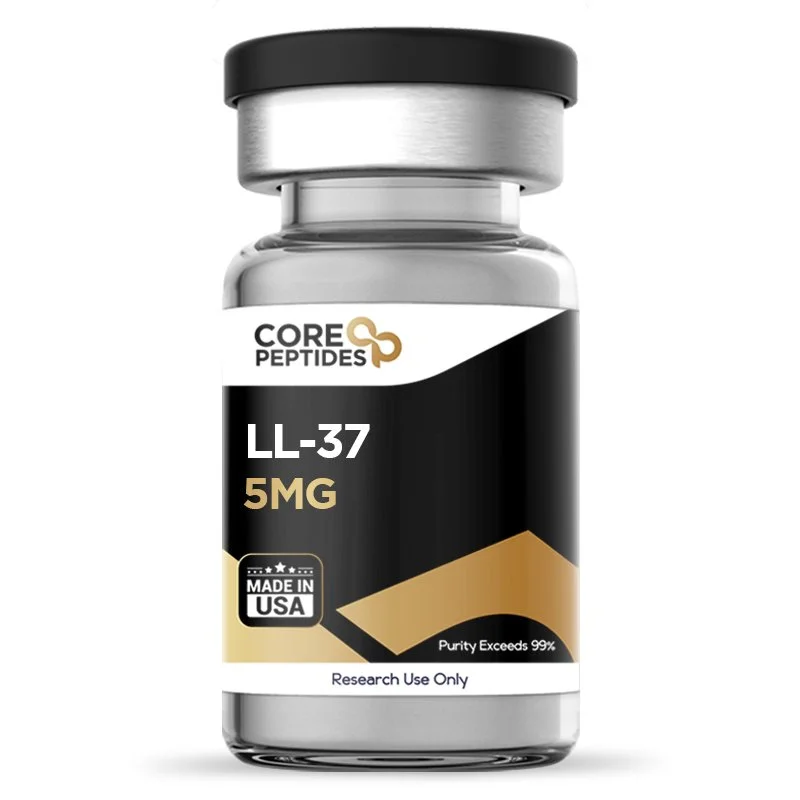
LL-37 (5mg) Peptide – Advanced Antimicrobial Research Peptide in the USA
LL-37 (5mg), also known as Cathelicidin, is a cationic antimicrobial research peptide composed of 37 amino acids. It is naturally expressed in neutrophils and epithelial cells and has become a major focus in laboratory research due to its potential antimicrobial, immunomodulatory, inflammatory, and tissue-repair-related properties.
At Core Peptide, we supply high-purity LL-37 (5mg) peptide exclusively for research and laboratory use to support advanced scientific investigations across the United States.
What Is LL-37 Peptide?
LL-37 peptide is derived from the extracellular cleavage of the human cathelicidin precursor protein hCAP18 by protease enzymes. Once cleaved, LL-37 forms a biologically active α-helical structure with strong cationic properties, which allows it to interact with microbial membranes and cellular targets.
Researchers have noted that LL-37 may form agglomerates and lipid bilayers, potentially protecting the peptide from enzymatic degradation while enabling interactions with bacterial, fungal, and viral membranes.
(Source: National Center for Biotechnology Information – PMC
https://www.ncbi.nlm.nih.gov/pmc/articles/PMC3836506/)
LL-37 (5mg) and Antimicrobial Research
Antimicrobial peptides like LL-37 are studied for their ability to interact with pathogens in a non-specific manner, making it difficult for microbes to develop resistance. This property has positioned LL-37 peptide as a valuable research tool in antimicrobial resistance studies.
Multiple studies suggest that LL-37 may first interact electrostatically with microbial membrane lipids, followed by lateral diffusion and peptide assembly. This interaction may lead to:
-
Membrane pore formation
-
Structural destabilization
-
Complete membrane disruption
These mechanisms have been observed in research models involving bacteria, fungi, and certain viral strains, reinforcing LL-37’s importance in antimicrobial peptide research.
LL-37 Peptide and Immune & Inflammatory Response Studies
One of the most studied aspects of LL-37 (5mg) is its role in immune modulation and inflammation. Research has explored how LL-37 interacts with self-nucleic acids released during tissue damage, such as RNA and DNA fragments.
A notable tissue culture study demonstrated that LL-37 combined with U1 RNA significantly increased inflammatory and defense-related gene expression. Researchers suggested that LL-37 may facilitate immune signaling by enabling nucleic acids to bind to scavenger receptors (SRs), triggering clathrin-dependent endocytosis and downstream cytokine production.
This interaction appears to involve receptors such as SR-A6 and SR-B1, which are critical for immune pathway activation. Blocking these receptors significantly reduced cytokine expression, highlighting LL-37’s potential role in immune signaling research.
(Source: Journal of Immunology
https://www.ncbi.nlm.nih.gov/pmc/articles/PMC3836506/)
LL-37 Peptide in Autoimmunity Research Models
LL-37 has been extensively studied in autoimmune disease models, particularly psoriasis. Research suggests that endogenous LL-37 may form complexes with DNA, activating type I interferon pathways and contributing to inflammatory cascades.
Interestingly, while LL-37 may enhance inflammation in certain contexts, studies also suggest it may protect keratinocytes from inflammasome activation triggered by cytosolic double-stranded DNA. LL-37-DNA complexes appear not to activate the AIM2 inflammasome, reducing IL-1β secretion.
This dual role highlights the complexity of LL-37 peptide in immune regulation and makes it a valuable research peptide for studying inflammatory balance and autoimmunity mechanisms.
LL-37 (5mg) and Arthritis Research
Research involving animal models of rheumatoid arthritis has demonstrated increased expression of rCRAMP, the rodent analog of LL-37, in inflamed joint tissues. Scientists observed that elevated LL-37 levels were associated with inflammatory cell infiltration and altered bone metabolism.
Some studies suggest that LL-37 may influence osteoblast apoptosis, potentially contributing to decreased bone formation in arthritic joints. These findings have positioned LL-37 peptide as a potential biomarker of inflammation in joint disease research models.
LL-37 Peptide and Tissue Repair Research
LL-37 has also been investigated for its role in angiogenesis and tissue repair. In murine models, LL-37 exposure appeared to enhance:
-
Endothelial cell proliferation
-
Vascularization
-
Skin cell regeneration
These effects are critical components of wound healing and tissue regeneration. Researchers suggest LL-37 may counteract inflammatory macrophage activation while promoting endothelial behaviors necessary for angiogenesis.
This makes LL-37 (5mg) a frequently used peptide in laboratory studies related to wound healing, vascular biology, and tissue repair mechanisms.
LL-37 Peptide and Cancer Cell Research
Ongoing research is evaluating LL-37’s potential role in cancer cell biology. Preliminary studies suggest that LL-37 may inhibit gastric cancer cell proliferation by activating bone morphogenetic protein (BMP) signaling pathways.
Additionally, LL-37 has been explored as a potential immunomodulatory adjuvant, particularly in combination with CpG oligodeoxynucleotides. Researchers observed increased immune sensitivity in lymphocytes when LL-37 was present, indicating potential applications in cancer immunology research.
LL-37 Peptide and Gastrointestinal Research
LL-37 expression has been observed to increase in gastrointestinal ulcer research models. This upregulation may be mediated through Toll-like receptor 3 (TLR-3) signaling pathways.
Due to its antimicrobial characteristics, LL-37 may help protect GI mucosa by interacting with lipopolysaccharides (LPS) and suppressing pro-inflammatory cytokines such as IL-6 and IL-8. These findings support ongoing research into LL-37’s role in gastrointestinal inflammation models.
Chemical Specifications of LL-37 (5mg)
-
Molecular Formula: C₂₀₅H₃₄₀N₅₀O₅₃
-
Molecular Weight: 4493.34 g/mol
-
Alternate Names: Cathelicidin, CAP-18
-
Form: Lyophilized peptide (research use only)
Why Buy LL-37 (5mg) from Core Peptide?
Core Peptide USA is a trusted supplier of high-purity research peptides for laboratories and institutions nationwide.
Why researchers choose Core Peptide:
-
USA-based peptide supplier
-
High-purity research peptides
-
Transparent product specifications
-
Secure shipping within the United States
-
Strict research-only compliance
Explore our full peptide catalog at:
https://corepeptide.us
References
-
Kahlenberg JM, Kaplan MJ. Little peptide, big effects: the role of LL-37 in inflammation and autoimmune disease.
https://www.ncbi.nlm.nih.gov/pmc/articles/PMC3836506/ -
Seil M et al. Spotlight on Human LL-37, an Immunomodulatory Peptide.
https://www.ncbi.nlm.nih.gov/pmc/articles/PMC4034075/
Be the first to review “LL-37 (5mg)”
Related products
Peptides for sale
Peptides for sale
Peptides for sale
Peptides for sale
Peptides for sale
Peptides for sale
Peptides for sale
Peptides for sale
Reviews
There are no reviews yet.