
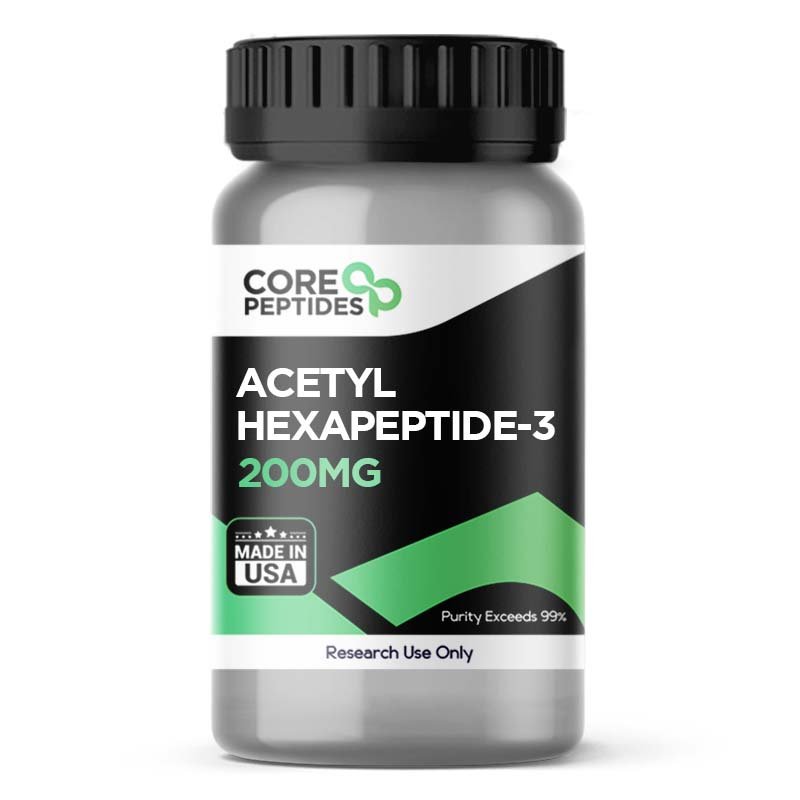
Acetyl Hexapeptide-3 (Argireline) (200mg)
Buy Research Peptide USA
Synthetic SNAP-25 Inhibiting Peptide for Research Use in the United States
Acetyl Hexapeptide-3 (Argireline) (200mg) is a synthetic peptide widely studied in laboratory research for its interaction with SNAP-25–mediated neurotransmitter release mechanisms. Developed as a competitive SNAP-25 inhibitor, this peptide is structurally designed to mimic a segment of the SNAP-25 protein involved in SNARE complex formation, a critical step in calcium-dependent exocytosis.
At Core Peptide, Acetyl Hexapeptide-3 (Argireline) (200mg) is supplied exclusively for laboratory and research use and is available to customers throughout the United States seeking high-purity synthetic research peptides.
👉 Explore related compounds in our
Research Peptides Collection
What Is Acetyl Hexapeptide-3 (Argireline) (200mg)?
Acetyl Hexapeptide-3 (Argireline) (200mg)—also known as Acetyl Hexapeptide-8 or Argireline—is a short-chain synthetic peptide composed of six amino acids. It was specifically engineered to resemble the N-terminal sequence of SNAP-25, a protein essential for synaptic vesicle fusion and neurotransmitter release.
SNAP-25 is a core component of the SNARE complex, which regulates calcium-triggered exocytosis in neurons and other cell types. By competing with SNAP-25 during SNARE complex assembly, Acetyl Hexapeptide-3 (Argireline) (200mg) may interfere with the release of signaling molecules such as acetylcholine, a neurotransmitter involved in muscle contraction and neuromuscular communication.
Due to this mechanism, Acetyl Hexapeptide-3 (Argireline) (200mg) is frequently studied as a non-toxic, peptide-based model for investigating neuromuscular signaling and skin–muscle interactions
Mechanism of Action: SNAP-25 and Exocytosis Modulation
The primary research interest surrounding Acetyl Hexapeptide-3 (Argireline) (200mg) lies in its potential to inhibit SNAP-25–dependent exocytosis. SNAP-25 participates in the formation of the SNARE complex alongside syntaxin and synaptobrevin, enabling vesicles containing neurotransmitters to fuse with the cell membrane.
Research suggests that Acetyl Hexapeptide-3 competes with endogenous SNAP-25 by mimicking its amino acid pattern, thereby disrupting SNARE complex formation. This disruption may reduce calcium-dependent vesicle fusion, limiting neurotransmitter release.
Because acetylcholine plays a central role in muscle contraction signaling, inhibition of its release has been widely studied in models related to muscle relaxation, skin biomechanics, and neuromuscular communication.
For foundational molecular biology references, see:
🔗 National Center for Biotechnology Information (NCBI) – https://www.ncbi.nlm.nih.gov/
Chemical Characteristics
-
Product Name: Acetyl Hexapeptide-3 (Argireline) (200mg)
-
Molecular Formula: C₃₄H₆₀N₁₄O₁₂S
-
Molecular Weight: 888.99 g/mol
-
Peptide Length: 6 amino acids
-
Alternate Names: Acetyl Hexapeptide-8, Argireline
For chemical database information, visit:
🔗 PubChem – Argireline – https://pubchem.ncbi.nlm.nih.gov/
Research Applications of Acetyl Hexapeptide-3 (Argireline) (200mg)
Skin and Wrinkle Research Models
Acetyl Hexapeptide-3 (Argireline) (200mg) has been extensively studied in skin tissue research, particularly in models evaluating wrinkle formation and skin microtopography. Laboratory and clinical research suggests that peptides targeting SNAP-25–mediated signaling may influence muscle tension beneath the skin, which plays a role in the formation of expression lines.
Several controlled studies using topical emulsions containing Acetyl Hexapeptide-3 have reported visible changes in wrinkle depth, skin hydration, and transepidermal water loss (TEWL). These findings have driven ongoing research into the peptide’s role in skin biomechanics and collagen organization.
Collagen and Skin Structure Studies
Beyond neuromuscular signaling, Acetyl Hexapeptide-3 (Argireline) (200mg) has been examined for its potential influence on collagen composition within skin tissues. Research in aged laboratory models suggests a possible shift in the ratio of type I to type III collagen fibers, which may impact tissue elasticity and structural integrity.
Type III collagen is commonly associated with scar tissue and reduced elasticity, while type I collagen contributes to tensile strength. These observations have positioned Acetyl Hexapeptide-3 as a peptide of interest in skin regeneration and tissue remodeling research.
Muscle Spasm and Neuromuscular Research
Acetyl Hexapeptide-3 (Argireline) (200mg) has also been investigated in neuromuscular research models, including studies focused on involuntary muscle contractions. In controlled clinical research settings, the peptide has been evaluated for its impact on blepharospasm, a condition characterized by involuntary eyelid muscle contractions.
Results from double-blind, placebo-controlled studies suggest that SNAP-25 inhibition by Acetyl Hexapeptide-3 may influence spasm frequency and duration, supporting further research into peptide-based neuromodulation strategies.
Scarring and Tissue Elasticity Research
Retrospective and observational studies have explored the role of Acetyl Hexapeptide-3 (Argireline) (200mg) in scar tissue research. Findings suggest that the peptide may be associated with improved tissue elasticity and reduced rigidity in regenerating skin areas.
These effects are hypothesized to stem from alterations in collagen fiber composition and reduced neuromuscular tension in healing tissues, making the peptide relevant for studies involving wound remodeling and scar camouflage.
Pain and Neurotransmission Studies
Modified forms of Acetyl Hexapeptide-3, including palmitoylated derivatives, have been investigated in pain perception research. In vitro and animal models suggest that SNAP-25 inhibition may reduce the release of pain-related neuromodulators such as calcitonin gene-related peptide (CGRP).
Additional studies propose that this mechanism may influence TRPV1 channel activation, which is associated with inflammatory and neuropathic pain signaling. These findings continue to drive interest in Acetyl Hexapeptide-3–based compounds for neurotransmission and sensory research.
Synthesis and Quality Standards
Acetyl Hexapeptide-3 (Argireline) (200mg) from Core Peptide is synthesized using solid-phase peptide synthesis (SPPS), ensuring:
-
High sequence fidelity
-
Batch-to-batch consistency
-
Suitability for controlled laboratory research
Learn more about our quality standards here:
👉 Quality Assurance
Be the first to review “Acetyl Hexapeptide-3 (200mg)”
Related products
Peptides for sale
Peptides for sale
Peptides for sale
Peptides for sale
Peptides for sale
Peptides for sale
Peptides for sale
Reviews
There are no reviews yet.