
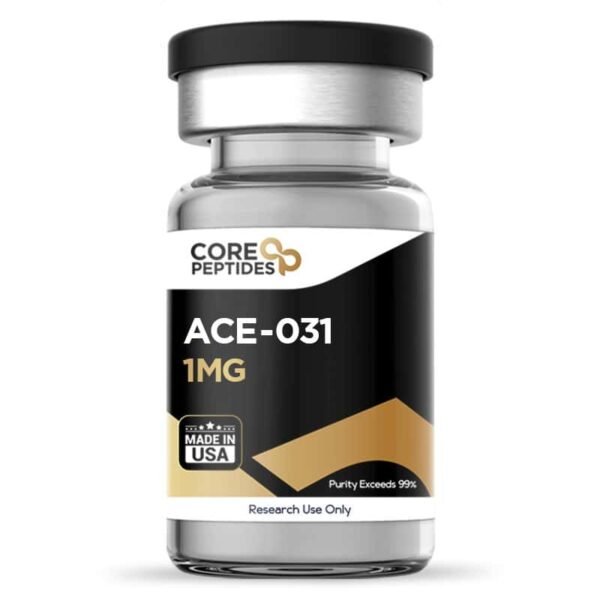
ACE-031 (1mg)
Buy ACE-031 (1mg) Peptide
Soluble ActRIIB Myostatin Inhibitor for Research Use in the United States
ACE-031 (1mg) is a recombinant fusion peptide widely studied in laboratory research for its role as a myostatin and activin signaling inhibitor. Structurally, ACE-031 consists of the extracellular domain of the activin receptor type IIB (ActRIIB / ACVR2B) fused to the Fc portion of human IgG1, forming a soluble decoy receptor commonly referred to as ActRIIB-IgG1.
At Core Peptide, ACE-031 (1mg) is supplied strictly for laboratory and research use and is available to researchers across the United States seeking high-quality myostatin pathway research compounds.
Explore additional compounds in our
Research Peptides Collection
What Is ACE-031 (1mg)?
ACE-031 (1mg) was developed as a myostatin pathway modulator designed to bind circulating ligands from the transforming growth factor-beta (TGF-β) superfamily, most notably myostatin (GDF-8) and select activins. Myostatin is a well-characterized negative regulator of skeletal muscle growth, predominantly expressed in skeletal muscle tissue.
By acting as a soluble ActRIIB decoy receptor, ACE-031 may prevent myostatin from binding to native ActRIIB receptors on muscle cells. This interruption is thought to reduce downstream Smad2/3 signaling, a pathway involved in suppressing muscle hypertrophy.
Myostatin was first identified in 1997 through comparative murine studies demonstrating that animals lacking functional myostatin exhibited dramatically increased skeletal muscle mass. Since then, myostatin inhibition has become a major focus of muscle biology, metabolism, and musculoskeletal research.
For background on myostatin biology, see:
🔗 NCBI – Myostatin (GDF-8)
https://www.ncbi.nlm.nih.gov/
Mechanism of Action: ActRIIB and Myostatin Inhibition
ACE-031 (1mg) functions by binding circulating myostatin before it can interact with cell-surface ActRIIB receptors. Under normal physiological conditions, myostatin binds to ActRIIB, initiating phosphorylation of Smad2 and Smad3 proteins. These transcription factors then translocate to the nucleus and regulate genes that suppress muscle growth and satellite cell activation.
By sequestering myostatin in circulation, ACE-031 may allow muscle satellite cells—partially committed muscle stem cells—to remain active, potentially supporting muscle fiber hypertrophy.
Importantly, myostatin appears to selectively regulate skeletal muscle, with minimal direct influence on cardiac or smooth muscle tissues, making it a highly targeted pathway in muscle research.
Chemical Characteristics
-
Product Name: ACE-031 (1mg)
-
Molecular Formula: C₃₄₁₈H₅₁₈₈N₉₂₈O₁₀₆₂S₃₈
-
Molecular Weight: ~77,489.82 g/mol
-
Structure: ActRIIB extracellular domain + IgG1 Fc
-
Alternate Names: ActRIIB-IgG1, Soluble Activin Type IIB Receptor
Chemical and structural references can be found via:
🔗 PubChem – https://pubchem.ncbi.nlm.nih.gov/
Research Applications of ACE-031 (1mg)
ACE-031 (1mg) and Muscle Hypertrophy Research
ACE-031 (1mg) has been investigated in controlled clinical and preclinical research settings for its impact on skeletal muscle mass. In a double-blind, placebo-controlled study involving healthy volunteers, a single exposure to ACE-031 resulted in measurable increases in lean body mass and thigh muscle volume.
Muscle changes were quantified using dual-energy X-ray absorptiometry (DEXA) and magnetic resonance imaging (MRI) approximately 29 days post-exposure. Researchers observed statistically significant increases in total lean mass and quadriceps muscle volume, suggesting ACE-031’s potential role in muscle hypertrophy research models.
The peptide’s extended half-life, estimated between 10–15 days, supports its classification as a long-acting myostatin pathway inhibitor in laboratory investigations
ACE-031 (1mg) and Fat Metabolism Research
Beyond muscle tissue, ACE-031 (1mg) has been studied in relation to fat metabolism and obesity models. Research suggests that elevated myostatin expression may correlate with increased adiposity and reduced muscle mass in obesity.
In murine models:
-
Overexpression of myostatin has been linked to increased fat accumulation
-
Myostatin deficiency has been associated with reduced adipose tissue expansion
Studies involving ACE-031 exposure in high-fat-diet murine models indicated a potential reduction in fat mass accumulation. Proposed mechanisms include:
-
Upregulation of fatty acid oxidation enzymes (e.g., CPT1, CPT2)
-
Promotion of beige/brown adipose tissue differentiation, which supports thermogenesis
These findings position ACE-031 (1mg) as a compound of interest in metabolic and adipose tissue research.
ACE-031 (1mg) and Muscle Contractile Function
ACE-031 has also been evaluated for its influence on muscle contractile force and energy metabolism. In murine dystrophic muscle models, ActRIIB blockade resulted in:
-
Increased muscle volume
-
Elevated basal oxygen consumption
-
Improved absolute force-generating capacity
Interestingly, while overall muscle strength increased, intrinsic contractile efficiency and fatigue resistance remained largely unchanged. These findings suggest ACE-031 may enhance muscle size and force output without significantly altering fiber-type distribution.
Advanced imaging techniques such as 31P-magnetic resonance spectroscopy were used to assess ATP metabolism and energy flux, revealing subtle shifts in mitochondrial function.
ACE-031 (1mg) and Bone Density Research
ACE-031 (1mg) has been investigated in bone metabolism studies, particularly in murine models of Duchenne Muscular Dystrophy (DMD), a condition associated with muscle degeneration and increased fracture risk.
Research findings include:
-
Increased femoral bone volume
-
Increased trabecular number and thickness
-
Reduced osteoclast activity
-
Increased osteoblast marker expression
Micro-CT analysis revealed improvements in bone strength, stiffness, and load-bearing capacity. These findings suggest that inhibiting ActRIIB ligands may influence bone remodeling pathways in addition to muscle growth.
Synthesis and Quality Standards
ACE-031 (1mg) supplied by Core Peptide is produced using recombinant protein expression and purification technologies consistent with laboratory research requirements. Each batch is handled to ensure:
-
Structural integrity
-
Batch-to-batch consistency
-
Suitability for in vitro and preclinical research
Learn more about our standards here:
Quality Assurance
Frequently Asked Questions – ACE-031 (1mg)
What is ACE-031 (1mg)?
ACE-031 (1mg) is a recombinant fusion peptide composed of the activin receptor type IIB extracellular domain fused to IgG1 Fc. It is studied as a myostatin and activin pathway inhibitor in laboratory research.
How does ACE-031 (1mg) work?
ACE-031 (1mg) acts as a soluble ActRIIB decoy receptor, binding circulating myostatin and preventing it from activating native ActRIIB receptors on muscle cells.
Is ACE-031 (1mg) a steroid or hormone?
No. ACE-031 (1mg) is neither a steroid nor a hormone. It is a recombinant protein-based research compound targeting signaling pathways within the TGF-β superfamily.
Is ACE-031 (1mg) legal in the United States?
Yes. ACE-031 (1mg) may be legally purchased in the United States for laboratory research purposes only, in accordance with supplier terms.
Is ACE-031 (1mg) approved for human use?
No. ACE-031 (1mg) is strictly intended for research use only and is not approved for human or veterinary use.
Where can I buy ACE-031 (1mg) for research?
ACE-031 (1mg) is available from Core Peptide for laboratory research use in the United States.
Be the first to review “ACE-031 (1mg)”
Related products
Peptides for sale

Peptides for sale

Peptides for sale
Peptides for sale
Peptides for sale
Peptides for sale
Peptides for sale
Peptides for sale
Reviews
There are no reviews yet.