
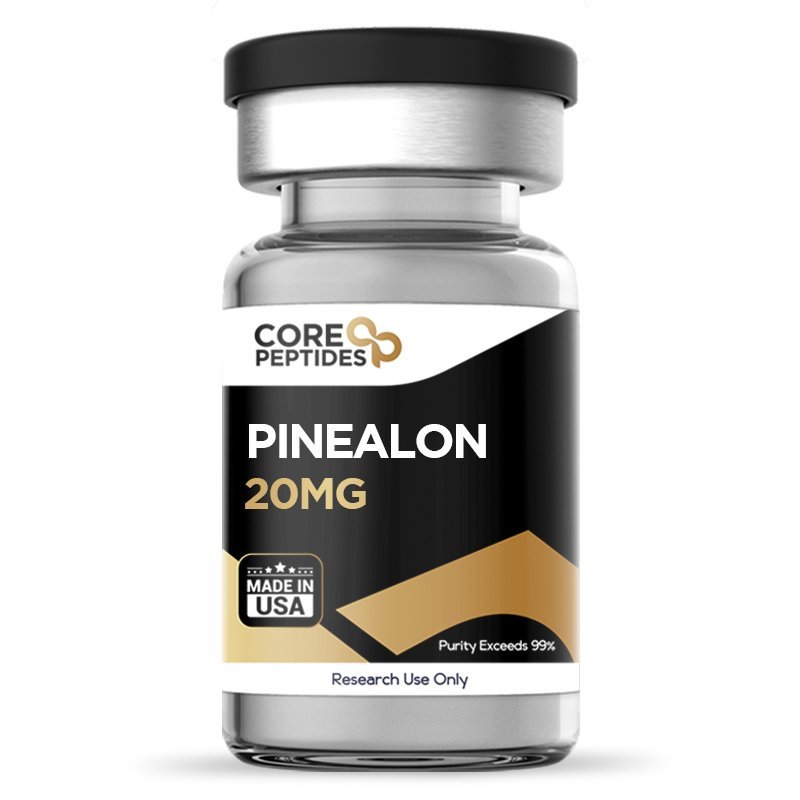
Pinealon (20mg) Peptide
Pinealon (20mg) is a short synthetic tripeptide composed of three amino acids—Glu-Asp-Arg, commonly referred to as the EDR peptide. This peptide has been widely studied in laboratory research for its potential role in neuroprotection, cellular stress modulation, and gene expression signaling. Due to its small molecular size, Pinealon has attracted particular interest for its hypothesized ability to penetrate biological barriers, including the blood–brain barrier, cellular membranes, and even the nuclear membrane.
At Core Peptide, Pinealon (20mg) is supplied strictly for research and laboratory purposes only and is intended for qualified institutions and researchers in the United States.
Browse additional cognitive and neuropeptides in our Research Peptides Collection.
What Is Pinealon Peptide?
Pinealon is derived from research on Cortexin, a low–molecular-weight polypeptide that has been studied for its effects on central nervous system activity. Researchers isolated Pinealon from Cortexin to better understand how short peptides may influence neuronal signaling and cellular protection mechanisms.
Scientific investigations suggest that Pinealon may interact with cellular signaling cascades related to oxidative stress, apoptosis, and metabolic regulation. Unlike longer peptides, Pinealon’s compact structure may allow it to interact more directly with intracellular components, including DNA, making it a topic of interest in epigenetic and molecular biology research.
Overview of Pinealon Research Pathways
Researchers have proposed that the MAPK / ERK signaling pathway may play a central role in Pinealon’s biological activity. This pathway is associated with cellular stress responses, apoptosis, inflammation, and metabolic regulation. Excessive activation of MAPK and ERK signaling is often linked to oxidative stress and programmed cell death.
Pinealon has been hypothesized to reduce the synthesis of reactive oxygen species (ROS), which serve as signaling messengers for MAPK and ERK activation. By potentially limiting ROS accumulation, Pinealon may help reduce downstream signaling that leads to cellular damage and apoptosis.
Studies also suggest that Pinealon may exhibit concentration-dependent activity:
-
At lower concentrations, it may suppress ROS synthesis and cellular stress
-
At higher concentrations, it may interact with the cell cycle and genomic regulation mechanisms
This dual-action hypothesis makes Pinealon a compelling subject for ongoing laboratory research.
Chemical Makeup of Pinealon
-
Molecular Formula: C₁₅H₂₆N₆O₈
-
Molecular Weight: 418.4 g/mol
-
Other Names:
-
Pinealon
-
EDR Peptide
-
Glu-Asp-Arg
-
Chemical identity and molecular data for Pinealon are cataloged by the National Center for Biotechnology Information (NCBI).
PubChem – Glu-Asp-Arg (EDR Peptide)
Pinealon Peptide and Cell Aging Research
Clinical and preclinical research has explored Pinealon’s potential role in cell aging and metabolic regulation. One study evaluating synthetic tripeptides, including Pinealon and Vesugen, examined research models of polymorbidity and organic brain syndrome. The findings suggested that Pinealon exhibited anabolic properties, with observed improvements in central nervous system activity and organ function compared to control models.
Importantly, researchers reported no significant changes in chromatin condensation, suggesting that Pinealon may exert effects without disrupting cellular structural integrity.
Another study suggested Pinealon may influence irisin levels, a hormone secreted by muscle cells during physical stress. Irisin is believed to support mitochondrial health, fat metabolism, and telomere integrity. By potentially modulating irisin expression, Pinealon may contribute to protective mechanisms associated with cellular aging and genomic stability.
Pinealon and Prenatal Hyperhomocysteinemia Studies
Hyperhomocysteinemia is characterized by elevated homocysteine levels in the bloodstream and is associated with neurological stress and vitamin deficiencies. Experimental studies examined the effects of Pinealon in murine models of prenatal hyperhomocysteinemia.
While Pinealon did not appear to directly reduce homocysteine levels, offspring exposed to Pinealon demonstrated improved cognitive processing compared to controls. Researchers suggested that Pinealon may reduce the toxic effects of homocysteine rather than influencing its metabolic breakdown.
This distinction highlights Pinealon’s potential role in cellular resilience rather than direct biochemical correction.
Pinealon Peptide and Serotonin Expression
Laboratory studies on isolated brain cell cultures have suggested that Pinealon may influence serotonin synthesis. Researchers observed up to a 1.9-fold increase in serotonin production in younger cell cultures following exposure to Pinealon.
Molecular modeling and docking simulations propose that Pinealon may bind to specific DNA sequences within the promoter region of the 5-tryptophan hydroxylase gene, an enzyme essential for serotonin synthesis. A lower binding energy compared to similar peptides suggests a potentially stable interaction, which may enhance transcriptional activity.
Additional research under stress conditions, such as mild hypothermia and hypobaric hypoxia, suggests Pinealon may influence serotonergic and adrenergic mediator accumulation in the cerebral cortex, supporting its classification as a neuroregulatory research peptide.
Anti-Apoptotic and Neuroprotective Research
Studies involving ischemic stroke models have suggested that Pinealon may modulate caspase-3, a key enzyme involved in apoptosis. By suppressing caspase-3 activity, Pinealon appeared to reduce neuronal cell death and hypoxia-induced inflammation.
Researchers also observed modulation of inflammatory cytokines such as interleukin-6 and tumor necrosis factor, both associated with neuroinflammation and cellular stress. These findings suggest Pinealon may help restore cellular signaling balance during hypoxic conditions.
Interestingly, similar anti-apoptotic activity was observed in skin cell research models, where Pinealon appeared to reduce apoptosis and support regenerative processes.
Why Choose Pinealon (20mg) from Core Peptide?
Core Peptide provides Pinealon (20mg) to support advanced laboratory research in neuroscience, molecular biology, and cellular aging.
Product highlights:
-
20mg vial for controlled research dosing
-
High-purity synthetic peptide
-
Suitable for neurobiological and cellular studies
-
Distributed for U.S. research institutions
Explore related compounds like NAD+ and Selank peptides in our catalog.
Be the first to review “Pinealon (20mg)”
Related products
Peptides for sale
Peptides for sale
Peptides for sale
Peptides for sale
Peptides for sale
Peptides for sale
Peptides for sale
Reviews
There are no reviews yet.