
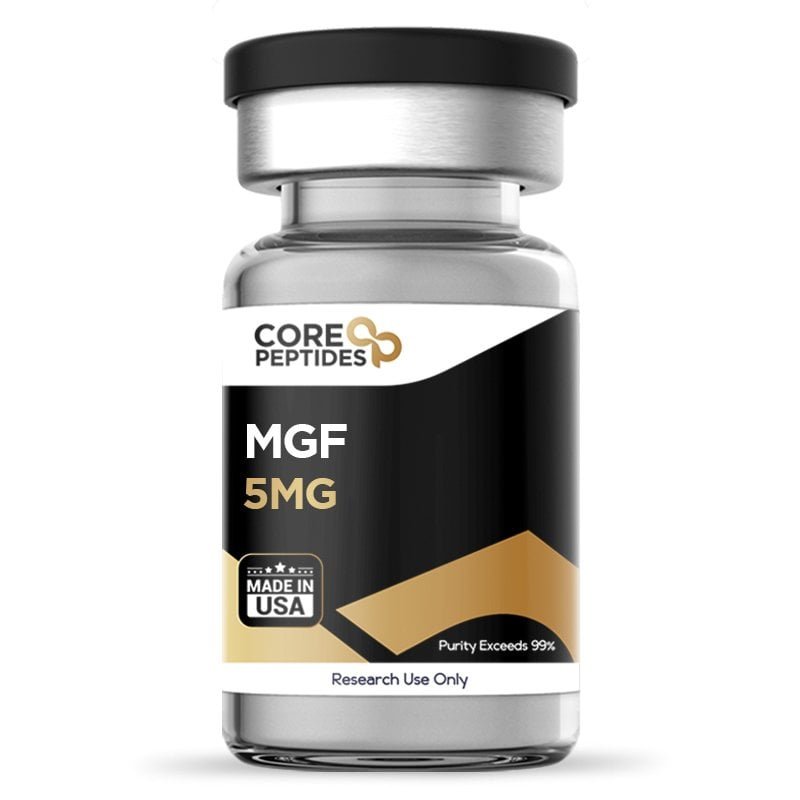
MGF (5mg) Peptide – Mechano Growth Factor for Research
MGF (5mg), short for Mechano Growth Factor, is an endogenous peptide belonging to the insulin-like growth factor (IGF-1) family. It is widely studied in laboratory environments for its potential role in mechanical stress signaling, muscle cell activity, tissue recovery pathways, and cellular growth modulation.
At Core Peptide, we supply MGF (5mg) exclusively for research and laboratory use, supporting universities, institutions, and private laboratories across the United States with high-purity peptide compounds.
View related compounds in our
Research Peptides Collection
What Is Mechano Growth Factor (MGF)?
Mechano Growth Factor is considered a splice variant (isoform) of IGF-1, also referred to as IGF-1Ec. What differentiates MGF from systemic IGF-1 is the presence of a 49 base-pair insert at exon 5, which may create a frameshift resulting in unique biological properties.
MGF expression is believed to increase under mechanical stress conditions, particularly in muscle tissue. Researchers have observed elevated MGF mRNA levels following resistance activity, injury, or localized strain, suggesting a direct relationship between mechanical load and peptide signaling.
Structural and Biological Overview
IGF-1 undergoes alternative splicing to produce three primary isoforms. These isoforms differ mainly at the C-terminal amino acid sequence, which appears to influence how each variant functions within tissues.
MGF (5mg) represents a locally acting IGF-1 isoform, as opposed to circulating IGF-1. Early research suggested that MGF levels rise rapidly after muscle injury, potentially acting as an early signal in cellular adaptation and repair models.
A commonly studied synthetic version is the MGF-Ct24E peptide, also known as the E-domain of IGF-1Ec, composed of 24 amino acids derived from the C-terminal region. This fragment has been extensively explored in muscle precursor cell research.
Chemical Makeup of MGF (5mg)
-
Molecular Formula: C₁₂₄H₂₀₄N₄₂O₄₁S
-
Molecular Weight: 2971.99 g/mol
-
Other Names: MGF-E, MGF-Ct24E, IGF-1Ec
-
Form: Lyophilized powder
-
Quantity: 5mg vial
MGF (5mg) and Muscle Cell Research
Muscle Precursor Cell Proliferation
One of the most cited areas of MGF research involves muscle satellite cells, also known as muscle precursor cells. These cells are responsible for muscle regeneration and adaptation following stress.
In controlled cell culture studies, exposure to synthetic MGF peptides appeared to:
-
Increase myotube size
-
Enhance cell fusion index
-
Promote expression of muscle-specific contractile proteins
-
Reduce the proportion of undifferentiated reserve cells
These findings suggest that MGF (5mg) may influence cellular differentiation and hypertrophic signaling pathways under experimental conditions. PubMed – IGF-1 Isoforms and MGF E-Peptide
MGF Peptide and Muscle Recovery Models
Additional research has evaluated MGF in experimentally induced muscle injury models. In murine studies involving muscle contusion, MGF exposure was associated with:
-
Reduced expression of inflammatory cytokines
-
Decreased oxidative stress markers
-
Lower levels of matrix metalloproteinases (MMPs)
-
Potential modulation of fibrotic signaling
While satellite cell differentiation markers (such as MyoD and myogenin) appeared unchanged, researchers hypothesized that MGF may help modulate the inflammatory environment surrounding injured muscle tissue rather than directly altering satellite cell activation.
Anti-Apoptotic and Cardiac Research
MGF has also been investigated in hypoxia-induced cardiac cell models. In these studies, MGF exposure appeared to:
-
Increase migration of mesenchymal stem cells
-
Elevate expression of cell-survival markers such as Bcl-2
-
Reduce markers associated with programmed cell death
Researchers suggested that MGF may function as both a chemotactic signal and a protective factor in stressed cardiac tissues under experimental conditions.
Skeletal and Bone Injury Research
In animal models examining bone defects, MGF was evaluated for its potential influence on osteoblast-like cell proliferation. Compared to IGF-1, MGF exposure appeared to produce:
-
Increased cellular proliferation
-
Improved histological bone healing scores
-
Enhanced radiographic healing observations
These findings have led researchers to speculate that MGF may activate distinct signaling pathways, such as MAPK-Erk1/2, which differ from classical IGF-1 mechanisms.
MGF (5mg) and Neuroprotective Research
MGF has also been explored in brain ischemia and neurogenesis studies. In gerbil and murine models:
-
Elevated endogenous MGF production was observed in ischemia-resistant neurons
-
Synthetic MGF exposure appeared to increase neuronal survival
-
Increased markers of neurogenesis (such as BrdU) were reported in hippocampal regions
These findings suggest the C-terminal domain of MGF may contribute to neuroprotective and proliferative signaling under laboratory conditions.
Why Choose Core Peptide?
Core Peptide is a trusted U.S. supplier of research-only peptides, offering:
High-purity, lab-verified compounds
Secure shipping within the United States
Transparent labeling and documentation
Research-compliant product standards
Explore related growth factor peptides in our
Peptide Research Library
References
-
Philippou A. et al., In Vivo Journal, 2009
-
IGF-1 Isoform Splicing Studies – PubMed
-
Muscle Injury and MGF Expression Research
Be the first to review “MGF (5mg)”
Related products

Peptides for sale
Peptides for sale
Peptides for sale

Peptides for sale
Peptides for sale
Peptides for sale
Peptides for sale
Peptides for sale
Reviews
There are no reviews yet.