
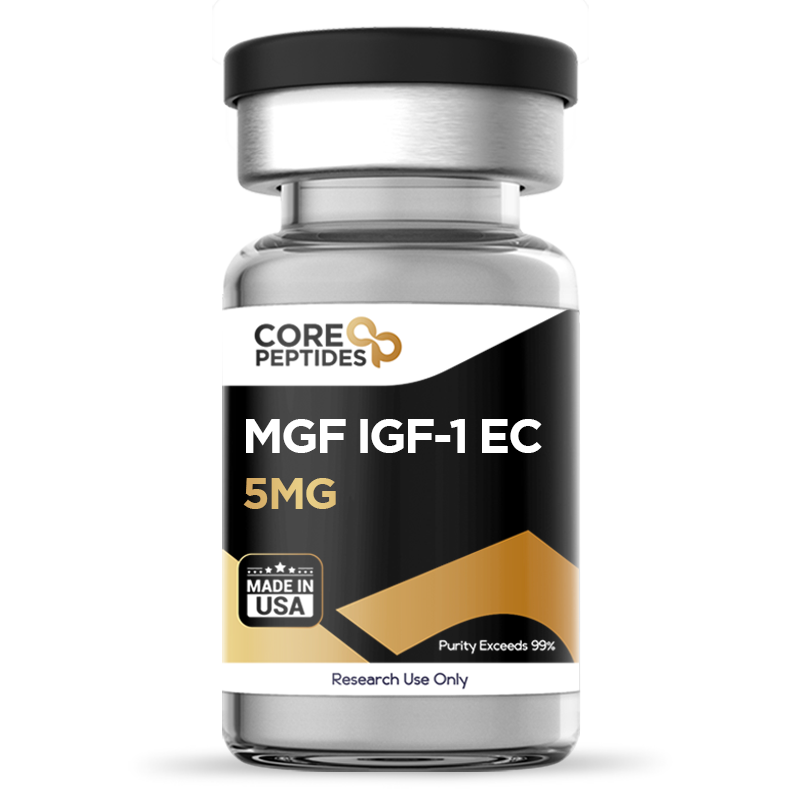

MGF IGF-1 EC (5mg) Peptide – Research Overview
MGF IGF-1 EC (5mg) is a laboratory research peptide classified as a splice variant of insulin-like growth factor-1 (IGF-1). Often referred to as Mechano Growth Factor (MGF) or IGF-1Ec, this peptide has drawn scientific interest for its role in mechanical stress signaling, localized tissue response, and cellular growth pathways.
At Core Peptide, we provide MGF IGF-1 EC (5mg) strictly for research and laboratory use, supplying high-purity peptide compounds to research facilities across the United States.
🔬 Browse additional compounds in our
Research Peptides Collection
What Is MGF IGF-1 EC?
MGF IGF-1 EC is an endogenously derived isoform of IGF-1, produced through alternative splicing of the IGF-1 gene. Unlike systemic IGF-1, IGF-1 EC contains a unique 49 base-pair insert at exon 5, which may introduce a structural frameshift and contribute to its distinct biological behavior.
Researchers have identified IGF-1 EC as a locally acting growth factor, meaning its activity appears concentrated at the site of mechanical stress or tissue strain rather than circulating systemically. This characteristic differentiates MGF IGF-1 EC (5mg) from other IGF-1 peptides commonly studied in endocrine research.
IGF-1 Splicing and Mechanical Stress Signaling
IGF-1 gene expression undergoes alternative splicing, resulting in three primary isoforms. The main distinction among these isoforms lies in their C-terminal amino acid sequences, which may influence receptor interactions and intracellular signaling.
MGF IGF-1 EC expression has been observed to increase significantly under mechanical load conditions, such as resistance-based muscle activity or tissue injury. Research suggests that:
-
Growth hormone may increase MGF expression by ~80% from baseline
-
Mechanical stress alone may elevate MGF mRNA levels by over 160%
-
Combined mechanical stress and hormonal signaling may amplify expression further
These observations have led scientists to investigate MGF IGF-1 EC (5mg) as a potential mediator of early cellular responses to mechanical strain.
Chemical Characteristics of MGF IGF-1 EC (5mg)
-
Molecular Formula: C₁₂₄H₂₀₄N₄₂O₄₁S
-
Molecular Weight: 2971.99 g/mol
-
Other Names: Mechano Growth Factor, IGF-1Ec, MGF-E
-
Form: Lyophilized powder
-
Quantity: 5mg vial
MGF IGF-1 EC (5mg) in Muscle Research
Muscle Cell Proliferation Models
One of the most studied applications of MGF IGF-1 EC involves muscle precursor (satellite) cells. In controlled cell culture experiments, synthetic MGF peptides—particularly the C-terminal E-domain—have been evaluated for their influence on muscle cell dynamics.
Observed outcomes in research settings include:
-
Increased myotube size
-
Elevated fusion index of muscle cells
-
Increased expression of muscle-specific contractile proteins
-
Reduced proportion of undifferentiated reserve cells
These findings suggest that MGF IGF-1 EC (5mg) may influence pathways associated with muscle cell differentiation and hypertrophic signaling under experimental conditions.:
PubMed – IGF-1 Isoforms and MGF E-Peptide
Muscle Recovery and Tissue Response Studies
MGF IGF-1 EC has also been examined in experimentally induced muscle injury models. In murine studies involving muscle contusion, exposure to MGF peptides was associated with:
-
Reduced inflammatory cytokine expression
-
Decreased oxidative stress markers
-
Lower expression of matrix metalloproteinases (MMPs)
-
Possible modulation of fibrotic signaling pathways
While satellite cell differentiation markers such as MyoD and myogenin appeared unchanged, researchers hypothesized that MGF IGF-1 EC may act by modulating the inflammatory microenvironment rather than directly driving satellite cell activation.
Anti-Apoptotic and Cardiac Research
MGF IGF-1 EC has been investigated in hypoxia-induced cardiac cell models to explore its potential role in programmed cell death (apoptosis). In these studies, MGF exposure appeared to:
-
Promote migration of mesenchymal stem cells toward hypoxic tissue
-
Increase expression of cell-survival genes such as Bcl-2
-
Reduce markers associated with apoptotic signaling
These observations have led researchers to suggest that MGF IGF-1 EC (5mg) may function as both a chemotactic signal and protective factor in cardiac tissue models under laboratory conditions.
Skeletal and Bone Injury Research
Animal studies evaluating bone defects have also included MGF IGF-1 EC in experimental protocols. Compared to IGF-1, MGF exposure appeared to:
-
Increase osteoblast-like cell proliferation
-
Improve radiographic bone healing outcomes
-
Enhance histological scores related to bone regeneration
Researchers have proposed that MGF IGF-1 EC may engage signaling pathways such as MAPK-Erk1/2, potentially influencing cell cycle regulation differently from systemic IGF-1.
Neuroprotective and Brain Research Models
MGF IGF-1 EC has been explored in brain ischemia and neurogenesis studies, particularly in animal models. Findings have included:
-
Increased endogenous MGF expression in ischemia-resistant neurons
-
Enhanced neuronal survival under hypoxic conditions
-
Elevated markers of neurogenesis, such as BrdU, in hippocampal regions
These results suggest that the C-terminal E-domain of IGF-1 EC may contribute to neuroprotective and proliferative signaling in controlled laboratory environments.
Why Choose Core Peptide?
Core Peptide is a trusted U.S. supplier of research-only peptides, offering:
High-purity, lab-verified compounds
Secure U.S.-based shipping
Transparent labeling and documentation
Strict research-use compliance
Explore more growth factor compounds in our
Peptide Research Library
References
-
Philippou A. et al., In Vivo Journal, 2009
-
IGF-1 Isoform Splicing Studies – PubMed
-
Muscle Injury and Growth Factor Research
Be the first to review “MGF IGF-1 EC (5mg)”
Related products
Peptides for sale

Peptides for sale
Peptides for sale

Peptides for sale
Peptides for sale

Peptides for sale

Peptides for sale
Peptides for sale
Reviews
There are no reviews yet.