
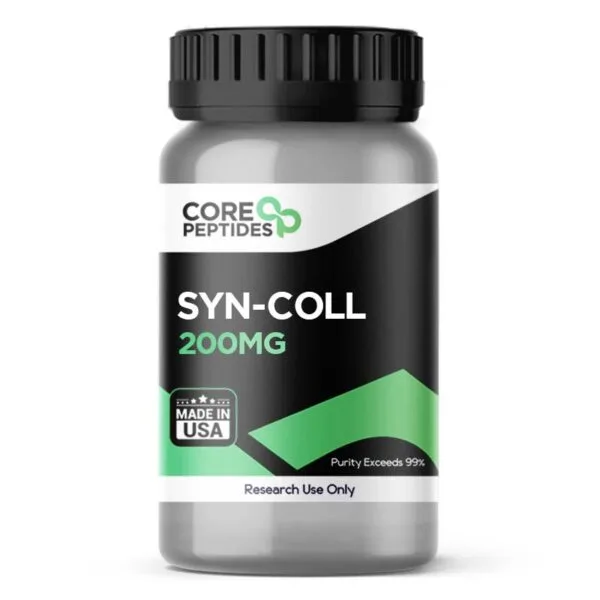
Syn-Coll (Palmitoyl Tripeptide-5) (200mg)
Syn-Coll (Palmitoyl Tripeptide-5) (200mg) is a synthetic lipopeptide widely researched for its potential role in collagen synthesis, extracellular matrix regulation, and skin aging mechanisms. Also known as Palmitoyl Tripeptide-5, this compound was designed to mimic the biological activity of thrombospondin-1 (TSP-1), a naturally occurring extracellular matrix protein involved in activating transforming growth factor beta (TGF-β).
At Core Peptide USA, Syn-Coll (Palmitoyl Tripeptide-5) (200mg) is supplied strictly for research and laboratory purposes only, meeting high standards of purity and consistency for peptide research within the United States.
Overview of Syn-Coll (Palmitoyl Tripeptide-5)
Syn-Coll is a palmitoylated tripeptide, meaning a fatty acid chain (palmitic acid) is attached to a short peptide sequence. This modification enhances peptide stability and interaction with biological membranes in experimental models.
The peptide was engineered to mimic a short active sequence of thrombospondin-1 (TSP-1)—specifically the region responsible for stimulating TGF-β, a growth factor known to regulate collagen production and skin structure. TGF-β plays a vital role in:
-
Maintaining dermal integrity
-
Supporting postnatal skin development
-
Stimulating collagen synthesis by fibroblasts
Syn-Coll carries the peptide sequence Palmitoyl-Lys-Val-Lys (Pal-KVK), which researchers suggest may activate similar signaling pathways as TSP-1.
Mechanism of Action
The primary research interest in Syn-Coll (Palmitoyl Tripeptide-5) (200mg) centers on its potential interaction with TGF-β signaling pathways.
TGF-β Activation and Collagen Synthesis
TGF-β is produced in a latent form and must be activated to exert its biological effects. Studies suggest that Syn-Coll may:
-
Mimic TSP-1 activity
-
Activate latent TGF-β
-
Increase fibroblast signaling
Once activated, TGF-β has been shown to promote the synthesis of Type I and Type III collagen, two major structural proteins in the skin’s extracellular matrix. Researchers have reported that TGF-β activation leads to a persistent increase in collagen and fibronectin mRNA expression in dermal fibroblasts.
Chemical Makeup
Molecular Formula:
C₃₃H₆₅N₅O₅
Molecular Weight:
611.9 g/mol
Other Known Titles:
-
Palmitoyl-lysyl-valyl-lysine
-
Palmitoyl Tripeptide-5
These chemical characteristics make Syn-Coll (Palmitoyl Tripeptide-5) (200mg) suitable for cell culture experiments, peptide formulation studies, and extracellular matrix research.
Syn-Coll Peptide and Collagen Synthesis Research
Collagen is a key structural protein within the extracellular matrix, providing strength, elasticity, and support to the skin. Age, UV exposure, oxidative stress, and inflammation can all reduce collagen production over time.
Multiple studies suggest that Syn-Coll may stimulate collagen synthesis by:
-
Activating TGF-β signaling
-
Increasing fibroblast activity
-
Enhancing Type I and Type III collagen production
Research comparing Syn-Coll with other peptides indicates that Palmitoyl Tripeptide-5 may stimulate collagen production more effectively than palmitoyl pentapeptide. One study suggested that Syn-Coll increased collagen I synthesis via TGF-β activation by approximately 60% more than palmitoyl pentapeptide under experimental conditions.
Syn-Coll (Palmitoyl Tripeptide-5) and Collagen Breakdown
In addition to stimulating collagen production, Syn-Coll has been studied for its potential role in reducing collagen degradation.
Matrix Metalloproteinases (MMPs)
Matrix metalloproteinases such as MMP-1 and MMP-3 are enzymes responsible for breaking down extracellular matrix proteins, including collagen. While MMPs are essential for tissue remodeling, excessive activity can accelerate skin aging.
Research suggests that Syn-Coll may:
-
Inhibit MMP-1 activity (linked to Type I collagen degradation)
-
Interfere with MMP-3 activity (associated with Type III collagen breakdown)
By modulating MMP activity, Syn-Coll (Palmitoyl Tripeptide-5) (200mg) may help maintain collagen integrity in experimental skin models.
Syn-Coll Peptide and Anti-Aging Research
Several studies have evaluated Syn-Coll’s potential impact on wrinkle appearance and skin roughness.
Clinical and experimental findings suggest that:
-
Syn-Coll formulations may reduce wrinkle depth in a dose-dependent manner
-
One study reported wrinkle reduction potential 3.5 times greater than placebo, measured using PRIMOS surface topography
-
An 84-day study involving 60 subjects found that twice-daily application improved wrinkle parameters by approximately 12%
These findings have positioned Syn-Coll as a peptide of interest in anti-aging and cosmetic science research.
Additional Research Insights
Beyond collagen synthesis and degradation, researchers suggest Syn-Coll may support skin structure through additional mechanisms:
-
Supporting the skin barrier and reducing transepidermal water loss
-
Acting as a humectant to retain moisture
-
Increasing surface lipids and emollient properties
Modified versions of Syn-Coll—such as Pal-KVK-AA, which incorporates an L-ascorbate moiety—have also been studied for potential depigmentation effects. Early research suggests this modification may inhibit melanin synthesis, making it relevant to studies on photoaging and hyperpigmentation.
Quality & Research Standards at Core Peptide USA
At Core Peptide, all research compounds—including Syn-Coll (Palmitoyl Tripeptide-5) (200mg)—are supplied with a focus on:
-
Research-grade purity
-
Consistent batch quality
-
Transparent documentation
Explore related peptide research categories:
For authoritative scientific background, researchers may consult:
-
National Center for Biotechnology Information (NCBI)
-
PubMed dermatological peptide studies
Be the first to review “Syn-Coll (Palmitoyl Tripeptide-5) (200mg)”
Related products
Peptides for sale
Peptides for sale
Peptides for sale
Peptides for sale
Peptides for sale
Peptides for sale
Peptides for sale
Reviews
There are no reviews yet.