
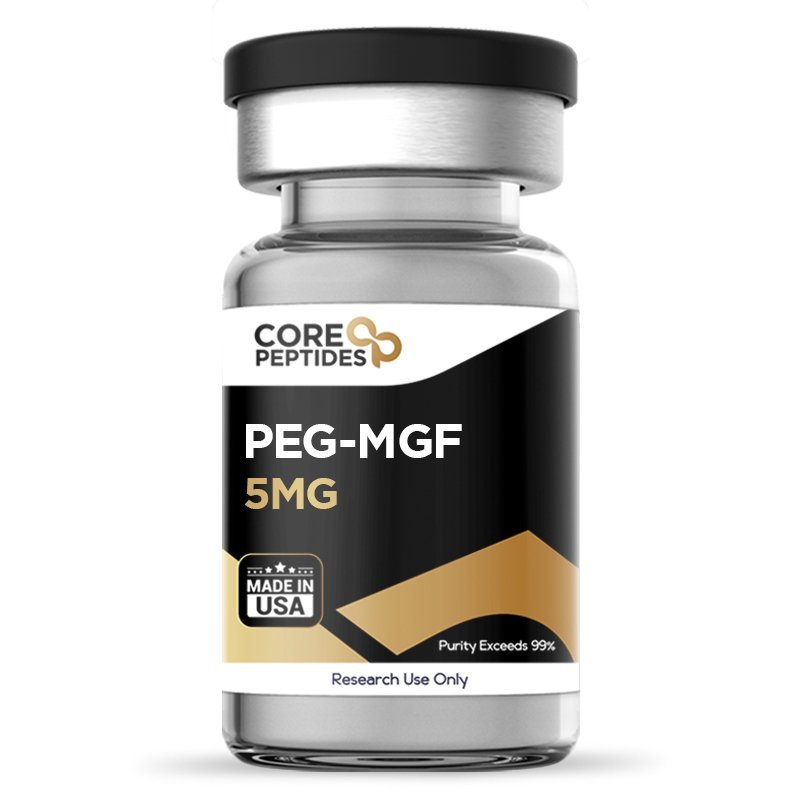

PEG-MGF (5mg) Peptide for Advanced Research Applications
PEG-MGF (5mg) is a synthetic, pegylated form of Mechano Growth Factor (MGF), a research peptide belonging to the insulin-like growth factor-1 (IGF-1) family. MGF, also known as IGF-1Ec, is an isoform produced through alternative splicing of the IGF-1 gene and is believed to be expressed in response to mechanical stress and tissue injury.
At Core Peptide, we provide PEG-MGF (5mg) exclusively for research and laboratory use, supplying academic institutions, biotechnology companies, and independent laboratories throughout the United States.
What Is PEG-MGF (5mg)?
Mechano Growth Factor (MGF) is considered an IGF-1 isoform characterized by a unique C-terminal amino acid sequence that may confer tissue-specific signaling properties. While native MGF is believed to have a short biological half-life, PEG-MGF (5mg) incorporates polyethylene glycol (PEG) through pegylation, a chemical modification designed to:
-
Extend peptide stability
-
Reduce rapid degradation
-
Delay systemic clearance
Researchers hypothesize that pegylation allows PEG-MGF (5mg) to maintain biological activity over a longer duration than unmodified MGF, making it particularly useful for controlled experimental models.
IGF-1 Isoforms and the Role of MGF
The IGF-1 gene may generate three distinct mRNA isoforms through alternative splicing:
-
IGF-1Ea
-
IGF-1Eb
-
IGF-1Ec (MGF)
Each isoform contains the same 70-amino-acid mature IGF-1 sequence but differs in the COOH-terminal extension, which is believed to influence tissue-specific responses. Research from the late 1990s and early 2000s suggested that MGF expression increases significantly following mechanical stress or muscle injury, indicating a possible role in tissue repair mechanisms.
Chemical Properties of PEG-MGF (5mg)
-
Molecular Formula: C₁₂₁H₂₀₀N₄₂O₃₉
-
Molecular Weight: N/A (PEG-modified)
-
Alternate Names: PEG-MGF-E, PEG-MGF-Ct24E
-
Form: Lyophilized powder
-
Quantity: 5mg vial
-
Grade: Research use only
PEG-MGF (5mg) and Muscle Structure Research
Resistance and mechanical loading have been shown to significantly upregulate MGF mRNA expression in muscle tissue. Studies indicate that muscle resistance activity may increase MGF mRNA levels by up to 163%, with even higher expression observed when combined with elevated growth hormone signaling.
Researchers theorize that this increase may reflect an upregulation of IGF-1 gene transcription prior to splicing, supporting the hypothesis that MGF plays a key role in the body’s intrinsic response to mechanical stress. In experimental models, PEG-MGF (5mg) has been studied for its potential to stimulate myoblast proliferation and muscle cell regeneration under controlled laboratory conditions.
Muscle Repair and Inflammatory Modulation Studies
Preclinical studies using murine muscle injury models suggest that MGF may influence several aspects of tissue repair, including:
-
Reduced fibrosis formation
-
Decreased inflammatory cytokine expression
-
Lower oxidative stress markers
-
Modulation of extracellular matrix components
MGF exposure appeared to reduce the expression of collagen types I and III, both of which are associated with fibrotic tissue formation. Additionally, observed reductions in pro-inflammatory markers such as TNF-α, IL-1β, IFN-γ, and TGF-β suggest a potential role for MGF in modifying the inflammatory environment following muscle injury.
PEG-MGF (5mg) and Cardioprotection Research
In hypoxia-induced cardiac injury models, MGF has been investigated for its possible influence on cell survival pathways. Studies involving oxygen-restricted rat models reported increased migration of mesenchymal stem cells (MSCs) toward cardiac tissue following MGF exposure.
Researchers observed elevated expression of the Bcl-2 gene, a regulator associated with apoptosis inhibition. These findings suggest that PEG-MGF (5mg) may be useful in experimental research focused on cardiac tissue repair and hypoxia-related cellular stress.
Bone Healing and Skeletal Research
Animal studies evaluating bone defects reported that MGF-treated tissues demonstrated greater healing and structural integrity compared to control and IGF-1–treated groups. Histological analysis suggested that MGF may activate the MAPK/ERK1/2 signaling pathway, potentially influencing cell cycle progression and osteogenic proliferation.
These findings support continued investigation of PEG-MGF (5mg) in laboratory models of skeletal injury and tissue regeneration.
Neurogenesis and Neuroprotection Studies
Research involving genetically modified murine models with elevated MGF expression in the hippocampus reported increased levels of BrdU, a marker of cellular proliferation. These observations suggest that MGF may influence neurogenesis when expressed at higher concentrations in brain tissue.
Additional long-term studies indicated sustained neurogenic markers across different developmental stages, reinforcing interest in PEG-MGF (5mg) for neuroscience research applications.
Muscle Cell Hypertrophy and Aging Research
In vitro studies examining muscle cells of varying ages found that MGF exposure appeared to:
-
Delay cellular senescence in younger cells
-
Increase cell proliferation in neonatal and young cultures
-
Enhance myotube size and fusion across age groups
Researchers concluded that MGF may influence satellite cell activation and muscle fiber development, highlighting its relevance in experimental muscle maintenance and repair studies.
Why Purchase PEG-MGF (5mg) from Core Peptide?
Core Peptide is a trusted U.S.-based supplier of research peptides. When ordering PEG-MGF (5mg) from corepeptide.us, researchers benefit from:
-
Research-grade peptide quality
-
Transparent sourcing standards
-
Fast domestic shipping within the United States
-
Reliable support for academic and commercial research
Explore additional compounds in our research peptide catalog to support your ongoing studies.
External Scientific References
The research background for PEG-MGF (5mg) is supported by peer-reviewed publications available through PubMed and NIH, including studies published in Frontiers in Endocrinology, In Vivo, and PLoS ONE—trusted resources maintained by the U.S. National Library of Medicine.
Be the first to review “PEG-MGF (5mg)”
Related products
Peptides for sale
Peptides for sale
Peptides for sale
Peptides for sale

Peptides for sale
Peptides for sale
Peptides for sale
Peptides for sale
Reviews
There are no reviews yet.