
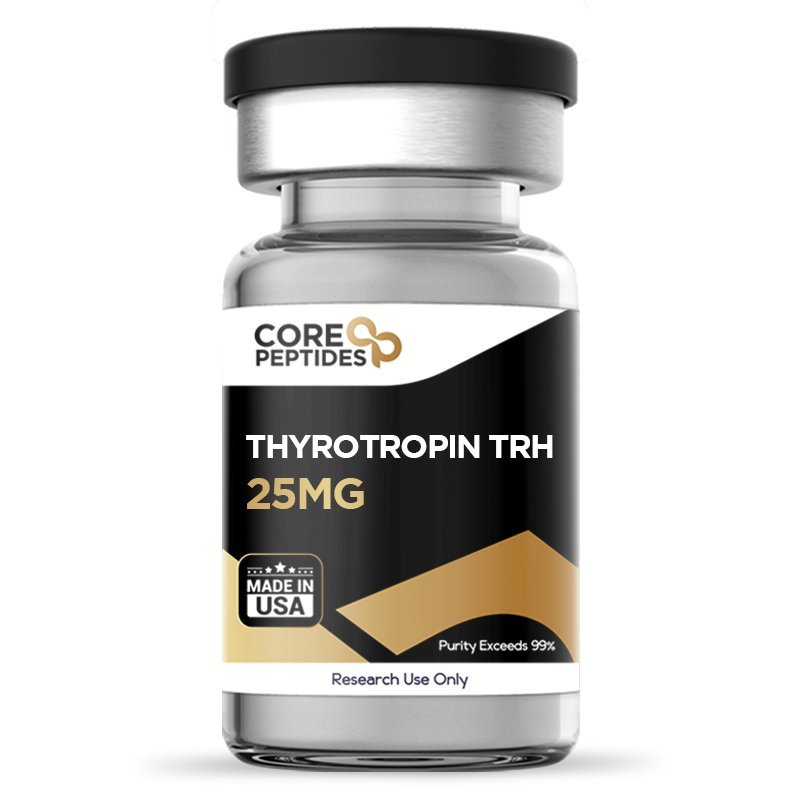
Thyrotropin TRH (25mg) Peptide – Research-Grade Hypothalamic Hormone Analogue
Thyrotropin TRH (25mg) is a synthetic research peptide modeled after the endogenous hypothalamic hormone thyrotropin-releasing hormone (TRH). TRH plays a foundational role in regulating thyroid hormone production and maintaining metabolic homeostasis through its interaction with the pituitary and thyroid glands.
At Core Peptide, we provide Thyrotropin TRH (25mg) exclusively for laboratory and research use within the United States. This research-grade peptide is supplied for experimental applications focused on endocrine signaling, neurological pathways, and systemic regulatory mechanisms.
Explore additional endocrine and metabolic research peptides:
https://corepeptide.us/collections/endocrine-peptides
What Is Thyrotropin TRH?
Thyrotropin-releasing hormone (TRH) is a naturally occurring hypothalamic peptide that functions as a central regulator within the hypothalamic-pituitary-thyroid (HPT) axis. Its primary role is to stimulate the pituitary gland to release thyroid-stimulating hormone (TSH), which subsequently acts on the thyroid gland to promote the synthesis and release of thyroxine (T4) and triiodothyronine (T3).
To study this mechanism in controlled research settings, scientists developed Thyrotropin, also known as Protirelin, a synthetic analogue that structurally and functionally mimics endogenous TRH.
External Reference:
Physiology of Thyroid Hormone – StatPearls
https://www.ncbi.nlm.nih.gov/books/NBK500006/
Overview of Thyrotropin TRH Mechanism
Thyrotropin TRH (25mg) is a tripeptide, composed of three amino acid residues arranged sequentially. Researchers believe Thyrotropin exerts its effects by binding to TRH receptors (TRH-1 and TRH-2), which are G-protein-coupled receptors expressed in both endocrine and neural tissues.
Upon receptor binding, a cascade of intracellular signaling events may occur, including:
-
Activation of phospholipase enzymes
-
Formation of inositol triphosphate (IP3)
-
Increased intracellular calcium concentrations
-
Activation of protein kinase C
-
Modulation of gene expression within the cell nucleus
Collectively, these signaling pathways are believed to transmit the TRH signal from the hypothalamus to the pituitary, resulting in TSH release and downstream thyroid hormone regulation.
Chemical Specifications of Thyrotropin TRH
-
Molecular Formula: C₁₆H₂₂N₆O₄
-
Molecular Weight: 362.39 g/mol
-
Peptide Class: Hypothalamic tripeptide
-
Other Known Names: Protirelin
These characteristics make Thyrotropin TRH (25mg) a valuable compound for mechanistic studies of endocrine signaling.
Thyrotropin TRH and Central Nervous System Research
Beyond its endocrine role, Thyrotropin-releasing hormone has been studied extensively within the central nervous system (CNS). Research involving rat hippocampal slices suggests that TRH may modulate neurotransmitter release under conditions of neuronal activation.
Specifically, studies showed that while TRH did not alter baseline levels of glutamate or aspartate, it significantly inhibited their release during potassium-induced depolarization. This suggests a potential modulatory function during heightened neuronal excitability, possibly mediated by calcium-dependent signaling pathways.
These findings have drawn interest in TRH research related to neurodegenerative conditions and seizure activity, although further studies are required to clarify mechanisms.
Thyrotropin TRH and Neurodegenerative Research
Researchers have also explored Thyrotropin TRH (25mg) in experimental models of Amyotrophic Lateral Sclerosis (ALS). It has been hypothesized that Thyrotropin may act as a neuromodulator during hypothalamic hyperactivity, potentially influencing symptom expression in neurodegenerative conditions.
While conclusions remain limited to laboratory settings, these studies highlight the broad research scope of Thyrotropin beyond thyroid regulation.
Thyrotropin TRH in Behavioral Research
Early investigations into Thyrotropin TRH suggested limited blood-brain barrier permeability. To address this, researchers administered the peptide directly into cerebrospinal fluid during controlled clinical trials.
In a double-blind study involving subjects with depressive symptoms, a majority of participants exhibited a notable reduction in depressive behavior following Thyrotropin exposure. Scientists proposed that these effects may be linked to interactions with serotonin and dopamine pathways, both of which play essential roles in mood regulation.
Importantly, these behavioral effects were described as rapid but short-lived, suggesting a temporary recalibration of neurotransmitter activity rather than permanent alteration.
Thyrotropin TRH and Thyroid Diagnostic Research
Thyrotropin has historically been used in thyroid diagnostic testing, commonly referred to as the “Thyrotropin test.” In one study, varying responses to the test were observed among subjects, including blunted responses associated with hypothyroid states and exaggerated responses linked to autoimmune thyroid activity.
These findings suggest that Thyrotropin TRH may be useful in research evaluating thyroid gland responsiveness and endocrine feedback mechanisms.
External Source:
PubChem – Protirelin Compound Summary
https://pubchem.ncbi.nlm.nih.gov/compound/Protirelin
Thyrotropin TRH and Cardiovascular Research
Research has also examined Thyrotropin’s potential effects on blood pressure and heart rate. Clinical observations indicated increases in blood pressure following Thyrotropin exposure, even in the absence of changes in thyroid hormone levels.
Further experimental studies localized these cardiovascular responses to specific hypothalamic nuclei, suggesting a role for autonomic nervous system regulation, including sympathetic and adrenal pathways.
These findings underscore the importance of controlled experimental design when studying Thyrotropin TRH in cardiovascular research models.
Thyrotropin TRH (25mg) for Research Use Only
Thyrotropin TRH (25mg) supplied by Core Peptide is intended strictly for laboratory and scientific research purposes. It is not approved for human or veterinary use, diagnosis, treatment, or disease prevention.
Be the first to review “Thyrotropin TRH (25mg)”
Related products
Peptides for sale
Peptides for sale
Peptides for sale
Peptides for sale
Peptides for sale
Peptides for sale
Peptides for sale
Reviews
There are no reviews yet.