
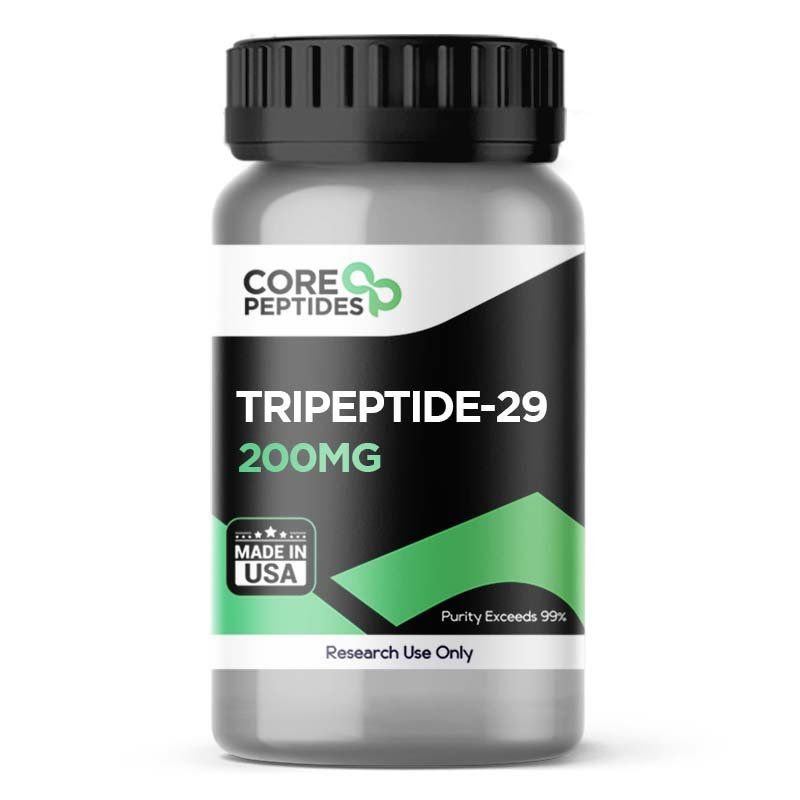
Tripeptide-29 (200mg) Research Peptide
Tripeptide-29 (200mg) is a small, naturally occurring amino acid peptide widely studied in biochemical and dermatological research due to its integral role in collagen structure and stability. As one of the primary building blocks of collagen protein, Tripeptide-29 has gained attention among researchers investigating extracellular matrix integrity, oxidative stress modulation, and age-related cellular processes.
Collagen is a major structural protein found throughout connective tissues and is a core component of the extracellular matrix (ECM). The ECM provides essential structural support to cells and tissues, influencing elasticity, resilience, and cellular communication. Research suggests that Tripeptide-29 may contribute directly to collagen fiber formation and stabilization, making Tripeptide-29 (200mg) a valuable compound for laboratory and in vitro research.
At Core Peptide, we provide high-purity Tripeptide-29 (200mg) strictly for research and laboratory use within the United States.
What Is Tripeptide-29?
Tripeptide-29, also known as Glycylprolylhydroxyproline (Gly-Pro-Hyp), is a naturally occurring tripeptide formed during the hydrolysis of type I collagen. It is recognized as one of the most abundant collagen-derived peptides and has been extensively studied for its biological relevance in connective tissue research.
Due to its small molecular size, Tripeptide-29 is hypothesized to exhibit favorable bioavailability in experimental models, supporting its widespread use in collagen and skin-aging research.
Chemical Makeup of Tripeptide-29
-
Molecular Formula: C₁₂H₁₉N₃O₅
-
Molecular Weight: 285.3 g/mol
-
Alternate Name: Gly-Pro-Hyp
The hydroxyproline (Hyp) residue in Tripeptide-29 is believed to play a critical role in stabilizing collagen triple helices through hydrogen bonding and interatomic interactions.
Tripeptide-29 and Collagen Integrity
Scientific studies indicate that Tripeptide-29 (200mg) may be a major contributor to the stability of type I collagen molecules. The hydroxyl group on hydroxyproline is thought to enhance favorable molecular interactions, potentially improving collagen microfibril resilience.
Research also suggests that collagen sequences containing Tripeptide-29 may demonstrate increased resistance to UV-induced degradation and oxidative damage. In laboratory settings, the presence of Tripeptide-29 within collagen structures has been associated with a reduced degradation rate when exposed to intensive radiation.
In dermal fibroblast studies, hydrolyzed type I collagen tripeptides—primarily composed of Tripeptide-29—have shown potential in reducing oxidative stress markers. These findings suggest that Tripeptide-29 may help preserve collagen integrity by inhibiting pathways associated with extracellular matrix breakdown.
External reference:
-
National Center for Biotechnology Information (NCBI):
Oxidative Stress and Cellular Aging Research
Researchers have hypothesized that Tripeptide-29 may exhibit antioxidant characteristics, potentially reducing reactive oxygen species (ROS) in cellular models. One in vitro study reported that collagen hydrolysates rich in Tripeptide-29 reduced the accumulation of advanced glycation end products (AGEs).
AGEs are known to alter protein structure and mechanical properties, accelerating cellular aging. By inhibiting glycation and oxidative stress, Tripeptide-29 was suggested to delay age-related cellular changes and preserve fibroblast function.
The study concluded that Tripeptide-29 “might improve aging phenotypes via inhibition of glycation and oxidative stress, leading to delayed cellular aging,” highlighting its relevance in longevity and tissue integrity research.
Tripeptide-29 and Glucose Metabolism Research
Emerging research indicates that Tripeptide-29 may act as a peptidic inhibitor of dipeptidyl peptidase-IV (DPP-IV). DPP-IV is a serine protease involved in glucose regulation through the degradation of incretin hormones such as GLP-1 and GIP.
Tripeptide-29 has demonstrated resistance to hydrolysis by DPP-IV, suggesting enhanced stability in experimental models. Inhibition of DPP-IV may increase circulating incretin levels, potentially influencing insulin secretion, glucagon regulation, and glucose homeostasis.
Although this research remains strictly preclinical, it highlights the growing scientific interest in Tripeptide-29 (200mg) for metabolic pathway investigations.
External reference:
-
National Institutes of Health (NIH):
Platelet Aggregation and Hemostasis Studies
Collagen-derived peptides containing Gly-Pro-Hyp motifs have been studied for their interaction with platelet receptors, particularly glycoprotein VI (GPVI). GPVI is a key receptor involved in platelet activation and blood clot formation.
Studies suggest that non-cross-linked Tripeptide-29 may induce intracellular signaling cascades in platelets, including tyrosine phosphorylation of Syk kinase and PLCγ2. These molecular events may stimulate platelet aggregation, contributing to hemostatic responses in research models.
Researchers concluded that Tripeptide-29 repeat motifs are sufficient to activate GPVI receptors, reinforcing its importance in collagen-related platelet studies.
Why Choose Tripeptide-29 (200mg) from Core Peptide?
When sourcing research peptides in the United States, quality and purity are critical. Core Peptide is committed to providing:
-
High-purity Tripeptide-29 (200mg)
-
Third-party tested research compounds
-
USA-based distribution and fast shipping
-
Transparent documentation and handling standards
Explore additional research peptides here:
Peptide Research Products – Core Peptide
References
Wiśniewski, K., Artemowicz, B., Lutostańska, A., Maćkowiak, J., & Koziołkiewicz, W. (1994). Central activity of peptide Gly-Pro-Hyp–the main component of collagen degradation products mixture. Acta Neurobiologiae Experimentalis, 54(1), 33–38.
Be the first to review “Tripeptide-29 (200mg)”
Related products
Peptides for sale
Peptides for sale
Peptides for sale

Peptides for sale
Peptides for sale
Peptides for sale
Peptides for sale
Reviews
There are no reviews yet.