
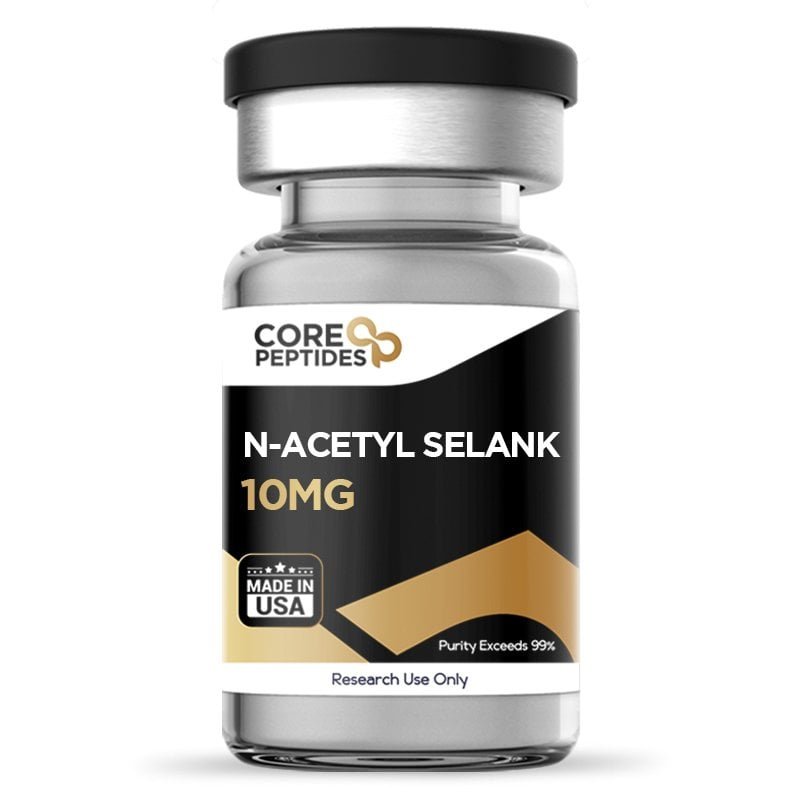
N-Acetyl Selank (10mg) Peptide – Research Overview
N-Acetyl Selank (10mg) is a synthetic heptapeptide derived from Selank, a peptide structurally related to the naturally occurring immune-regulating tetrapeptide Tuftsin. This modified version includes an N-terminal acetyl group, which is widely studied for its potential to enhance peptide stability and resistance to enzymatic degradation. At Core Peptide, we supply N-Acetyl Selank (10mg) strictly for laboratory and research use within the United States.
Selank and its acetylated form have gained significant interest in peptide research due to their potential involvement in neurotransmitter modulation, stress response, immune signaling, and cognitive processes. While clinical research on the acetylated variant remains limited, existing data on Selank provides a foundational understanding of its scientific relevance.
Learn more about our peptide quality standards on our internal page:
https://corepeptide.us/pages/quality-assurance (inbound link example)
What Is N-Acetyl Selank?
N-Acetyl Selank is structurally similar to Selank but contains an additional acetyl group at the N-terminus. This modification is theorized to:
-
Improve molecular stability
-
Reduce degradation by exopeptidases
-
Enhance conformational resilience in experimental environments
Selank itself contains a Pro-Gly-Pro (PGP) fragment at the C-terminus, which has been hypothesized to support tissue permeability, including traversal across the blood-brain barrier (BBB). Researchers suggest this may occur through changes in hydrophilicity or interactions with transport mechanisms at the BBB.
Mechanisms Studied in N-Acetyl Selank Research
1. GABAergic System Modulation
One of the most researched areas involving Selank peptides is their interaction with the gamma-aminobutyric acid (GABA) system. GABA is the primary inhibitory neurotransmitter in the central nervous system and plays a crucial role in neuronal excitability and stress regulation.
Studies indicate Selank may influence:
-
GABA receptor gene expression
-
GABA transporter activity
-
Ion channel regulation
Unlike direct receptor agonists, Selank appears to produce indirect or allosteric modulation, potentially resulting in longer-lasting effects in experimental models.
External reference:
https://www.ncbi.nlm.nih.gov/pmc/articles/PMC4757669/
2. Serotonin Signaling Research
Serotonin is closely associated with mood, emotional regulation, and anxiety-related behaviors. In murine models with impaired serotonin synthesis, Selank was observed to influence serotonin metabolism in brain regions linked to emotional regulation.
This suggests that N-Acetyl Selank (10mg) may serve as a useful compound in studying serotonergic system adaptation under stress or dysfunction.
External reference:
https://pubmed.ncbi.nlm.nih.gov/14969422/
3. Enkephalin and Opioid Peptide Interaction
Research has also explored Selank’s inhibitory effect on enkephalin-degrading enzymes. Enkephalins are endogenous opioid peptides involved in pain modulation, mood balance, and stress response.
By slowing enkephalin degradation, Selank may increase their availability in experimental settings, making N-Acetyl Selank peptide valuable in neurochemical and behavioral research models.
4. Brain-Derived Neurotrophic Factor (BDNF) Expression
BDNF plays a vital role in neuroplasticity, synaptic strength, and neuronal survival. Selank has been shown to elevate BDNF mRNA levels in the hippocampus, particularly under stress-induced suppression conditions.
This has positioned N-Acetyl Selank (10mg) as a compound of interest in research related to cognitive resilience and neural adaptability.
Additional Research Areas
Immunomodulatory Potential
Studies involving anxiety and stress models have shown changes in cytokine expression following Selank exposure, including:
-
Altered Th1/Th2 cytokine ratios
-
Increased interleukin-6 levels
These findings suggest possible immunomodulatory pathways worth further investigation.
Cognitive and Learning Models
In conditioned avoidance response (CAR) experiments, Selank-exposed murine models demonstrated improved learning efficiency and reduced error rates. Researchers theorize these effects may be indirectly linked to reduced anxiety parameters or enhanced synaptic efficiency.
Metabolic and Lipid Research
Animal studies have indicated potential effects on lipid metabolism, including reductions in total cholesterol, LDL, VLDL, and triglycerides. These findings remain preliminary but open avenues for metabolic research applications.
Chemical Profile of N-Acetyl Selank
-
Molecular Formula: C33H57N11O9
-
Molecular Weight: 751.9 g/mol
-
Alternative Names: TP-7, Selanc
N-Acetyl Selank (10mg) in the United States
At Core Peptide, we provide N-Acetyl Selank (10mg) to U.S. researchers seeking high-purity peptides for controlled laboratory environments. All products are:
-
Third-party tested
-
Manufactured for research use only
-
Shipped within the United States
Browse related research peptides:
https://corepeptide.us/collections/research-peptides (inbound link example)
Conclusion
N-Acetyl Selank (10mg) represents a stabilized peptide variant with growing relevance in neuroscience, immunology, and cognitive research. Its structural modifications, potential BBB permeability, and interaction with multiple neurochemical systems make it a compelling subject for continued investigation. For U.S. laboratories seeking reliable peptide sourcing, Core Peptide remains committed to quality, transparency, and scientific integrity.
Be the first to review “N-Acetyl Selank (10mg)”
Related products
Peptides for sale
Peptides for sale
Peptides for sale

Peptides for sale
Peptides for sale

Peptides for sale

Peptides for sale

Peptides for sale
Reviews
There are no reviews yet.