
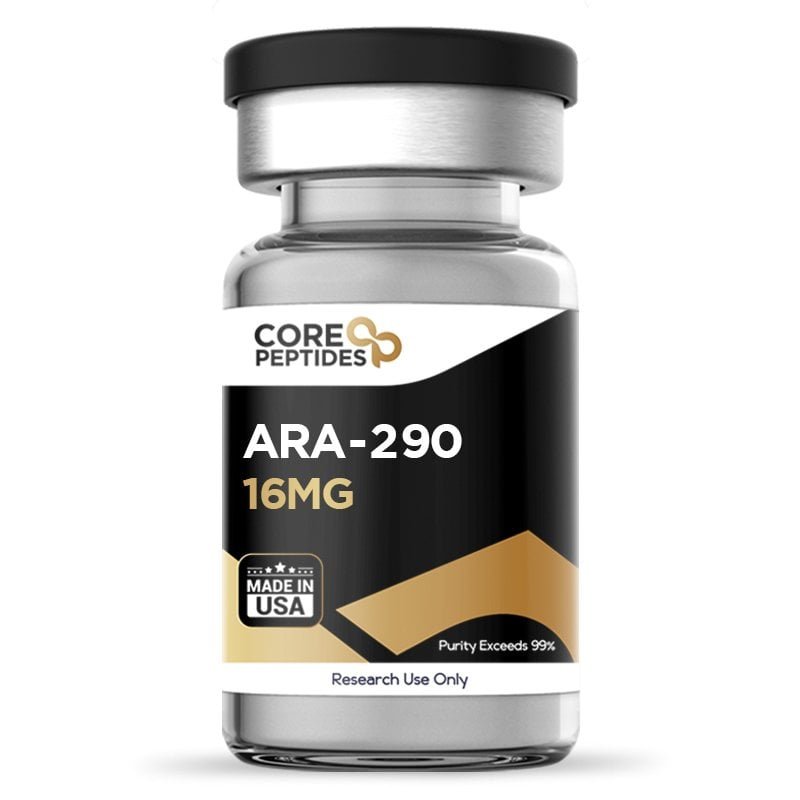
ARA-290 (16mg) Peptide: Tissue Repair and Anti-Inflammatory Research Agent
ARA-290 (16mg), also known in scientific literature as cibinetide or helix B surface peptide (HBSP), is an 11-amino-acid chain derived from the beta domain of erythropoietin (EPO) (source). Unlike full-length EPO, which stimulates red blood cell production, ARA-290 targets tissue repair, anti-inflammatory, and regenerative pathways without impacting erythropoiesis. This makes it a promising candidate for research into tissue protection, nociception, and immunomodulation.
Overview of ARA-290 Peptide
Research has indicated that ARA-290 (16mg) may activate the tissue-protective receptor (TPR) pathway, a complex of the beta receptor unit (CD131) and a subunit from the EPO receptor, also called the innate repair receptor (IRR) (source). Binding to this receptor allows ARA-290 to potentially reduce pain, inflammation, and cellular damage while promoting tissue repair.
The peptide has a chemical formula of C51H54N16O21 and a molecular weight of 1257.3 g/mol, making it suitable for precise laboratory research purposes. Other names include PH-BSP.
ARA-290 (16mg) and Nociception Research
ARA-290 peptide has shown potential in research targeting pain reduction via nociceptive pathways. Nociception, or the neural response to harmful stimuli, is largely mediated by TRP channels, especially TRPV1, which respond to thermal, chemical, and mechanical triggers (source).
Experimental murine studies have suggested that ARA-290 may inhibit TRPV1 activation, reducing the release of neuropeptides that trigger pain signals. For instance, murine models treated with ARA-290 demonstrated increased pain thresholds to capsaicin exposure, indicating potential analgesic activity without interfering with other sensory modalities.
Learn more about nociception research here.
ARA-290 Peptide and Retinal Ischemia Studies
Research has explored ARA-290 (16mg) in retinal ischemia models, where ischemic conditions can lead to tissue damage and vision loss. Studies using endothelial colony-forming cells (ECFCs) suggest that ARA-290 may:
-
Reduce pro-inflammatory cytokines like IL-1β and TNF-α
-
Enhance vascular repair and regeneration
-
Improve cell survival under oxidative stress
In oxygen-induced retinopathy (OIR) murine models, ARA-290 demonstrated a capacity to improve vaso-reparative outcomes, potentially making it a useful peptide for research in ischemic retinal diseases (source).
Read more about retinal ischemia and ECFCs.
Anti-Inflammatory and Immunomodulatory Potential
ARA-290 (16mg) has shown potential in regulating inflammatory cytokines and protecting cells from immune-mediated damage. In pancreatic islet transplantation models, administration of ARA-290:
-
Protected islet cells from cytokine-induced apoptosis
-
Inhibited secretion of IL-6, IL-12, and TNF-α
-
Reduced caspase 3/7 activity, indicating cell-protective effects
Mechanistically, these effects may be mediated by the EPOR-βcR complex, which activates survival pathways including PI3K-Akt and JAK2-STAT5, while reducing NF-κB-mediated transcription of pro-inflammatory genes (source).
This indicates that ARA-290 may be a promising peptide for studies involving tissue inflammation, transplantation immunology, and regenerative medicine.
ARA-290 Peptide and Tissue Protection
The tissue-protective properties of ARA-290 (16mg) stem from its ability to bind TPR receptor cells without stimulating erythropoiesis. Laboratory studies have shown that ARA-290 may:
-
Promote tissue regeneration
-
Reduce tissue damage and inflammation
-
Support wound healing and scar reduction
This makes it a valuable tool for researchers studying organ protection, tissue repair, and regenerative medicine models.
Mechanism of Action: TPR Pathway and Adaptive Immunity
ARA-290 may modulate both innate and adaptive immunity by engaging the TPR receptor pathway. Binding to this receptor can:
-
Reduce secretion of inflammatory cytokines such as IL-6
-
Fine-tune dendritic cell antigen presentation, potentially preventing immune rejection in transplantation studies
-
Protect tissues against immuno-compromising conditions
These mechanisms make ARA-290 a potential research agent for autoimmune studies, transplant tolerance, and inflammation research.
Why Choose CorePeptide.us for ARA-290 (16mg)
CorePeptide.us offers research-grade ARA-290 (16mg) peptide for laboratory and preclinical studies. All products are shipped to United States research institutions with verified quality and purity. Researchers can leverage this peptide for studies in:
-
Tissue repair and regeneration
-
Nociception and pain mitigation
-
Retinal ischemia and vascular repair
-
Anti-inflammatory and immunomodulatory pathways
Visit our ARA-290 product page to review specifications and place an order.
References and Further Reading
-
Brines M, Cerami A. The receptor that tames the innate immune response. Mol Med. 2012 May 9;18(1):486-96. PubMed
-
Dahan, A., et al. ARA-290 improves symptoms in patients with sarcoidosis-associated small nerve fiber loss. Molecular Medicine, 19(1), 334–345. PMC
-
Jara-Oseguera, A., et al. TRPV1: on the road to pain relief. Current Molecular Pharmacology, 1(3), 255–269. DOI
Be the first to review “ARA-290 (16mg)”
Related products
Peptides for sale
Peptides for sale
Peptides for sale
Peptides for sale
Peptides for sale
Peptides for sale
Peptides for sale
Peptides for sale
Reviews
There are no reviews yet.