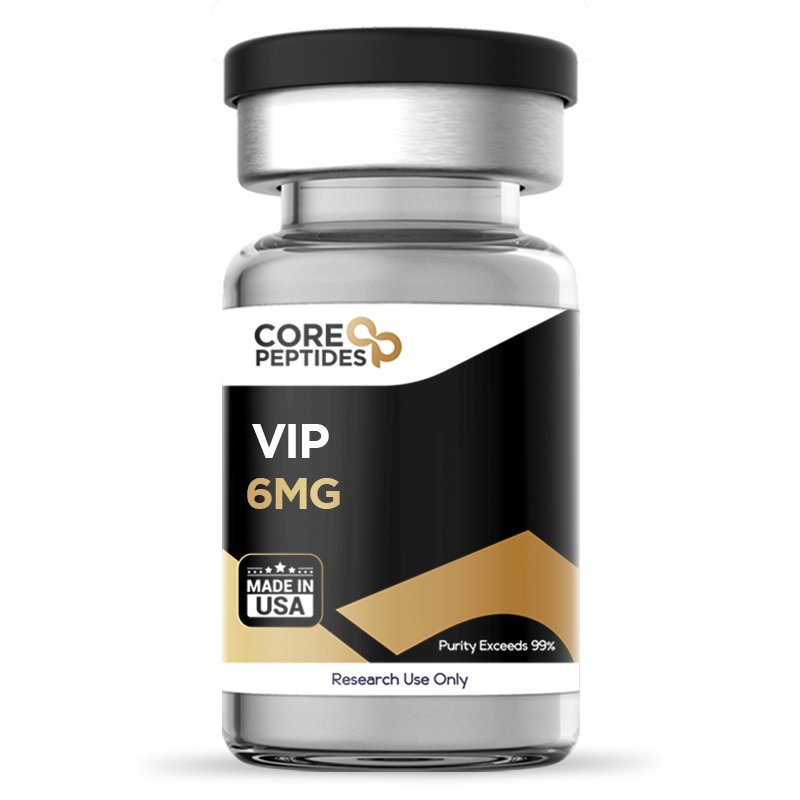
VIP (6mg) – Vasoactive Intestinal Peptide for Advanced Research
VIP (6mg) Peptide
VIP (6mg), also known as Vasoactive Intestinal Peptide, is a naturally occurring neuropeptide composed of 28 amino acid residues. It is found throughout both the central and peripheral nervous systems and has been widely studied for its pleiotropic biological activity. Due to its broad receptor distribution and signaling potential, VIP has become an important subject of interest in immunology, neuroscience, cardiovascular research, and inflammation studies.
At Core Peptide (https://corepeptide.us), VIP (6mg) is supplied strictly for research and laboratory use only, supporting scientific investigations across the United States.
What Is VIP Peptide?
Vasoactive Intestinal Peptide is a short peptide hormone and neurotransmitter originally identified in the gastrointestinal tract but later found to be widely distributed in the nervous and immune systems. Researchers suggest that VIP functions as:
-
A neurotransmitter and neuromodulator
-
A vasodilator
-
An immune system regulator
-
A secretagogue, influencing cellular signaling pathways
Its widespread presence suggests that VIP may act on multiple physiological systems simultaneously, making it a valuable research peptide.
Chemical Makeup of VIP (6mg)
-
Molecular Formula: C₁₄₇H₂₃₇N₄₃O₄₃S
-
Molecular Weight: 3326.8 g/mol
-
Amino Acid Length: 28 residues
-
Other Names:
-
PHM27
-
Vasoactive intestinal polypeptide
-
This well-characterized molecular profile allows for reproducible experimentation in controlled laboratory environments.
VIP Receptors and Mechanism of Action
Researchers posit that the VIP peptide binds to three G protein–coupled receptors:
-
VPAC1
-
VPAC2
-
PAC1
Receptor Distribution
-
VPAC1: Brain, liver, lungs, intestine, immune cells
-
VPAC2: Central nervous system, pancreas, heart, kidney, skeletal muscle, GI and reproductive tracts
-
PAC1: Predominantly brain and adrenal tissues
Upon receptor binding, VIP may activate the adenylate cyclase pathway, increasing cyclic adenosine monophosphate (cAMP) production, a critical regulator of immune and neural signaling. Due to receptor localization, VIP’s biological effects may vary depending on the tissue studied.
VIP Peptide and Inflammation Research
VIP has been widely researched for its potential anti-inflammatory properties in both innate and adaptive immunity.
Immune Modulation
Studies suggest that VIP:
-
Inhibits pro-inflammatory cytokines and chemokines
-
Suppresses Th1-type inflammatory responses
-
Promotes Th2-type immune responses
-
Supports immune homeostasis
Because VIP is produced by immune cells themselves, it may act as an endogenous regulator to maintain immune equilibrium.
Intestinal Inflammation and Barrier Integrity
Research involving murine models of necrotizing enterocolitis (NEC) suggests that VIP may help preserve intestinal epithelial barrier integrity. Exogenous VIP exposure was associated with:
-
Reduced NEC severity
-
Lower IL-6 and TNFα levels
-
Increased expression of tight junction protein Claudin-3
These findings suggest that VIP may play a role in moderating inflammation while supporting epithelial barrier stability.
VIP Peptide and the Blood-Brain Barrier
The blood-brain barrier (BBB) and blood-spinal barrier (BSB) protect central nervous system tissues from harmful agents. Disruption of these barriers may lead to neuroinflammation and degeneration.
Researchers propose that VIP may:
-
Support BBB and BSB integrity
-
Regulate immune responses via cAMP signaling
-
Modulate regulatory T-cell (Treg) activity
Autoimmune targeting of VIP or its receptors may increase BBB permeability, leading to “leakiness” and exacerbated neuroinflammatory processes. Ongoing research explores VIP’s potential neuroprotective role in these models.
VIP Peptide and Cardiac Fibrosis Research
Cardiac fibrosis is strongly associated with activation of the renin-angiotensin system, leading to vascular inflammation and tissue scarring.
Studies suggest that VIP may:
-
Reduce angiotensinogen (Agt) expression
-
Decrease angiotensin receptor type 1a (AT1a) mRNA levels
-
Lower myocardial fibrosis in high-salt diet murine models
Interestingly, VIP concentrations were found to be nearly absent in end-stage cardiomyopathy, supporting its potential relevance in cardiovascular research. While VIP did not affect all pro-fibrotic mediators, its selective modulation of key pathways continues to attract research interest.
VIP Peptide and Behavioral Research
VIP neurons are active in regions associated with behavior, reproduction, and circadian rhythms.
Research suggests VIP may influence:
-
Prolactin (PRL) secretion
-
Social behaviors such as pair bonding and affiliation
-
Aggression and stress responses
-
Circadian rhythm regulation via the suprachiasmatic nucleus (SCN)
VIP’s interactions with other neuropeptides such as oxytocin and vasopressin suggest a broader role in social behavior networks and environmental adaptation in animal models.
Why Researchers Choose VIP (6mg) from Core Peptide
Researchers select VIP (6mg) for its:
-
Well-documented receptor pathways
-
Broad relevance across immune, neural, and cardiovascular research
-
Naturally occurring structure with defined biological roles
-
High interest in translational and mechanistic studies
At Core Peptide, all products are handled with strict quality control to ensure consistency and research reliability.
Explore Related Research Peptides:
https://corepeptide.us/collections/all
External Scientific Resources:
https://pubmed.ncbi.nlm.nih.gov
https://www.ncbi.nlm.nih.gov
https://www.ncbi.nlm.nih.gov/pmc
Research Use Disclaimer
VIP (6mg) is intended for research and laboratory use only.
Not for human or veterinary consumption. Customers must review and comply with our Terms and Conditions prior to ordering.
Buy VIP (6mg) Peptide in the USA
For laboratories seeking a trusted domestic supplier, Core Peptide offers VIP (6mg) with professional handling and fast U.S. shipping.
Order VIP (6mg) Today:
ttps://corepepptide.us
Reference
Delgado, M., & Ganea, D. (2013). Vasoactive intestinal peptide: a neuropeptide with pleiotropic immune functions. Amino Acids, 45(1), 25–39.


Reviews
There are no reviews yet.