
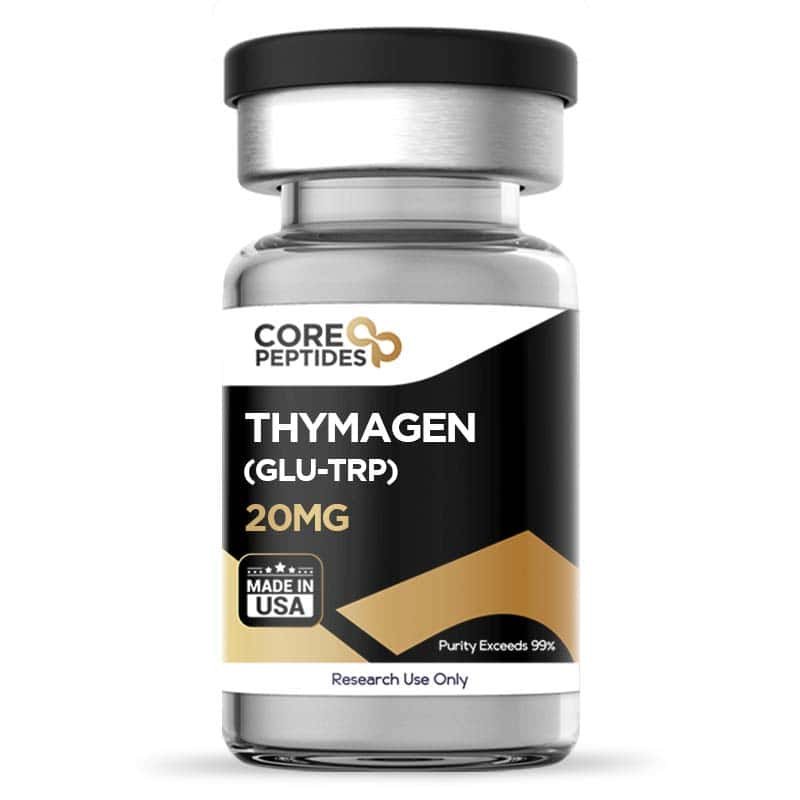
Thymagen (20mg) Peptide – Research-Grade Immune Bioregulator
Thymagen (20mg) is a synthetically formulated bioregulator peptide widely studied in laboratory and experimental settings for its potential role in immune system regulation. Also known as EW (Glu-Trp), Thymogen, or Oglufanide, Thymagen belongs to the group of Khavinson peptides, a class of short regulatory peptides originally derived from tissue-specific polypeptides.
At Core Peptide, we provide research-grade Thymagen (20mg) for qualified laboratory use in the United States. Each vial is manufactured to strict quality standards and intended exclusively for scientific research purposes.
Explore additional immune-focused peptides in our collection:
Internal Link: https://corepeptide.us/collections/immune-support-peptides
What Is Thymagen Peptide?
Thymagen is an artificial peptide analog of thymalin, a thymus-derived polypeptide. Its simple dipeptide structure—glutamic acid and tryptophan (Glu-Trp)—allows researchers to explore how minimal peptide sequences may influence immune signaling pathways and cellular regulation.
Research has increasingly focused on Thymagen’s potential immunomodulating characteristics, particularly its interaction with immune cells, cytokine production, and intracellular signaling systems. These properties have positioned Thymagen (20mg) as a peptide of interest in immune research, aging studies, and cellular resilience investigations.
Chemical Makeup of Thymagen
-
Molecular Formula: C₁₆H₁₉N₃O₅
-
Molecular Weight: 333.3 g/mol
-
Amino Acid Sequence: Glu-Trp
-
Other Names: Thymogen, Oglufanide, EW peptide
This minimal structure makes Thymagen especially valuable in mechanistic research examining peptide-cell interactions at the molecular level.
Thymagen and Immune Cell Research
Cyclic Nucleotide Modulation
Several murine studies suggest that Thymagen may influence cyclic nucleotide systems, particularly the balance between cAMP and cGMP in immune cells. In experimental models of sensitization and anaphylaxis, researchers observed changes in phosphodiesterase activity within spleen lymphocytes following Thymagen exposure.
These findings suggest that Thymagen may contribute to immune response balancing, especially during hypersensitivity or immune stress scenarios.
External Reference: PubMed – Effect of thymagen on cyclic nucleotides cite1659006
Bacterial Infection Models
In research involving Yersinia enterocolitica infection models, Thymagen was studied for its potential role in immune regulation. Findings suggested a possible reduction in excessive polyclonal immune responses and a decrease in autoimmune-like reactions. Additionally, Thymagen appeared to enhance nonspecific resistance, potentially limiting bacterial spread across tissues.
These observations highlight why Thymagen (20mg) continues to be studied in infection-related immune research.
External Link: https://pubmed.ncbi.nlm.nih.gov/7660690/
T-Lymphocyte Differentiation & Immunodeficiency
Experimental research also suggests that Thymagen may influence T-lymphocyte differentiation, particularly in models of secondary immunodeficiency associated with autoimmune conditions. Investigators reported measurable improvements in immune markers, reinforcing Thymagen’s relevance in immune system research.
Thymagen and Fungal Infection Studies
In murine models of secondary immunodeficiency complicated by candidiasis, Thymagen was investigated for its potential to activate immunocompetent systems, including thymic activity. Results suggested a reduction in infection severity following Thymagen exposure, further supporting its role in immune resilience research.
Thymagen and Cardiac Cell Research
Beyond immune studies, Thymagen has also been explored in cardiac research models, particularly those involving experimentally induced arrhythmias. In several murine arrhythmia models, Thymagen demonstrated potential anti-ischemic properties without involving opiate receptors or calcium channel blockade.
While additional research is required, these findings broaden Thymagen’s relevance across multiple physiological research domains.
External Source: National Center for Biotechnology Information (NCBI)
Thymagen and Tumor Cell Research
Cancer Prevention Models
In studies involving chemically induced carcinogenesis, Thymagen exposure appeared to reduce both tumor incidence and tumor multiplicity in murine models. Researchers observed fewer papilloma and carcinoma cells in tissue cultures exposed to Thymagen.
Radiation Exposure Studies
Long-term radiation exposure studies also explored Thymagen’s effects. Models receiving Thymagen alongside radionuclide exposure showed reduced tumor occurrence and improved longevity markers compared to controls. Interestingly, models exposed only to Thymagen demonstrated slower aging rates and fewer benign and malignant tumors.
These findings suggest Thymagen may play a role in cellular protection and longevity research, though conclusions remain limited to laboratory settings.
Why Choose Core Peptide for Thymagen (20mg)?
-
USA-focused distribution and fast domestic shipping
-
Research-grade purity standards
-
Secure, temperature-controlled packaging
-
Transparent documentation for laboratory use
Explore our full catalog of Khavinson and immune research peptides:
Internal Link: https://corepeptide.us
Final Thoughts on Thymagen Peptide Research
Thymagen (20mg) remains a compelling subject in peptide research due to its minimal structure and wide-ranging experimental applications. From immune modulation and infection models to cardiac and tumor research, Thymagen continues to attract attention in laboratory environments.
Be the first to review “Thymagen (20mg)”
Related products

Peptides for sale
Peptides for sale
Peptides for sale
Peptides for sale
Peptides for sale
Peptides for sale
Peptides for sale
Peptides for sale
Reviews
There are no reviews yet.