
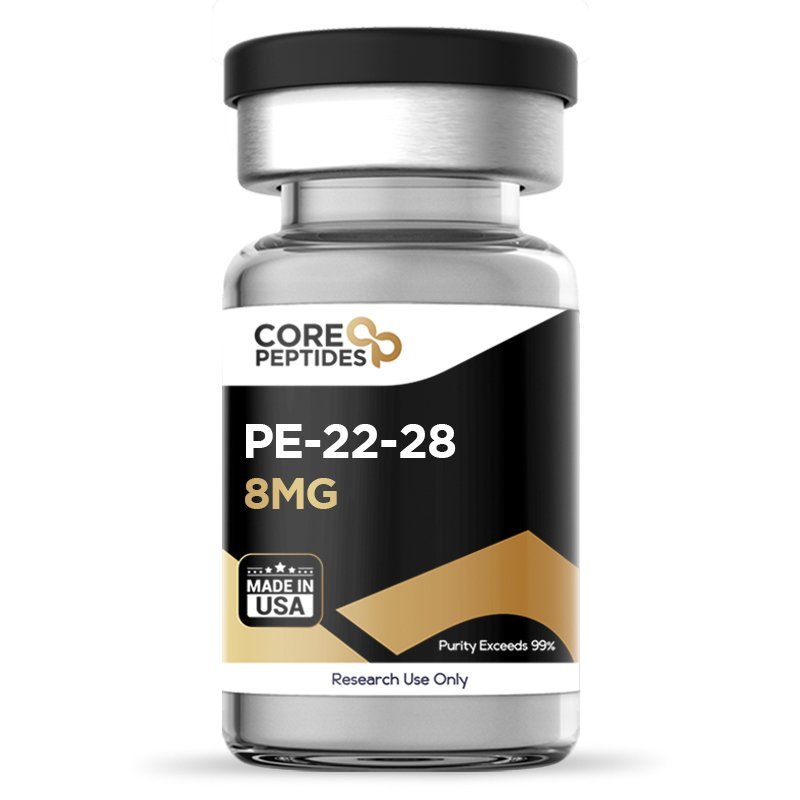
PE-22-28 (8mg) Peptide for Advanced Research Applications
PE-22-28 (8mg) is a synthetic peptide derived from spadin, a naturally occurring peptide cleaved from sortilin, a protein highly expressed in the central nervous system. Due to its shortened amino acid sequence and enhanced stability, PE-22-28 has gained significant interest in neuroscience and pharmacological research, particularly in studies involving the TREK-1 potassium channel.
At Core Peptide, we supply PE-22-28 (8mg) strictly for research and laboratory use, serving universities, biotech firms, and independent research facilities across the United States.
What Is PE-22-28 (8mg)?
PE-22-28 is a seven–amino acid peptide corresponding to amino acids 22–28 of the original spadin sequence. According to Djillani et al., this shortened analog may represent “the shortest, most efficient sequence capable of blocking the TREK-1 channel” while maintaining improved stability in vivo.
Unlike full-length spadin, PE-22-28 (8mg) is engineered to enhance bioavailability and receptor affinity, making it an attractive compound for controlled experimental models.
Chemical Properties of PE-22-28 (8mg)
-
Molecular Formula: C₃₅H₅₅N₁₁O₉
-
Molecular Weight: 773.89 g/mol
-
Amino Acid Sequence: GVSWGLR
-
Form: Lyophilized powder
-
Purity: Research-grade
-
Quantity: 8mg vial
TREK-1 Channel Research and Mechanism of Action
The TREK-1 (TWIK-related potassium channel 1) is a two-pore potassium channel implicated in neuronal excitability, mood regulation, anesthesia response, and pain perception. TREK-1 is abundantly expressed in the hippocampus and prefrontal cortex, regions closely associated with cognition, learning, and emotional processing.
Studies suggest that blocking TREK-1 channels may increase neuronal firing and resistance to depressive phenotypes in experimental models. PE-22-28 (8mg) is believed to inhibit TREK-1 activity similarly to spadin, but with greater efficiency and faster onset in laboratory studies.
PE-22-28 (8mg) and Neurogenesis Research
Multiple studies have explored the role of spadin derivatives in hippocampal neurogenesis. Research indicates that PE-22-28 may activate intracellular signaling pathways such as:
-
MAPK
-
PI3K
-
cAMP/CREB cascade
Activation of these pathways has been associated with increased expression of brain-derived neurotrophic factor (BDNF), a key regulator of neuronal growth, synaptic plasticity, and memory formation.
In rodent studies, spadin exposure significantly increased BrdU-positive cells in the hippocampus within four days, suggesting rapid activation of neuronal proliferation pathways. Given its structural similarity, PE-22-28 (8mg) is widely studied for its potential influence on neurogenesis and synaptogenesis in experimental models.
Post-Stroke Depression (PSD) Research Models
In animal models of post-stroke depression, spadin and selective serotonin reuptake inhibitors (SSRIs) were compared. While both compounds demonstrated behavioral improvement, SSRIs required longer exposure and exhibited broader systemic effects.
In contrast, spadin—and potentially PE-22-28 (8mg)—showed faster onset with fewer off-target interactions, making it a valuable candidate for mechanistic research into PSD and recovery-related neuroplasticity.
Serotonin Signaling and TREK-1 Interaction
Research has shown that TREK-1 inhibition may facilitate serotonergic neuron activation in the dorsal raphé nucleus. Studies suggest that spadin increases serotonin transmission through interactions involving:
-
mPFC TREK-1 channels
-
mGluR2/3 receptors
-
Calcium signaling (Ca²⁺ influx)
Experiments demonstrated additive and synergistic effects when spadin was combined with serotonin agonists. Scientists theorize that PE-22-28 (8mg) may operate through similar molecular pathways, increasing serotonin neuron firing rates and enhancing intracellular calcium signaling in neuronal cultures.
Muscle Function and Peripheral Research
Beyond the central nervous system, TREK-1 channels are also expressed in peripheral tissues, including muscle. TREK-1 activation promotes muscle relaxation, while inhibition may enhance contraction responsiveness.
Because PE-22-28 (8mg) functions as a TREK-1 blocker in experimental settings, it remains under investigation for its potential role in muscle excitability and neuromuscular signaling research.
Why Choose Core Peptide for PE-22-28 (8mg)?
Core Peptide is a U.S.-based peptide supplier dedicated to quality, transparency, and compliance. When you purchase PE-22-28 (8mg) from corepeptide.us, you receive:
-
Research-grade purity
-
Third-party quality standards
-
Fast domestic shipping within the United States
-
Reliable supply chain for academic and commercial labs
For related compounds, explore our research peptide collection to support your ongoing studies.
External Scientific References
The research foundations for PE-22-28 (8mg) are supported by peer-reviewed publications, including:
-
Djillani et al., Frontiers in Pharmacology – TREK-1 inhibition and spadin analogs
(PubMed ID: 28955242) -
Mazella et al., PLoS Biology – Discovery of spadin as a TREK-1 blocker
(PubMed ID: 20405001)
These articles are publicly accessible through PubMed, a trusted biomedical database maintained by the U.S. National Library of Medicine.
Be the first to review “PE-22-28 (8mg)”
Related products
Peptides for sale

Peptides for sale
Peptides for sale
Peptides for sale
Peptides for sale
Peptides for sale
Peptides for sale

Peptides for sale
Reviews
There are no reviews yet.