
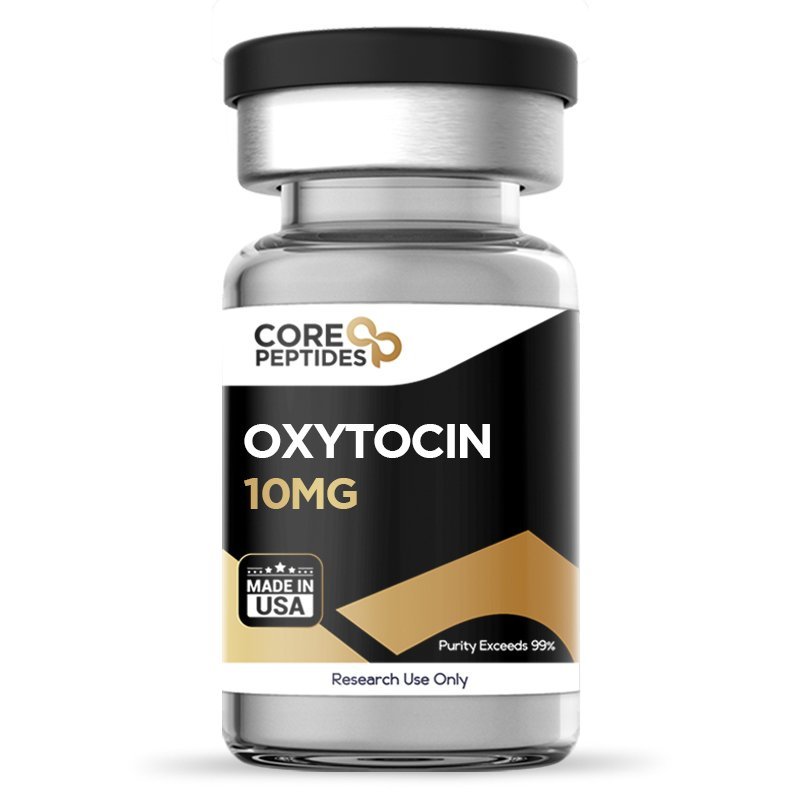

Oxytocin (10mg) – High-Purity Research Peptide in the United States
Oxytocin (10mg) is a well-studied peptide hormone widely researched for its biochemical and neurological properties. At Core Peptide, we supply Oxytocin (10mg) strictly for laboratory and scientific research purposes. Our products are trusted by researchers across the United States who require verified purity, consistency, and reliable domestic shipping.
Oxytocin is naturally occurring in biological systems and has long been of interest in peptide and neurotransmitter research. The synthetic recombinant form of Oxytocin (10mg) offered by Core Peptide is developed to be structurally analogous to the endogenous peptide while maintaining strict research-grade standards.
What Is Oxytocin (10mg)?
Oxytocin is a cyclic nonapeptide hormone composed of nine amino acids. Scientists consider Oxytocin to be produced in the hypothalamus and stored in the posterior pituitary gland, where it may be released in response to specific physiological stimuli. Beyond its hormonal role, Oxytocin is also recognized as a neurotransmitter with potential influence on neural signaling pathways.
The Oxytocin (10mg) peptide supplied by Core Peptide is synthetically manufactured for research environments and is not intended for medical, diagnostic, or human use.
Learn more about our quality standards here:
Peptide Quality Assurance – Core Peptide
Chemical Makeup of Oxytocin (10mg)
Researchers value Oxytocin (10mg) due to its well-defined molecular structure:
-
Molecular Formula: C₄₃H₆₆N₁₂O₁₂S₂
-
Molecular Weight: 1007.19 g/mol
-
Other Known Names: Endopituitrina
Detailed compound information is available through authoritative databases such as:
PubChem – Oxytocin Compound Summary
Oxytocin (10mg) and Neurochemical Research
Oxytocin Peptide and Dopamine Signaling
Scientific literature suggests Oxytocin may influence dopaminergic activity within central nervous system regions associated with reward and motivation, including the ventral tegmental area (VTA) and nucleus accumbens. Researchers hypothesize that Oxytocin receptors located within these regions may modulate dopamine release or neuronal sensitivity, potentially impacting reward-related signaling pathways.
These interactions may involve secondary messengers such as nitric oxide, highlighting the complexity of Oxytocin’s role in neurotransmitter regulation. For expanded academic discussion, see:
International Journal of Molecular Sciences – Oxytocin Research
Oxytocin (10mg) and Neuroplasticity
Oxytocin (10mg) is actively studied for its potential influence on neuroplasticity. By interacting with G-protein coupled receptors, Oxytocin may elevate intracellular calcium concentrations, a process linked to synaptic modulation and neuronal excitability.
Oxytocin receptors are distributed across multiple neural cell types, suggesting the peptide may influence synaptic remodeling, neurotransmitter balance (glutamate and GABA), and neural circuit development. These characteristics make Oxytocin (10mg) valuable in controlled neuroscience research settings.
Reference material is available via:
NCBI – Oxytocin Signaling Studies
Oxytocin Peptide and Reproductive Research
Oxytocin (10mg) and Labor-Related Studies
Oxytocin has been widely examined in reproductive research due to its association with uterine smooth muscle activity. Once bound to G-protein coupled receptors, Oxytocin may increase intracellular calcium levels, potentially contributing to muscle contraction mechanisms.
Clinical research models have examined outcomes associated with continuous versus discontinued Oxytocin exposure during active labor. These studies offer insights into how peptide signaling and feedback mechanisms may influence physiological responses.
Oxytocin (10mg) and Lactation Research
Oxytocin is also studied for its role in mammary gland myoepithelial cell contraction, which may facilitate milk ejection through alveolar ducts. Research suggests Oxytocin activity may operate through positive feedback loops, where initial stimulation leads to increased peptide release.
Such studies contribute to broader understanding of endocrine signaling and peptide-mediated physiological processes.
Oxytocin (10mg) and Cardiovascular Research
Research models have explored Oxytocin’s potential vasodilatory properties, particularly in small peripheral arteries. Some studies indicate Oxytocin may influence vascular tone and cardiac parameters such as ejection time, making it relevant in cardiovascular peptide research.
These investigations are conducted strictly in controlled research environments and contribute to expanding peptide science.
Oxytocin Peptide and Behavioral Research Models
Oxytocin has also been examined in behavioral and neurodevelopmental research, including studies related to autism spectrum disorder (ASD). Research findings suggest lower plasma Oxytocin levels in certain study groups compared to controls, prompting further investigation into peptide signaling pathways and behavioral modulation.
For peer-reviewed insights, consult:
StatPearls – Oxytocin Overview
Why Choose Core Peptide for Oxytocin (10mg)?
Core Peptide is a trusted supplier of Oxytocin (10mg) for research use in the United States.
Our Advantages:
-
High-purity, lab-tested peptides
-
Clear research-use-only labeling
-
Fast and secure US shipping
-
Transparent sourcing and documentation
Browse our peptide catalog:
Research Peptides – Core Peptide
Order Oxytocin (10mg) in the USA
If you are seeking Oxytocin (10mg) from a reliable United States-based peptide supplier, Core Peptide delivers quality, consistency, and trusted service.
Be the first to review “Oxytocin (10mg)”
Related products
Peptides for sale
Peptides for sale
Peptides for sale
Peptides for sale
Peptides for sale
Peptides for sale
Peptides for sale
Peptides for sale
Reviews
There are no reviews yet.