
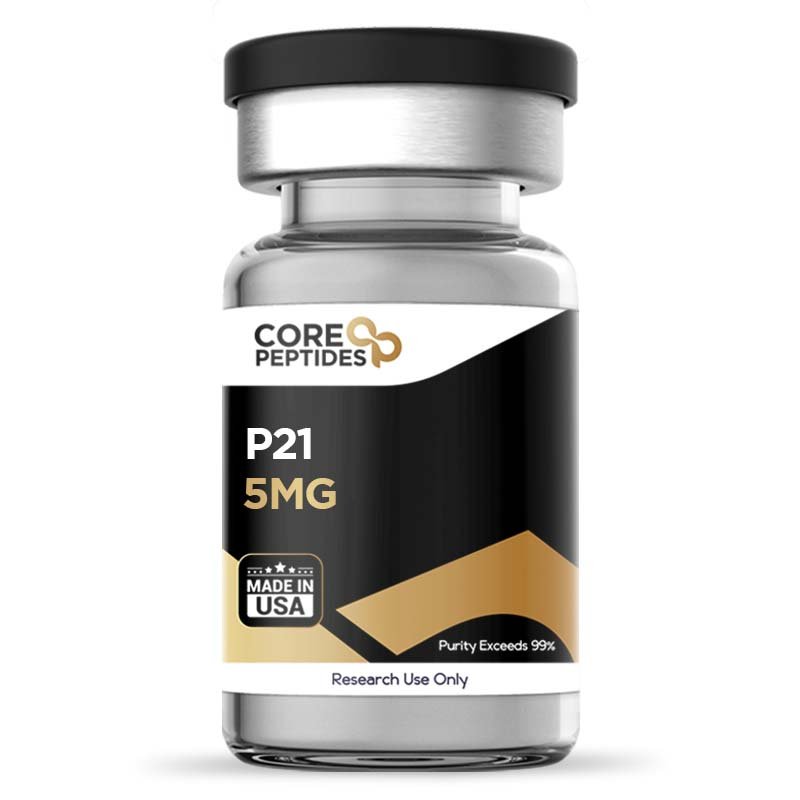
P21 (5mg) – Advanced Neurotrophic Research Peptide in the United States
P21 (5mg), also known as P021, is a synthetic neurotrophic research peptide designed to mimic key functional regions of ciliary neurotrophic factor (CNTF) without triggering immune or allergic responses. At Core Peptide, we provide P21 (5mg) exclusively for laboratory and scientific research purposes, supporting neuroscience studies across the United States.
CNTF is a naturally occurring protein associated with neuronal survival, differentiation, and neuroprotection. However, due to stability and immune-response limitations, researchers developed P21 as a smaller, more stable peptide that retains CNTF-like activity in experimental models.
What Is P21 (5mg)?
P21 (5mg) is a synthetic peptide derived from CNTF’s most active regions, identified through epitope mapping techniques. Researchers isolated key amino acid sequences responsible for CNTF’s neurotrophic activity, leading to the development of smaller peptides with enhanced stability and bioavailability.
To improve resistance to enzymatic degradation and potentially enhance central nervous system penetration, researchers incorporated adamantane moieties into the peptide structure. The resulting compound, P21, appears capable of activating CNTF receptor complexes and downstream signaling pathways in experimental models.
Core Peptide supplies P21 (5mg) in research-grade purity for controlled laboratory investigations only.
Learn more about our standards here:
Peptide Quality Assurance – Core Peptide
Chemical Makeup of P21 (5mg)
The well-defined molecular structure of P21 (5mg) contributes to its popularity in neuroscience research:
-
Molecular Formula: C₃₀H₅₄N₆O₅
-
Molecular Weight: 578.3 g/mol
-
Sequence: Ac-DGGL-adamantanylglycine-NH₂
-
Other Names: P021
For additional compound data, consult:
PubChem – Peptide Compounds Overview
P21 (5mg) and Cognitive Research Models
P21 Peptide and Cognitive Impairment
P21 (5mg) has been widely studied in experimental models of cognitive impairment and synaptic dysfunction. In transgenic murine models associated with Alzheimer-like pathology, exposure to P21 prior to the onset of amyloid-β or tau accumulation appeared to support synaptic compensation mechanisms.
Research suggests that P21 may help rescue dendritic and synaptic deficits while promoting neurogenesis in hippocampal regions. These effects are thought to be mediated through increased expression of synaptic markers such as synapsin, PSD-95, and MAP2, proteins considered essential for synaptic communication, dendritic stability, and neuronal connectivity.
P21 (5mg) and Neurogenesis
Neurogenesis—the formation of new neurons—plays a vital role in learning and memory. Studies indicate that P21 may increase the proliferation and differentiation of adult hippocampal progenitor cells in experimental models.
One proposed mechanism involves the peptide’s influence on brain-derived neurotrophic factor (BDNF). BDNF is a key protein involved in neuronal survival, synaptic plasticity, and dendritic growth. By increasing BDNF expression, P21 may help maintain neural circuit integrity in aging and neurodegenerative research models.
More background reading:
NCBI – Neurotrophic Factor Research
P21 (5mg) and Alzheimer’s Disease (AD) Research
P21 Peptide and Tau Pathology
Multiple studies have investigated the effects of P21 in Alzheimer’s disease research models. Chronic exposure to P21 in aged murine models appeared to reduce total tau levels in brain tissue and cerebrospinal fluid.
Researchers hypothesize that P21 may indirectly influence tau phosphorylation by modulating downstream signaling molecules such as glycogen synthase kinase-3 (GSK-3). GSK-3 is involved in tau phosphorylation, a process associated with neurofibrillary tangle formation in AD models.
P21 (5mg) and Amyloid-β Research
Additional experiments suggest that early exposure to P21 may reduce amyloid-β plaque accumulation and improve cognitive performance in transgenic murine models. Improvements in synaptic proteins, CREB activity, and reduced neuroinflammation markers have been reported, indicating a broad neurotrophic profile in experimental conditions.
For peer-reviewed literature, see:
FEBS Letters – Neurotrophic Peptide Research
P21 (5mg) and Retinal Degeneration Research
P21 (5mg) has also been studied in experimental models of age-related macular degeneration (AMD). AMD is considered a neurodegenerative condition affecting retinal neurons and supporting cells.
Studies in aged and transgenic murine models suggest that chronic exposure to P21 may reduce photoreceptor degeneration, retinal inflammation, and pathological changes in retinal pigment epithelium (RPE). These findings support the hypothesis that retinal and cerebral neurodegenerative processes may share common molecular pathways.
Why Choose Core Peptide for P21 (5mg)?
Core Peptide is a trusted supplier of P21 (5mg) for research use across the United States.
Our Commitment:
-
High-purity, lab-verified peptides
-
Clear research-use-only labeling
-
Fast domestic US shipping
-
Transparent sourcing and documentation
Explore our peptide catalog:
Research Peptides – Core Peptide
Research Use Disclaimer
P21 (5mg) sold by Core Peptide is intended strictly for laboratory and scientific research purposes only. It is not approved for human or veterinary use and is not marketed as a drug or dietary supplement.
Please review our policies before ordering:
Terms & Conditions – Core Peptide
Order P21 (5mg) in the United States
If you are seeking a reliable United States-based supplier of P21 (5mg), Core Peptide delivers consistency, purity, and trusted service for research professionals.
Be the first to review “P21 (5mg)”
Related products
Peptides for sale

Peptides for sale
Peptides for sale
Peptides for sale
Peptides for sale
Peptides for sale

Peptides for sale
Peptides for sale
Reviews
There are no reviews yet.