
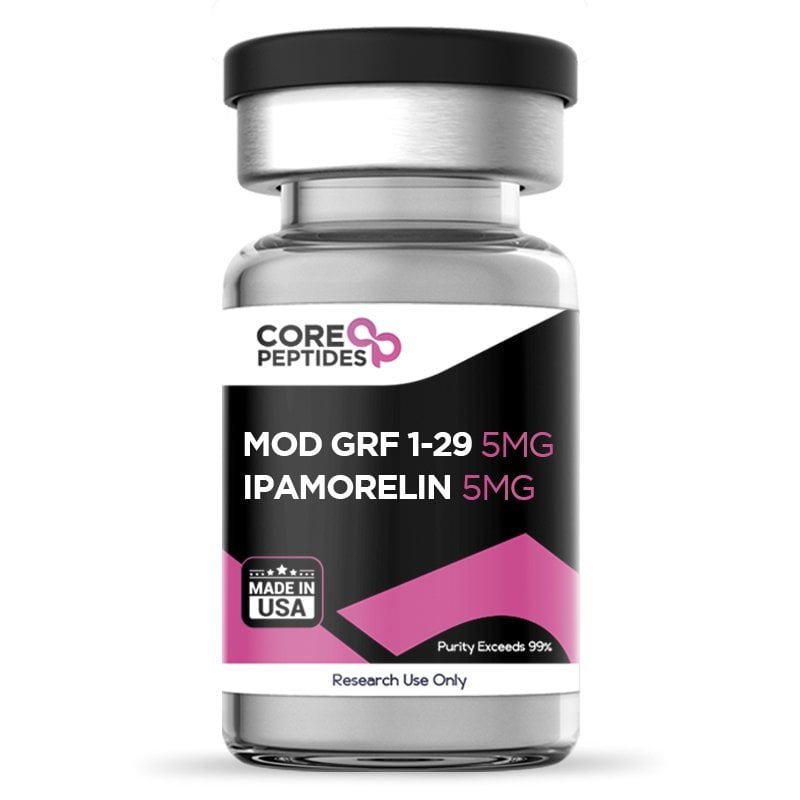
Mod GRF 1-29 & Ipamorelin Blend (10mg)
The Mod GRF 1-29 & Ipamorelin Blend (10mg) is a widely studied peptide combination in scientific and laboratory research focused on growth hormone secretagogues (GHS). This peptide blend combines Modified GRF 1-29 (CJC-1295 without DAC) with Ipamorelin, two compounds known for their selective interaction with growth hormone–related pathways. At Core Peptide, we supply high-purity research peptides to qualified researchers across the United States, ensuring reliability, transparency, and quality.
Learn more about our full peptide catalog on the
Core Peptide Research Products Page
Understanding Ipamorelin Peptide Research
Ipamorelin is a synthetic pentapeptide that has been studied for its potential role as a growth hormone secretagogue. Structurally and functionally, it is believed to mimic aspects of the endogenous hormone ghrelin, often referred to as the “hunger hormone.”
Research suggests that Ipamorelin selectively binds to Growth Hormone Secretagogue Receptors (GHS-R1a) located in the anterior pituitary gland. This receptor specificity makes Ipamorelin distinct from earlier GHRPs, as studies indicate it does not significantly stimulate the secretion of other pituitary hormones such as:
-
Prolactin
-
Luteinizing Hormone (LH)
-
Follicle-Stimulating Hormone (FSH)
-
Thyroid-Stimulating Hormone (TSH)
-
Adrenocorticotropic Hormone (ACTH)
This selective profile has made Ipamorelin a frequent subject of investigation in controlled laboratory environments. Ipamorelin – PubChem Compound Summary
Modified GRF 1-29 (CJC-1295 Without DAC)
Modified GRF 1-29, also known as CJC-1295 without DAC, is a synthetic analog of natural Growth Hormone Releasing Hormone (GHRH). It consists of the first 29 amino acids of endogenous GHRH, with four amino acid substitutions designed to improve stability and resistance to enzymatic degradation.
In research models, Mod GRF 1-29 has been shown to interact with GHRH receptors on somatotroph cells of the anterior pituitary gland. This interaction may facilitate intracellular signaling cascades that promote growth hormone release, primarily via:
-
Activation of the adenylyl cyclase pathway
-
Increased cAMP (cyclic adenosine monophosphate)
-
Stimulation of protein kinase A (PKA)
-
Enhanced calcium ion influx
These signaling events are widely regarded as critical steps in growth hormone secretion.
CJC-1295 Without DAC – PubChem
Synergistic Research Potential of the Peptide Blend
When studied together, Mod GRF 1-29 & Ipamorelin Blend (10mg) appears to demonstrate synergistic activity. Mod GRF 1-29 is theorized to enhance the natural pulsatile release of growth hormone, while Ipamorelin may amplify this effect through GHS-R1a receptor activation.
A 1998 study examining growth hormone secretagogues in rat pituitary cells and animal models suggested that these peptides act as agonists of GHRP-like receptors, promoting elevated growth hormone secretion without significantly impacting cortisol or ACTH levels. Subsequent human research further indicated dose-dependent increases in circulating growth hormone concentrations.
Chemical Makeup
Molecular Formula
-
Modified GRF 1-29: C₁₅₂H₂₅₂N₄₄O₄₂
-
Ipamorelin: C₃₈H₄₉N₉O₅
Molecular Weight
-
Modified GRF 1-29: 3367.95 g/mol
-
Ipamorelin: 711.86 g/mol
Other Known Names
-
Mod GRF 1-29: CJC-1295 without DAC
-
Ipamorelin: Ipamorelin Acetate, Aib-His-D-2-Nal-D-Phe-Lys-NH₂
Research Areas of Interest
Pituitary Signaling Pathways
Ipamorelin is thought to activate G-protein–coupled signaling via the Gαq/11 pathway, stimulating phospholipase C (PLC). This may result in the generation of IP₃ and DAG, leading to intracellular calcium release and downstream signaling events associated with growth hormone secretion.
Gastrointestinal and Appetite Studies
Animal studies have examined Ipamorelin’s interaction with ghrelin receptors related to gastric motility and appetite regulation. Findings suggest potential effects on gastric emptying and feeding behavior, making it an area of continued scientific interest.
Bone Density Research
Murine model studies have evaluated Ipamorelin’s possible influence on bone mineral content using DEXA and pQCT imaging. Observations included potential changes in cortical bone area and mineral density, although findings remain preliminary and research-focused.
Why Choose Core Peptide?
At Core Peptide, we are committed to supporting legitimate research by providing:
USA-based distribution
High-purity, lab-verified peptides
Secure and discreet shipping
Transparent documentation and Terms & Conditions
Explore related offerings on our
Research Peptides Collection
Be the first to review “Mod GRF 1-29 & Ipamorelin Blend (10mg)”
Related products
Peptides for sale
Peptides for sale
Peptides for sale
Peptides for sale
Peptides for sale
Peptides for sale
Peptides for sale
Peptides for sale
Reviews
There are no reviews yet.