
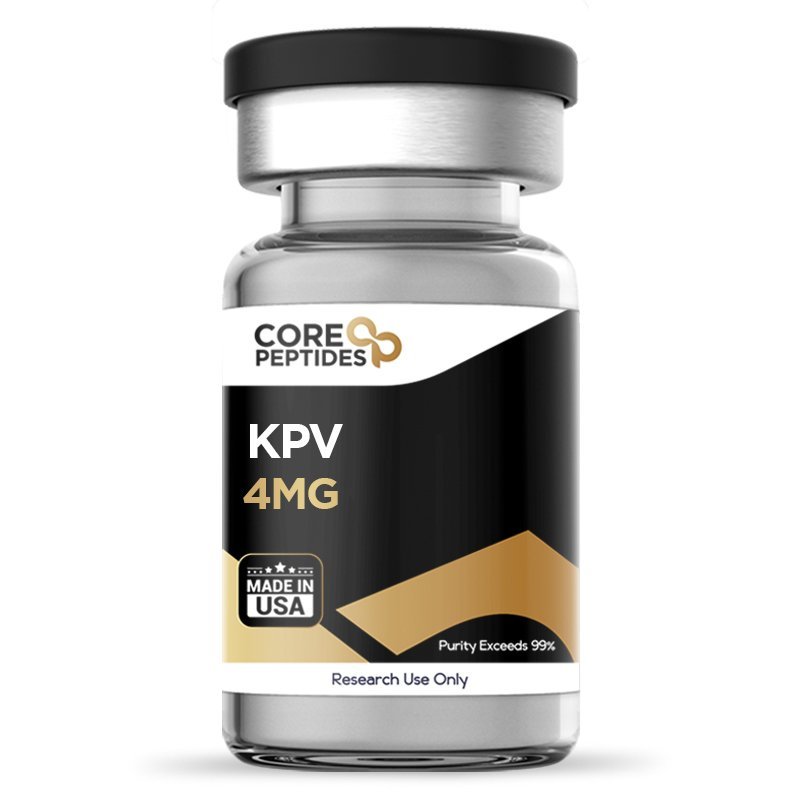
KPV (4mg) Peptide – Advanced Research Peptide from Core Peptide
KPV (4mg) is a short-chain tripeptide derived from the alpha-melanocyte-stimulating hormone (α-MSH), a naturally occurring peptide hormone involved in multiple biological signaling pathways. Due to its compact structure and promising biological interactions observed in preclinical studies, KPV (4mg) has become a peptide of interest in laboratory and academic research across the United States.
At Core Peptide, we supply high-purity research peptides designed exclusively for laboratory and scientific investigation. Our KPV (4mg) offering is intended for controlled research environments and complies with industry standards for peptide synthesis and quality.
What Is KPV Peptide?
KPV is a tripeptide composed of three amino acids:
-
Lysine (K)
-
Proline (P)
-
Valine (V)
This sequence represents the C-terminal fragment (amino acids 11–13) of the α-MSH hormone. Scientific literature suggests that this fragment contains the core signaling sequence responsible for many of α-MSH’s observed biological properties.
Unlike full-length α-MSH, KPV (4mg) is structurally simple, which makes it easier to study in isolated research models. Early studies identified KPV as a potentially active messenger peptide involved in inflammatory signaling modulation.
Chemical Profile of KPV (4mg)
-
Molecular Formula: C₁₆H₃₀N₄O₄
-
Molecular Weight: 342.43 g/mol
-
Other Names:
-
MSH (11–13)
-
ACTH (11–13)
-
α-MSH (11–13)
-
The small molecular size of KPV (4mg) may contribute to its stability and transport properties in experimental models, making it particularly interesting for cellular and intestinal research.
Scientific Research on KPV Peptide
KPV (4mg) and Intestinal Inflammation Research
Multiple murine and cellular studies have examined KPV (4mg) in the context of intestinal inflammation. In one well-known study published in Gastroenterology, researchers investigated the role of KPV uptake via the PepT1 transporter in inflamed intestinal cells. Results indicated a measurable reduction in inflammatory markers when KPV was introduced, even at nanomolar concentrations.
🔗 External reference: https://pubmed.ncbi.nlm.nih.gov/18061135/
Further murine studies explored KPV combined with hyaluronic acid to improve localized peptide delivery in chemically induced intestinal inflammation. These models demonstrated reduced inflammatory infiltrates and improved tissue response compared to placebo groups.
Cellular Mechanisms and Cytokine Modulation
Research suggests that KPV (4mg) may influence inflammatory pathways by downregulating pro-inflammatory cytokines such as TNF-α. In vitro models of inflamed intestinal epithelial cells showed that exposure to KPV resulted in a measurable decrease in cytokine release, supporting its role as a signaling modulator rather than a systemic agent.
Notably, some studies indicate that KPV activity may occur independently of the melanocortin-1 receptor (MC1R), suggesting alternative intracellular signaling pathways are involved.
KPV (4mg) in Wound and Tissue Research
Beyond intestinal models, KPV (4mg) has been studied in wound-healing and tissue-repair research. Because many epithelial and skin cells express MC1R receptors, α-MSH analog fragments like KPV have drawn attention for their potential role in cellular migration and repair signaling.
In corneal epithelial models, KPV exposure appeared to accelerate re-epithelialization following mechanical abrasion. Interestingly, the observed effects were reduced when nitric oxide synthase inhibitors were introduced, indicating a possible link between KPV activity and nitric oxide (NO) signaling pathways.
🔗 External reference: https://pubmed.ncbi.nlm.nih.gov/2550304/
Scar Formation and Recovery Models
Murine studies evaluating surgical incision recovery showed that animals exposed to KPV (4mg) exhibited reduced inflammatory cell accumulation during early healing phases. Long-term observations suggested a smaller scar area compared to control groups, potentially due to moderated inflammatory responses during tissue remodeling.
These findings continue to support the peptide’s relevance in experimental tissue recovery models, although further research is required to clarify mechanisms and applications.
Why Researchers in the USA Choose Core Peptide
Researchers across the United States choose Core Peptide for consistent quality, transparent labeling, and research-focused service.
Why order KPV (4mg) from Core Peptide?
-
High-purity peptide synthesis
-
Clear labeling for research use
-
USA-focused distribution
-
Batch-tested quality standards
Explore our broader peptide catalog here:
https://corepeptide.us/collections/peptides
Learn more about our quality standards:
https://corepeptide.us/pages/quality-assurance
References
-
Hiltz, M. E., & Lipton, J. M. (1989). Antiinflammatory activity of a COOH-terminal fragment of alpha-MSH. FASEB Journal.
🔗 https://pubmed.ncbi.nlm.nih.gov/2550304/ -
Dalmasso, G. et al. (2008). PepT1-mediated tripeptide KPV uptake reduces intestinal inflammation. Gastroenterology.
🔗 https://pubmed.ncbi.nlm.nih.gov/18061135/
Be the first to review “KPV (4mg)”
Related products
Peptides for sale
Peptides for sale
Peptides for sale
Peptides for sale
Peptides for sale
Peptides for sale
Peptides for sale
Peptides for sale
Reviews
There are no reviews yet.