
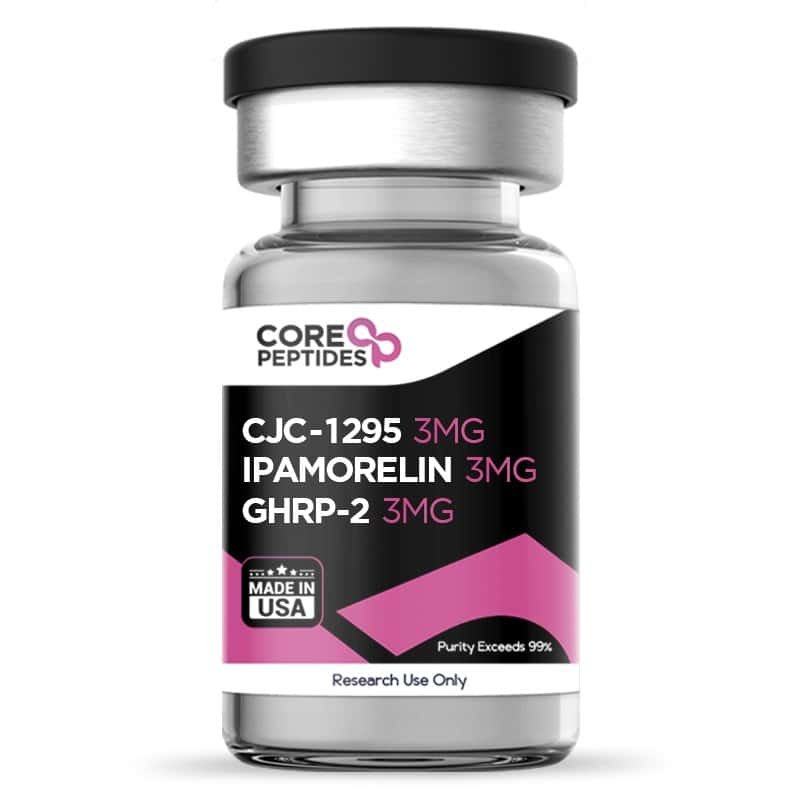
CJC-1295 (Mod GRF 1-29) & Ipamorelin & GHRP-2 Blend (9mg)
CJC-1295 Mod GRF 1-29 blend
At Core Peptide, we specialize in supplying high-quality research peptides in the United States, supporting laboratory, academic, and analytical research environments. The CJC-1295 (Mod GRF 1-29) & Ipamorelin & GHRP-2 peptide Blend (9mg) is a carefully prepared research peptide blend designed exclusively for scientific investigation and in vitro or preclinical research applications.
CJC-1295 Mod GRF 1-29 blend combines three well-documented synthetic peptides that are frequently explored by research teams studying growth hormone–related signaling pathways, receptor interactions, and endocrine system mechanisms. When examined together, researchers have suggested these peptides may demonstrate synergistic activity in controlled research settings.
⚠️ Important Notice:
This product GHRP-2 peptide is for research and laboratory use only. It is not intended for human or veterinary use, diagnosis, treatment, or consumption. Please review our Terms and Conditions before purchasing.
Overview of the Peptide Blend
The CJC-1295 Mod GRF 1-29 blend is studied due to the complementary pathways each peptide appears to engage in growth hormone research models.
CJC-1295 (Mod GRF 1-29) blend
CJC-1295 (Mod GRF 1-29) is a synthetic analog of Growth Hormone–Releasing Hormone (GHRH). Researchers identify GHRH (1-29) as the shortest functional sequence of native GHRH capable of receptor binding.
The modified version used in research includes:
-
Tetrasubstitution for improved stability
-
A Drug Affinity Complex (DAC) component that may allow interaction with plasma proteins
These structural features are frequently studied for their potential influence on peptide longevity and receptor affinity in experimental models.
Learn more about related research compounds in our Research Peptides Collection.
Ipamorelin
Ipamorelin is a synthetic pentapeptide often studied for its interaction with ghrelin (GHS-R1a) receptors located primarily in the pituitary gland. In laboratory settings, Ipamorelin is categorized as a Growth Hormone Secretagogue (GHS) due to its reported receptor selectivity.
Researchers frequently investigate Ipamorelin for:
-
Its signaling behavior compared to endogenous ghrelin
-
Its potential role in endocrine feedback loops
-
Its interaction with other growth hormone–related peptides
GHRP-2 (Growth Hormone Releasing Peptide-2)
GHRP-2, also known as Pralmorelin, is a hexapeptide composed of six amino acids. Like Ipamorelin, it is studied for its activity at GHS-R1a receptors, making it a subject of interest in ghrelin receptor research.
Because both Ipamorelin and GHRP-2 engage similar receptor pathways, research teams often explore their combined effects when used alongside GHRH analogs such as CJC-1295 (Mod GRF 1-29).
Why Researchers Study This Peptide Blend
The CJC-1295 Mod GRF 1-29 blend is commonly explored in research environments due to its multi-pathway approach to growth hormone signaling.
Growth Hormone Pathway Research
Clinical and preclinical studies suggest that peptides stimulating growth hormone release may operate via:
-
Direct pituitary stimulation
-
Hypothalamic signaling modulation
While the precise mechanisms remain under investigation, research has shown notable endocrine responses in controlled study models. These findings have made this peptide blend a valuable tool for exploring hormone regulation systems.
Food Intake and Ghrelin Signaling Studies
GHRP-2 and Ipamorelin are both associated in research literature with ghrelin receptor activation, which has led scientists to investigate their role in:
-
Appetite regulation models
-
Energy balance research
-
Hormonal signaling related to food intake
These studies are ongoing and are used strictly for scientific understanding—not clinical conclusions.
Bone Density and Structural Research
Some experimental models suggest that growth hormone signaling peptides may influence bone mineral content (BMC) and bone mineral density (BMD). Ipamorelin, in particular, has been examined in murine studies using DXA and pQCT imaging techniques to analyze skeletal changes.
Researchers hypothesize that observed changes may relate to bone size and structure rather than alterations in volumetric density, making this area an active topic of investigation.
Muscle and Lean Mass Research
The synergy of CJC-1295 Mod GRF 1-29 blend & has also been examined in lean mass and muscle signaling studies. Research involving GHRH-deficient models has suggested that GHRH analogs may influence:
-
Lean mass preservation
-
Pituitary gene expression
-
Growth hormone mRNA activity
These findings have encouraged continued laboratory exploration into peptide-driven anabolic signaling pathways.
Chemical Composition
Molecular Formula
-
CJC-1295 (Mod GRF 1-29): C₁₅₂H₂₅₂N₄₄O₄₂
-
Ipamorelin: C₃₈H₄₉N₉O₅
-
GHRP-2: C₄₅H₅₅N₉O₆
Molecular Weight
-
CJC-1295 (Mod GRF 1-29): 3367.9 g/mol
-
Ipamorelin: 711.9 g/mol
-
GHRP-2: 817.9 g/mol
Quality Standards at Core Peptide
At CorePeptide.us, we prioritize:
-
Research-grade purity
-
Proper labeling and documentation
-
Secure packaging for laboratory handling
-
Transparent sourcing and testing standards
Visit our About Us page to learn more about our quality commitment, or contact our team via the Contact Page.
External Research References
For additional scientific context, researchers may consult:
-
NCBI – CJC-1295 (Mod GRF 1-29)
https://pubchem.ncbi.nlm.nih.gov/compound/CJC1295-Without-DAC -
NCBI – Ipamorelin
https://pubchem.ncbi.nlm.nih.gov/compound/Ipamorelin -
NCBI – Pralmorelin (GHRP-2)
https://pubchem.ncbi.nlm.nih.gov/compound/Pralmorelin -
The Journal of Clinical Endocrinology & Metabolism
Rogério G. Gondo et al., 2001 -
Mericq et al., J Clin Endocrinol Metab, 1998
Be the first to review “CJC-1295 (Mod GRF 1-29) & Ipamorelin & GHRP-2 Blend (9mg)”
Related products

Peptides for sale
Peptides for sale
Peptides for sale
Peptides for sale
Peptides for sale
Peptides for sale
Peptides for sale
Reviews
There are no reviews yet.