
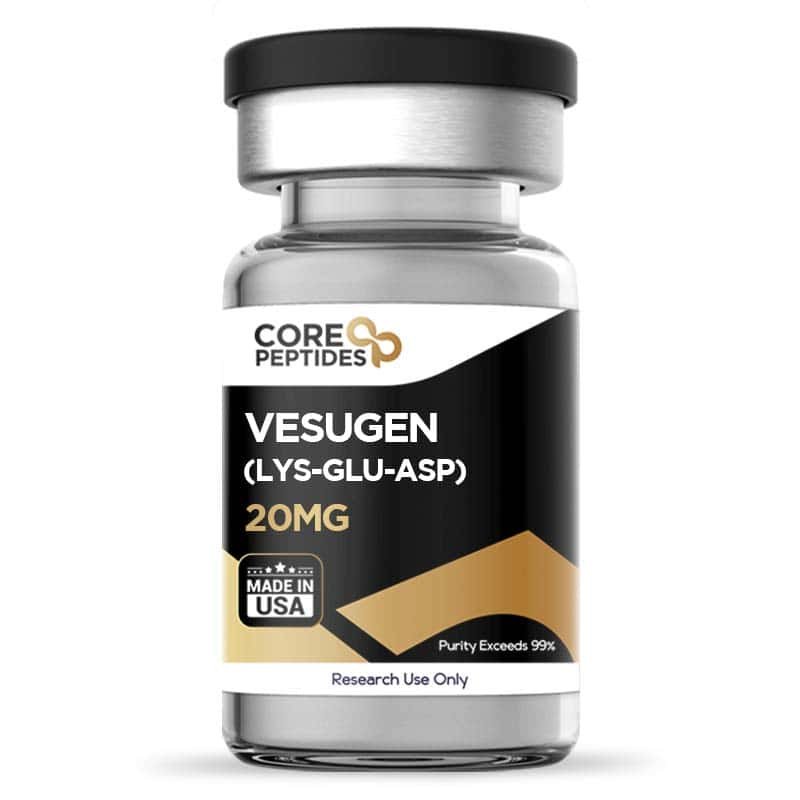
Vesugen (20mg) Peptide – KED Bioregulator for Advanced Research
Vesugen (20mg) Peptide
Vesugen (20mg) is a synthetic bioregulator peptide composed of the amino acid sequence Lys-Glu-Asp (KED). Identified within the class of Khavinson peptides, Vesugen is primarily studied for its potential influence on vascular endothelial cells, while also drawing growing interest in neuroprotection, aging, and gene expression research.
At Core Peptide USA, Vesugen is supplied exclusively for laboratory and research purposes, meeting high purity standards and supporting advanced experimental investigations across vascular biology, neuroscience, and gerontology. The peptide’s relatively short tripeptide structure is believed to contribute to its tissue specificity, a defining characteristic of bioregulator peptides.
View product page:
Vesugen (20mg) – Core Peptide USA
https://corepeptide.us/products/vesugen-20mg
What Is Vesugen Peptide?
Vesugen, also referred to as KED peptide or lysyl glutamyl aspartic acid, is derived from amino acid sequences associated with vascular wall proteins. Unlike traditional growth factors or hormones, Vesugen belongs to a class of peptides proposed to act at the epigenetic and transcriptional level, potentially influencing how genes are expressed in specific tissues.
The peptide has been primarily explored in research models focusing on:
-
Vascular endothelial integrity
-
Age-related vascular decline
-
Neurodegeneration and neuroplasticity
-
Cellular aging and differentiation
This broad research scope makes Vesugen (20mg) a versatile compound in controlled laboratory environments.
Chemical Makeup of Vesugen (KED)
-
Molecular Formula: C₁₅H₂₆N₄O₈
-
Molecular Weight: 390.39 g/mol
-
Amino Acid Sequence: Lys-Glu-Asp (KED)
-
Peptide Class: Synthetic bioregulator (Khavinson peptide)
-
Other Names:
-
KED peptide
-
Lysyl glutamyl aspartic acid
-
SCHEMBL3767701
-
The tripeptide structure is believed to enhance Vesugen’s specificity toward vascular endothelial and neural tissues, which has fueled its study in multiple biological research domains.
Vesugen and Vasoprotective Research
One of the most extensively discussed areas of Vesugen research is its vasoprotective potential, particularly in the context of aging and vascular dysfunction. Endothelial cells, which line the interior of blood vessels, play a critical role in vascular tone, permeability, and overall cardiovascular health.
Endothelial Cell Proliferation and Ki-67
Early-stage studies suggest that Vesugen may influence endothelial cell renewal by modulating Ki-67, a protein closely associated with cell proliferation. Ki-67 expression typically declines with age, contributing to reduced regenerative capacity in vascular tissues.
Vesugen is hypothesized to interact with promoter regions of the Ki-67 gene, potentially increasing its expression and supporting endothelial cell proliferation. This mechanism may be particularly relevant in research models of atherosclerosis and restenosis, where endothelial dysfunction is a central feature.
External reference:
National Center for Biotechnology Information (NCBI) – Endothelial Cell Biology
https://www.ncbi.nlm.nih.gov
Epigenetic Regulation and Vascular Function
Beyond cellular proliferation, Vesugen may exert its effects through epigenetic regulation, interacting with DNA in the minor groove and forming hydrogen bonds with specific base pairs. This interaction could influence gene expression without altering the underlying DNA sequence.
In vitro studies have suggested that Vesugen may help normalize the expression of endothelin-1, a potent vasoconstrictor that is often elevated in atherosclerotic conditions. Additionally, Vesugen appears to influence connexin expression, proteins essential for intercellular communication within endothelial layers.
Another area of interest is Vesugen’s potential to increase sirtuin-1 (SIRT1) expression. SIRT1 is involved in DNA repair and cellular longevity, suggesting a possible role for Vesugen in maintaining vascular genomic stability during aging.
Vesugen and Neuroprotective Research
Vesugen has also been studied in experimental models of neurodegeneration, particularly in murine models simulating Alzheimer’s-like pathology. These investigations focus on neuroplasticity, neuron morphology, and synaptic integrity.
Neuroplasticity and Dendritic Spine Density
Research examining long-term potentiation (LTP) in the hippocampus suggests that Vesugen may help counteract neuroplasticity impairments observed in neurodegeneration models. While some findings did not reach statistical significance, trends toward restored synaptic function were noted.
More pronounced effects were observed in dendritic spine morphology, particularly in the CA1 region of the hippocampus. Vesugen exposure appeared to prevent the elimination of postsynaptic structures and restore mushroom and thin spines, which are critical for memory formation and synaptic strength.
Interestingly, sex-specific responses were reported, with male models showing more significant restoration of spine density. These findings suggest that Vesugen’s neuroprotective actions may be influenced by biological variables that warrant further investigation.
Vesugen and Gene Expression in Neurodegeneration
Additional research has explored Vesugen’s influence on genes associated with aging, apoptosis, and neurogenesis. These include:
-
p16 and p21, regulators of cellular senescence
-
NES (Nestin), associated with neural progenitor cells
-
GAP43, a protein involved in axonal growth and neural regeneration
Vesugen has also been shown to interact with genes implicated in neurodegenerative disease pathways, including SUMO, APOE, and IGF-1, all of which play roles in protein stability, lipid metabolism, and neuronal survival.
Vesugen and Geroprotective Research
Vesugen’s potential geroprotective properties have been examined in studies involving aged cell cultures, particularly prostatic fibroblasts. In late-passage cultures exhibiting signs of cellular aging, Vesugen appeared to stimulate the expression of differentiation factors such as CXCL12 and WEGC1.
CXCL12 is a chemokine involved in immune signaling, angiogenesis, and cell migration, while WEGC1 remains less characterized but is believed to play a role in cellular differentiation. Notably, Vesugen’s effects were more pronounced in aged cultures, suggesting a potential age-dependent response.
Clinical-oriented research has also explored Vesugen’s influence on biological age markers, reporting anabolic effects and improved central nervous system activity. These findings further support ongoing interest in Vesugen as a research peptide in aging biology.
Vesugen (20mg) from Core Peptide USA
When purchasing Vesugen from Core Peptide USA, researchers receive:
-
Research-grade peptide purity
-
Verified quality control standards
-
Secure packaging for laboratory stability
-
Reliable shipping within the United States
Browse related bioregulator peptides:
https://corepeptide.us/collections/bioregulator-peptides
References
-
Khavinson, V. Kh., et al. (2014). Advances in Gerontology, 27(1), 108–114.
-
Kozlov, K. L., et al. (2016). Advances in Gerontology, 29(4), 646–650. PMID: 28539025.
-
Khavinson, V., et al. (2021). Pharmaceuticals (Basel), 14(6), 515. PMID: 34071923.
Be the first to review “Vesugen (20mg)”
Related products
Peptides for sale
Peptides for sale
Peptides for sale

Peptides for sale
Peptides for sale

Peptides for sale
Peptides for sale
Peptides for sale
Reviews
There are no reviews yet.