
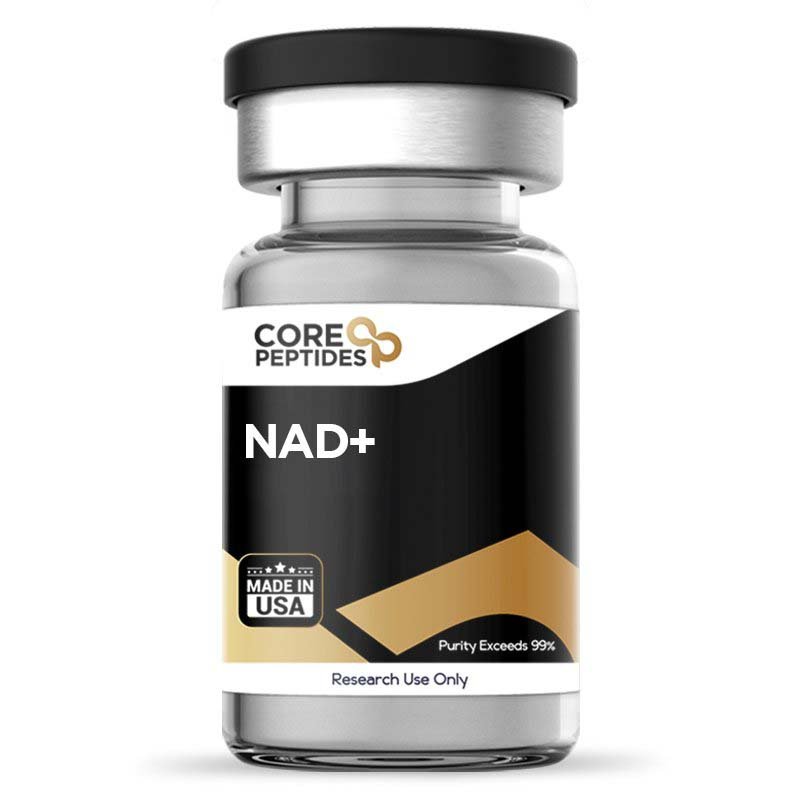
NAD+ (100mg / 750mg) – Research Overview
NAD+ (100mg / 750mg), short for Nicotinamide Adenine Dinucleotide, is an endogenous nucleotide widely studied for its central role in cellular metabolism, energy production, DNA repair, and intracellular signaling. At Core Peptide, we provide NAD+ (100mg / 750mg) exclusively for research and laboratory use within the United States.
NAD+ is present in all living cells and is considered essential for maintaining cellular homeostasis. Researchers suggest that declining NAD+ levels may influence aging-related cellular processes, metabolic efficiency, and stress responses. As a result, NAD+ research compounds continue to receive attention across molecular biology, neuroscience, metabolism, and longevity research.
Learn more about our research-grade standards:
https://corepeptide.us/pages/quality-assurance (inbound link)
What Is NAD+?
Nicotinamide Adenine Dinucleotide (NAD+) is a dinucleotide composed of two nucleotides joined through their phosphate groups. One nucleotide contains an adenine base, while the other contains nicotinamide. NAD+ exists in two forms:
-
NAD+ (oxidized form)
-
NADH (reduced, energy-carrying form)
Researchers describe NAD+ as a central coenzyme in redox reactions, enabling the transfer of electrons during metabolic processes. Once NAD+ accepts electrons, it becomes NADH, which then delivers energy to the electron transport chain for ATP production.
NAD+ Biosynthesis and Cellular Role
Research suggests that NAD+ can be synthesized through multiple pathways, including:
-
De novo synthesis from tryptophan
-
Salvage pathways involving nicotinamide
-
Preiss–Handler pathway using nicotinic acid
-
Nicotinamide riboside (NR) and nicotinamide mononucleotide (NMN) pathways
Once synthesized, NAD+ is believed to participate in over 500 enzymatic reactions, making it one of the most critical cofactors in cellular biology. https://www.ncbi.nlm.nih.gov/pmc/articles/PMC5795269/
NAD+-Dependent Enzymes
Researchers have identified three major enzyme classes that rely on NAD+ availability:
1. Sirtuins (SIRTs)
Sirtuins are NAD+-dependent deacetylases implicated in:
-
Mitochondrial homeostasis
-
Cellular stress resistance
-
Stem cell maintenance
-
Neuroprotection
2. Poly(ADP-ribose) Polymerases (PARPs)
PARPs are involved in:
-
DNA damage detection
-
Genome stability
-
DNA base excision repair
PARP activation consumes NAD+, linking DNA repair capacity directly to NAD+ availability.
3. Cyclic ADP-Ribose Synthetases (CD38/CD157)
These enzymes regulate calcium signaling and immune cell activity. They also hydrolyze NAD+, influencing intracellular NAD+ levels.
Researchers suggest that these enzyme classes may compete for available NAD+, making NAD+ balance a critical factor in cellular function.
https://www.ncbi.nlm.nih.gov/pmc/articles/PMC5088772/
NAD+ (100mg / 750mg) and Productive Aging Research
NAD+ intermediates such as NMN and NR have been studied extensively in aging models. In long-term murine studies, NMN supplementation was associated with:
-
Increased NAD+ synthesis
-
Improved energy metabolism
-
Reduced age-associated weight gain
-
Enhanced physical activity and lipid profiles
These findings have positioned NAD+ (100mg / 750mg) as a key compound for investigating cellular aging and metabolic resilience.
https://www.ncbi.nlm.nih.gov/pmc/articles/PMC7494058/
NAD+ and Neurodegenerative Research
Mitochondrial dysfunction is considered a contributing factor in neurodegenerative conditions. Research models suggest that restoring NAD+ levels may:
-
Improve mitochondrial respiration
-
Enhance ATP production
-
Support neuronal survival
In studies involving aged murine models, NMN administration appeared to rapidly increase NAD+ levels in neural tissue, suggesting efficient intracellular utilization.
https://pubmed.ncbi.nlm.nih.gov/31917996/
DNA Repair and Ischemic Stress Studies
NAD+ has been studied extensively for its role in DNA repair mechanisms, particularly following ischemic or oxidative stress. PARP enzymes use NAD+ to initiate PARylation, a process that recruits DNA repair proteins to damaged sites.
Research indicates that replenishing NAD+ in neuronal cultures exposed to oxygen-glucose deprivation may:
-
Improve DNA base excision repair
-
Enhance cell viability
-
Reduce oxidative DNA damage
However, excessive PARP activation may also deplete NAD+ levels, linking DNA repair efficiency to cellular energy balance.
NAD+ and Metabolic Organ Research
Liver and Kidney
Studies suggest that restoring NAD+ levels in aged models may:
-
Improve glucose homeostasis
-
Reduce obesity-associated metabolic stress
-
Enhance kidney cell resilience
NMN-related studies also indicate protective effects against chemically induced kidney injury.
Skeletal and Muscular Function
NAD+ plays a direct role in cellular respiration, including glycolysis and the citric acid cycle. Research models suggest increased NAD+ availability may:
-
Enhance ATP production
-
Reduce inflammation
-
Improve mitochondrial efficiency
Cardiovascular Research Applications
NAD+ deficiency has been linked to reduced sirtuin activity and impaired cardiac energy metabolism. In ischemia-reperfusion research models, NMN exposure prior to ischemic events appeared to provide cardioprotective signaling effects. https://www.ncbi.nlm.nih.gov/pmc/articles/PMC5088772/
NAD+ (100mg / 750mg) for Research in the USA
At Core Peptide, NAD+ (100mg / 750mg) is supplied to qualified laboratories across the United States. All products are:
-
Manufactured to research-grade purity
-
Independently quality tested
-
Intended strictly for laboratory research
Explore related research compounds:
https://corepeptide.us/collections/research-peptides (inbound link)
Conclusion
NAD+ (100mg / 750mg) remains one of the most extensively studied molecules in cellular biology due to its central role in metabolism, DNA repair, and energy production. Its relevance across aging, neurological, metabolic, and cardiovascular research continues to expand. For U.S.-based laboratories seeking consistent quality and reliable sourcing, Core Peptide provides trusted research-only NAD+ compounds.
Be the first to review “NAD+ (100mg / 750mg)”
Related products
Peptides for sale
Peptides for sale
Peptides for sale
Peptides for sale
Peptides for sale
Peptides for sale
Peptides for sale
Peptides for sale
Reviews
There are no reviews yet.