
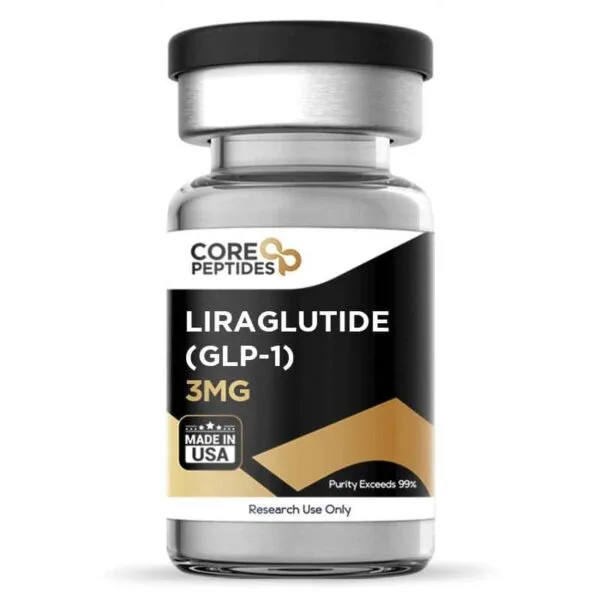
Liraglutide (3mg) – GLP-1 Analog Research Peptide from Core Peptide
Liraglutide (3mg) is a synthetic peptide analog of glucagon-like peptide-1 (GLP-1), a hormone involved in glucose metabolism, appetite regulation, and endocrine signaling. Due to its structural stability and prolonged biological activity compared to native GLP-1, Liraglutide (3mg) has become an important compound in metabolic, endocrine, and receptor-signaling research.
At Core Peptide, we supply high-purity peptides formulated strictly for laboratory and scientific research. Our Liraglutide (3mg) product is intended for controlled research environments and is distributed to qualified customers across the United States.
What Is Liraglutide?
Liraglutide is a long-acting GLP-1 receptor agonist, engineered to mimic the activity of endogenous GLP-1 while resisting rapid enzymatic degradation. Structurally, it is based on the native GLP-1 peptide but includes a fatty acid side chain that enables reversible albumin binding. This modification significantly extends its half-life in experimental models.
Because of these characteristics, Liraglutide (3mg) is widely studied in research related to:
-
Glucose metabolism
-
Insulin signaling pathways
-
Appetite and satiety signaling
-
Neuroendocrine regulation
Chemical and Structural Profile of Liraglutide (3mg)
-
Peptide Class: GLP-1 analog
-
Amino Acid Length: 31 amino acids
-
Molecular Weight: ~3751.2 g/mol
-
Structural Modification: Fatty acid acylation for albumin binding
The lipid side chain plays a critical role in delaying renal clearance and enzymatic breakdown by dipeptidyl peptidase-4 (DPP-4). This makes Liraglutide (3mg) particularly useful for studying prolonged GLP-1 receptor activation in laboratory models.
Mechanism of Action in Research Models
GLP-1 Receptor Activation
In experimental systems, Liraglutide (3mg) binds to the GLP-1 receptor (GLP-1R), a G-protein-coupled receptor expressed in pancreatic, gastrointestinal, and central nervous system tissues. Activation of this receptor has been shown to stimulate glucose-dependent insulin secretion and suppress glucagon release in metabolic research models.
Unlike native GLP-1, which is rapidly degraded, Liraglutide’s modified structure allows sustained receptor engagement, making it an important tool in long-term signaling studies.
🔗 External reference: https://pubmed.ncbi.nlm.nih.gov/18182448/
Appetite and Central Nervous System Research
Beyond pancreatic signaling, Liraglutide (3mg) has been studied for its effects on hypothalamic pathways associated with appetite and energy balance. Preclinical research indicates that GLP-1 receptor activation in the brain may influence satiety signaling and food intake regulation.
Animal studies have demonstrated altered feeding behavior following exposure to GLP-1 analogs, supporting the peptide’s relevance in neuroendocrine and behavioral research.
🔗 External reference: https://pubmed.ncbi.nlm.nih.gov/20881245/
Liraglutide (3mg) in Metabolic Research
Glucose and Insulin Signaling Studies
In metabolic research, Liraglutide (3mg) is commonly used to explore insulin sensitivity, beta-cell function, and glucose homeostasis. Studies suggest that GLP-1 analogs may support beta-cell survival and improve insulin signaling efficiency in experimental models.
These properties have made Liraglutide a widely referenced compound in research involving metabolic disorders and endocrine regulation.
🔗 External reference: https://pubmed.ncbi.nlm.nih.gov/19151290/
Cardiometabolic Research Interest
Some preclinical studies have also examined GLP-1 analogs for their potential influence on cardiovascular biomarkers, inflammation pathways, and lipid metabolism. While these findings remain within experimental contexts, they have expanded interest in Liraglutide (3mg) as a multi-pathway research peptide.
Why Researchers Choose Core Peptide for Liraglutide (3mg)
Researchers across the United States rely on Core Peptide for consistent quality, transparent sourcing, and research-focused service.
Benefits of ordering from Core Peptide include:
-
Research-grade peptide synthesis
-
Clearly labeled compounds for laboratory use
-
Reliable U.S.-based distribution
-
Strict adherence to research-only standards
Browse our full peptide catalog:
https://corepeptide.us/collections/peptides
Learn more about our quality standards:
https://corepeptide.us/pages/quality-assurance
References
-
Knudsen, L. B. et al. (2000). Glucagon-like peptide-1 derivatives as long-acting receptor agonists. Journal of Medicinal Chemistry.
🔗 https://pubmed.ncbi.nlm.nih.gov/18182448/ -
van Bloemendaal, L. et al. (2014). GLP-1 receptor activation in the brain. Nature Reviews Endocrinology.
🔗 https://pubmed.ncbi.nlm.nih.gov/20881245/ -
Drucker, D. J. (2006). The biology of incretin hormones. Cell Metabolism.
🔗 https://pubmed.ncbi.nlm.nih.gov/19151290/
Be the first to review “Liraglutide (3mg)”
Related products
Peptides for sale
Peptides for sale
Peptides for sale
Peptides for sale
Peptides for sale
Peptides for sale
Peptides for sale
Reviews
There are no reviews yet.