
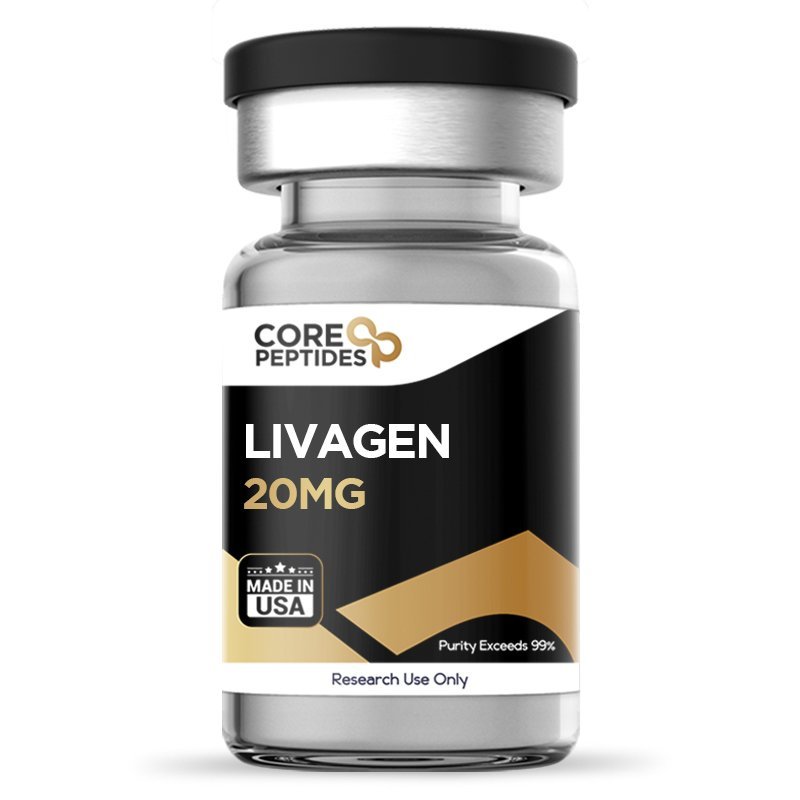
Livagen (20mg) Peptide – Advanced Research Peptide in the USA
Livagen (20mg) is a short bioregulatory peptide that has gained attention in laboratory research for its potential role in gene expression, chromatin remodeling, immune modulation, and cellular repair mechanisms. Available exclusively for research and laboratory use, Livagen peptide is widely studied in molecular biology, genetics, and immunology research settings across the United States.
At Core Peptide, we provide high-purity Livagen (20mg) peptide to support advanced scientific investigations conducted by qualified professionals and institutions.
What Is Livagen Peptide?
Livagen is a tetrapeptide composed of four amino acids:
-
Lysine
-
Alanine
-
Aspartic acid
-
Glutamic acid
This specific amino acid sequence allows Livagen peptide to function as a bioregulator, meaning it may influence biological processes at the cellular and genetic level. Researchers have explored Livagen for its potential ability to interact with chromatin, DNA, and gene expression pathways.
According to molecular biology research, DNA is tightly wrapped around histone proteins, forming chromatin. When chromatin becomes overly condensed, gene activity may decrease. Livagen (20mg) has been studied for its potential to de-condense chromatin, possibly allowing previously inactive genes to become transcriptionally active again.
(Source: National Human Genome Research Institute – Chromatin
https://www.genome.gov/genetics-glossary/Chromatin)
Livagen (20mg) and Gene Regulation Research
One of the most studied applications of Livagen peptide is its role in gene regulation. Scientific publications suggest that Livagen may promote chromatin activation by influencing heterochromatin structure, potentially restoring cellular activity in aging or stressed cells.
A study published in Bulletin of Experimental Biology and Medicine examined the effects of Livagen peptide on chromatin activation in lymphocytes, concluding that Livagen induced deheterochromatinization, a process associated with increased gene activity.
(PubMed: https://pubmed.ncbi.nlm.nih.gov/12533768/)
This makes Livagen (20mg) a peptide of interest for researchers studying:
-
Epigenetics
-
DNA transcription mechanisms
-
Cellular aging models
-
Gene expression regulation
Livagen Peptide and Immune System Research
Livagen has also been explored in immune system research, particularly in relation to lymphocyte function. Lymphocytes are white blood cells that play a crucial role in immune defense and inflammatory response regulation.
Researchers suggest that Livagen may influence ribosomal activity within lymphocytes by modifying chromatin structure, potentially enhancing protein synthesis. This mechanism has led scientists to explore Livagen peptide in studies related to immune coordination and inflammatory response control.
A clinical research publication reported that peptide bioregulators, including Livagen, caused activation of chromatin in lymphocytes of aged models, suggesting potential relevance in immune aging research.
(Georgian Medical News, PMID: 16705247
https://pubmed.ncbi.nlm.nih.gov/16705247/)
Livagen (20mg) in Cardiac and Cellular Studies
Cardiac disorders such as hypertrophic cardiomyopathy (HCM) are associated with dysregulated gene expression. Livagen peptide has been investigated in cell culture models to evaluate its influence on chromatin structure and nucleolar organizer regions (NORs).
Research suggests that Livagen, alone or in combination with cobalt ions, may modify chromatin organization and ribosomal RNA synthesis activity. These findings are significant for researchers studying:
-
Cellular hypertrophy models
-
Gene expression dysregulation
-
Chromosomal behavior in disease states
Such studies highlight the importance of Livagen (20mg) as a research peptide, not as a therapeutic or diagnostic agent.
Livagen Peptide and Antioxidant Research
Additional research has examined Livagen’s potential role in antioxidant and immunoprotective systems, particularly in liver-related experimental models. Findings suggest that Livagen peptide may help normalize immune responses and antioxidant status during induced hepatic stress.
While the precise mechanisms remain under investigation, these studies contribute to Livagen’s relevance in laboratory research involving oxidative stress, immune balance, and cellular recovery models.
Chemical Specifications of Livagen (20mg)
-
Molecular Formula: C₁₈H₃₁N₅O₉
-
Molecular Weight: 461.5 g/mol
-
Alternate Name: KEDA
-
Form: Lyophilized peptide (research use only)
Each Livagen (20mg) vial from Core Peptide is manufactured to meet strict laboratory research standards.
Why Buy Livagen (20mg) from Core Peptide?
At Core Peptide USA, we are committed to supplying high-quality research peptides to scientists and laboratories nationwide.
Why researchers choose Core Peptide:
-
USA-based peptide supplier
-
High-purity peptides for research use
-
Transparent product specifications
-
Secure shipping within the United States
-
Compliance with research-only standards
Explore additional research peptides in our catalog at:
https://corepeptide.us
References
-
National Human Genome Research Institute – Chromatin
https://www.genome.gov/genetics-glossary/Chromatin -
Khavinson VKh et al. Effects of Livagen peptide on chromatin activation in lymphocytes.
https://pubmed.ncbi.nlm.nih.gov/12533768/ -
Lezhava T et al. Anti-aging peptide bioregulators induce reactivation of chromatin.
https://pubmed.ncbi.nlm.nih.gov/16705247/
Be the first to review “Livagen (20mg)”
Related products
Peptides for sale
Peptides for sale
Peptides for sale

Peptides for sale
Peptides for sale
Peptides for sale
Peptides for sale
Peptides for sale
Reviews
There are no reviews yet.