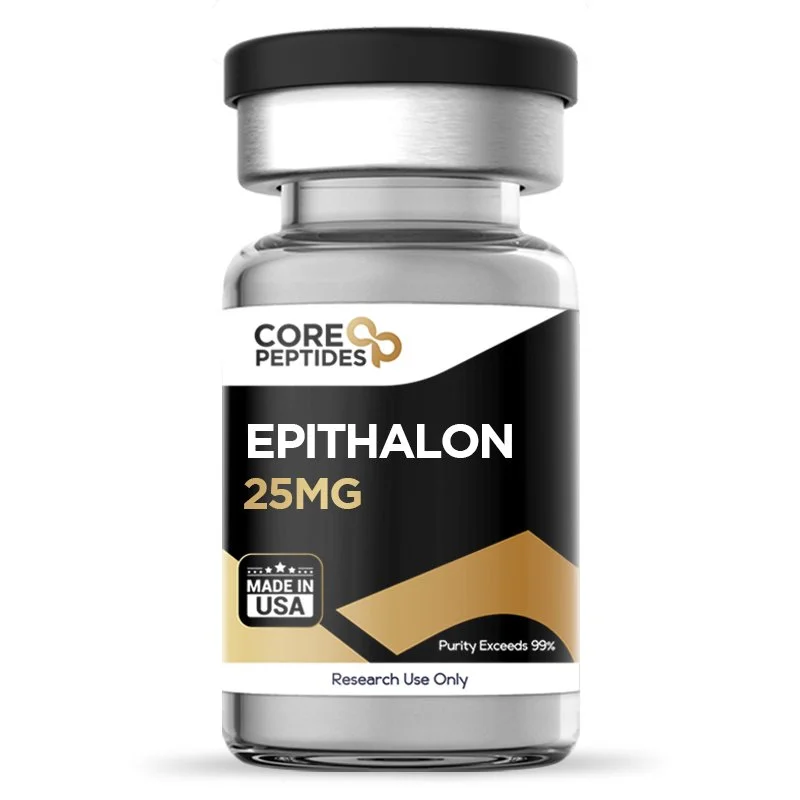
Epithalon (25mg) – Advanced Research Peptide for Longevity and Cellular Studies
Epithalon (25mg)—also known as Epitalon, Epithalone, or AEDG peptide—is a synthetic tetrapeptide widely studied for its potential role in cellular aging, telomere regulation, oxidative stress reduction, and pineal gland signaling. Derived from naturally occurring peptides found in the pineal gland and eye retina, Epithalon has remained a subject of significant scientific interest in longevity and gerontology research.
At Core Peptide, we supply Epithalon (25mg) strictly for research and laboratory use, supporting academic and private research institutions throughout the United States with high-purity peptide compounds.
What Is Epithalon?
Epithalon is a synthetic tetrapeptide composed of four amino acids: Alanine–Glutamic Acid–Aspartic Acid–Glycine (Ala-Glu-Asp-Gly). It was developed to replicate the biological activity of Epithalamin, a naturally occurring peptide complex produced by the pineal gland.
Epithalamin has been associated in experimental models with increased melatonin secretion, improved immune response, and lifespan extension. Using modern peptide synthesis techniques, researchers isolated the core active sequence and produced Epithalon, enabling more precise investigation into its mechanisms.
Chemical Profile of Epithalon (25mg)
-
Molecular Formula: C₁₄H₂₂N₄O₉
-
Molecular Weight: 390.34 g/mol
-
Peptide Type: Synthetic tetrapeptide
-
Alternate Names: Epitalon, Epithalone, AEDG peptide
For compound-level data, researchers may consult the National Center for Biotechnology Information (NCBI) and PubMed databases:
Epithalon (25mg) and Longevity Research
One of the most widely studied areas involving Epithalon (25mg) is its potential role in cellular longevity and gene regulation. Research suggests Epithalon may interact with histone proteins, influencing chromatin structure and gene expression.
In stem cell models, Epithalon was shown to bind to histones H1/6 and H1/3, potentially increasing accessibility of DNA for transcription. This interaction appeared to upregulate genes associated with neuronal differentiation, including Nestin, GAP43, β-Tubulin III, and Doublecortin. Expression levels of these markers increased by up to 1.8 times, suggesting enhanced protein synthesis and cellular functionality.
These findings have contributed to ongoing interest in Epithalon as a geroprotective research peptide.
Telomere and Anti-Aging Studies
Telomeres—protective caps at the ends of chromosomes—shorten with each cell division, eventually limiting cellular replication (the Hayflick limit). Multiple studies suggest Epithalon (25mg) may stimulate telomerase activity, potentially extending telomere length.
In fetal fibroblast studies, Epithalon exposure restored telomere length and enabled up to 10 additional cell divisions beyond the normal replication limit. This suggests Epithalon may influence fundamental mechanisms of cellular aging and genome stability.
Epithalon Peptide and Oxidative Stress
Oxidative stress is a major contributor to cellular aging and dysfunction. Research involving aged oocytes indicates that Epithalon may significantly reduce reactive oxygen species (ROS) levels at specific concentrations.
Additional findings suggest Epithalon may:
-
Improve mitochondrial membrane potential
-
Increase mitochondrial DNA (mtDNA) copy numbers
-
Reduce DNA damage markers such as γH2AX
-
Decrease apoptosis indicators
These antioxidative properties may help preserve cellular integrity in aging models.
Epithalon (25mg) and Melatonin Regulation
The pineal gland plays a central role in regulating circadian rhythms through melatonin secretion. With age, melatonin levels naturally decline. Studies in aging primates indicate that Epithalon may stimulate pineal activity, restoring melatonin levels to ranges observed in younger subjects.
This research has positioned Epithalon (25mg) as a peptide of interest in sleep, circadian rhythm, and neuroendocrine studies.
Immunological and Anti-Mutagenic Research
Experimental models suggest Epithalon may reduce chromosomal aberrations in bone marrow cells, particularly in accelerated-aging murine strains. When administered early, Epithalon appeared to decrease mutation frequency across multiple genetic models.
Other studies involving lymphocytic cells from elderly subjects suggest Epithalon may activate ribosomal genes and decondense heterochromatin, restoring suppressed genetic activity associated with aging.
Cancer and Cellular Proliferation Studies
Preclinical animal research has explored Epithalon’s influence on tumor progression. In murine models with mammary and ovarian tumors, Epithalon exposure was associated with reduced tumor cell proliferation and metastasis.
While these findings are preliminary and limited to animal research, they continue to drive interest in Epithalon’s regulatory influence on abnormal cellular growth.
Retinal and Neurobiological Research
Epithalon has also been studied for its effects on retinal cells and visual function. Clinical observations suggest improved bioelectric activity and preserved retinal morphology in geriatric subjects, with positive outcomes reported in up to 90% of participants.
Researchers suggest these effects may stem from shared transcriptional mechanisms between the pineal gland and retina.
Why Choose Core Peptide for Epithalon (25mg)?
At Core Peptide USA, we are committed to supporting high-level peptide research by offering:
-
High-purity Epithalon (25mg)
-
Accurate labeling and quality-controlled packaging
-
Reliable shipping across the United States
-
Research-only compliance and documentation
Explore additional resources:
Conclusion
Epithalon (25mg) continues to be one of the most extensively researched peptides in the field of longevity science. With evidence spanning telomere biology, oxidative stress, melatonin regulation, and gene expression, Epithalon remains a valuable compound for controlled laboratory investigation.
For researchers in the United States seeking a trusted source of Epithalon (25mg), Core Peptide delivers quality, consistency, and scientific integrity.


Reviews
There are no reviews yet.