
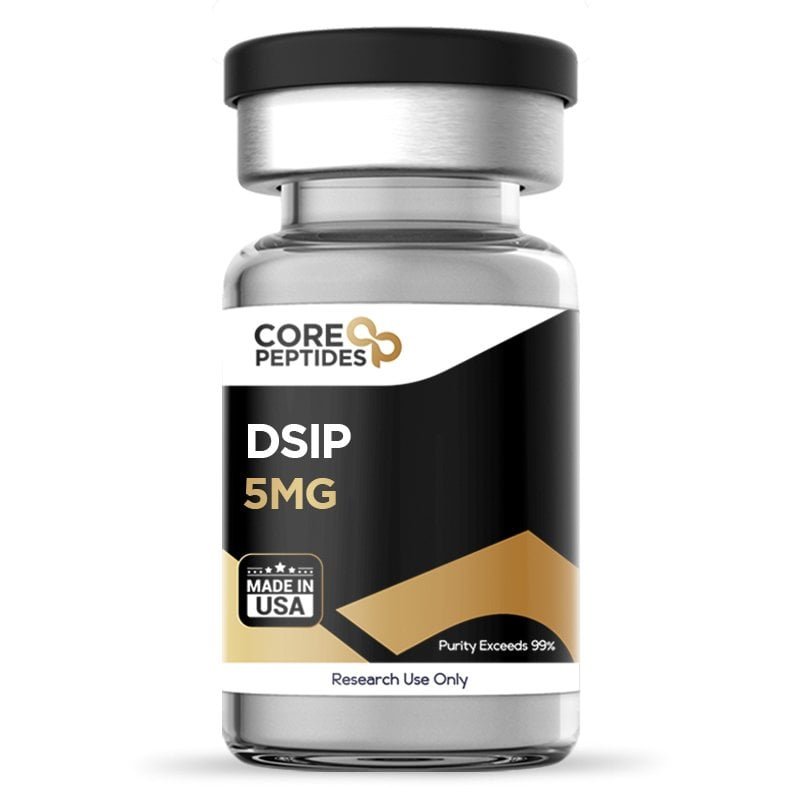
DSIP (5mg) – Delta Sleep-Inducing Peptide for Advanced Research
DSIP (5mg), short for Delta Sleep-Inducing Peptide, is a naturally occurring nonapeptide composed of nine amino acids. First isolated from the central nervous system during experimental sleep studies, DSIP has remained an area of scientific interest for decades due to its proposed role in sleep regulation, neuroendocrine signaling, stress modulation, and cellular protection.
At Core Peptide, we provide DSIP (5mg) strictly for research and laboratory purposes to qualified professionals across the United States. Our focus is purity, accuracy, and consistency—key requirements for meaningful peptide research.
What Is DSIP (Delta Sleep-Inducing Peptide)?
Delta Sleep-Inducing Peptide was originally identified in models undergoing electrically induced sleep. Researchers observed its association with slow-wave sleep (SWS)—also known as delta sleep—leading to its name. Unlike conventional sedatives, DSIP does not act as a hypnotic agent but appears to influence sleep architecture, particularly deep, restorative sleep phases.
Over time, DSIP peptide research expanded beyond sleep, uncovering potential involvement in pain modulation, endocrine regulation, stress tolerance, and oxidative balance.
Other Names for DSIP:
-
DSIP nonapeptide
-
Emideltide
Mechanisms of Action of DSIP (5mg)
Although DSIP’s exact biological pathways are still under investigation, current research suggests several possible mechanisms through which DSIP (5mg) may exert its effects:
Neurotransmitter Modulation
DSIP may interact with GABA and NMDA receptors, two critical systems regulating neural excitation and inhibition. Murine studies suggest DSIP enhances inhibitory GABAergic activity while dampening excitatory glutamatergic signaling, creating a neurochemical environment favorable to sleep initiation and maintenance.
Opioid Receptor Interaction
Research also indicates indirect modulation of opioid receptors, potentially explaining DSIP’s observed effects on pain perception, withdrawal models, and stress response.
Alpha-1 Adrenergic Receptors
Experimental data suggest DSIP may influence alpha-1 adrenergic receptors located in the pineal gland. This interaction could be linked to circadian rhythm regulation and adaptive stress responses.
These findings collectively highlight the complex and multifaceted biological activity of DSIP (5mg).
Chemical Profile of DSIP
-
Molecular Formula: C₃₅H₄₈N₁₀O₁₅
-
Molecular Weight: 848.82 g/mol
-
Structure: Linear nonapeptide
For additional compound data, researchers can reference the National Center for Biotechnology Information (NCBI) via PubChem:
👉 PubChem Compound Summary – Emideltide (DSIP)
https://pubchem.ncbi.nlm.nih.gov/compound/3623358
DSIP and Sleep Cycle Research
One of the most studied aspects of DSIP (5mg) is its relationship with sleep architecture. In controlled feline studies, DSIP administration resulted in a measurable increase in slow-wave sleep within the first hour, with sustained effects lasting up to seven hours.
Slow-wave sleep is the deepest stage of non-REM sleep and is characterized by high-amplitude delta waves on EEG recordings. This stage is essential for physical restoration, memory consolidation, and hormonal release.
Human clinical observations further suggest DSIP may increase sleep pressure, shorten sleep onset time, and improve overall sleep efficiency without altering REM sleep structure.
Endocrine and Hormonal Research
DSIP peptide studies have also explored interactions with the hypothalamic-pituitary axis. In murine models, DSIP exposure resulted in elevated luteinizing hormone (LH) levels without significantly affecting follicle-stimulating hormone (FSH).
Additional research suggests DSIP may influence growth hormone (GH) secretion, potentially through dopaminergic pathways. Because GH release is closely linked to slow-wave sleep, DSIP’s relationship with delta sleep may partially explain this endocrine response.
DSIP (5mg) and Stress Response Studies
Stress-modulating properties of DSIP have been evaluated in controlled murine experiments involving acute and chronic stress exposure. Researchers observed alterations in beta-endorphin, substance P, and corticosterone levels, all key biomarkers of stress physiology.
These findings suggest DSIP may initiate biochemical cascades that help organisms adapt to stress, possibly via interaction with the opioidergic and neuroendocrine systems.
Longevity and Antioxidant Research
Some of the most intriguing DSIP studies involve cellular protection and longevity. In long-term murine research, DSIP administration was associated with reduced chromosomal abnormalities, decreased oxidative damage, and increased lifespan.
Researchers hypothesize these effects may stem from DSIP’s influence on endogenous antioxidant enzymes such as superoxide dismutase and catalase, along with reduced lipid peroxidation markers.
While these findings are preliminary and species-specific, they continue to drive interest in DSIP as a research peptide.
Why Choose Core Peptide for DSIP (5mg)?
At Core Peptide USA, we are committed to supporting advanced peptide research by providing:
-
High-purity DSIP (5mg)
-
Accurate labeling and secure packaging
-
Reliable shipping throughout the United States
-
Transparent documentation and research-only compliance
Explore related peptide offerings on our site:
-
👉 Peptide Storage Guidelines (internal educational resource)
Final Thoughts
DSIP (5mg) remains one of the most compelling peptides studied for its role in sleep regulation, neuroendocrine signaling, stress response, and cellular defense mechanisms. With decades of scientific literature supporting ongoing exploration, DSIP continues to hold value in controlled laboratory research.
For researchers in the United States seeking a reliable source of DSIP (5mg), Core Peptide provides quality, consistency, and professional support every step of the way.
Be the first to review “DSIP (5mg)”
Related products
Peptides for sale
Peptides for sale
Peptides for sale
Peptides for sale
Peptides for sale
Peptides for sale
Peptides for sale
Peptides for sale
Reviews
There are no reviews yet.