
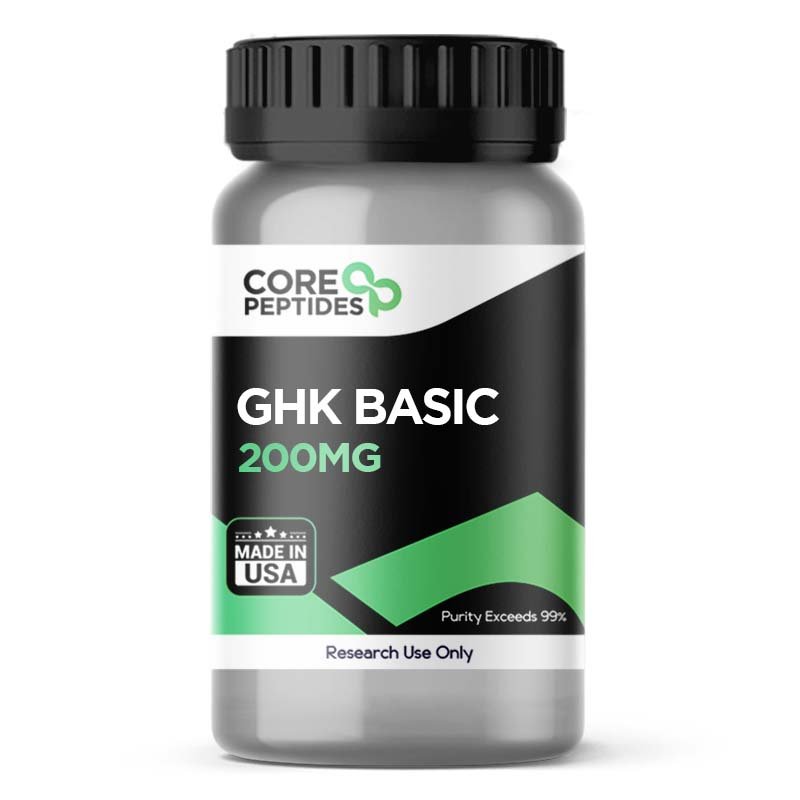
GHK-Cu (200mg) Research Peptide
GHK-Cu (200mg) is a naturally occurring copper-binding peptide complex extensively studied in biochemical, dermatological, and regenerative research. Available from Core Peptide USA, this compound is manufactured and supplied strictly for laboratory and research purposes only and is distributed to qualified research professionals throughout the United States.
GHK-Cu is composed of the tripeptide glycyl-histidyl-lysine (GHK) bound to a copper ion (Cu²⁺). Research suggests that copper binding enhances the stability and bioactivity of the GHK sequence, facilitating its delivery to cells and amplifying its signaling potential. This copper tripeptide complex has been widely investigated for its role in tissue repair, wound healing, extracellular matrix regulation, and inflammatory modulation.
What Is GHK-Cu?
GHK-Cu is a naturally occurring copper peptide complex found in human plasma, saliva, and urine. It is produced by multiple cell types and appears to play a role in restoring tissue homeostasis following injury. The copper ion is thought to stabilize the GHK peptide and act as a delivery mechanism, allowing it to participate in cellular signaling pathways more efficiently than the peptide alone.
Research indicates that GHK-Cu may regulate numerous biological processes, including collagen synthesis, elastin production, glycosaminoglycan formation, immune response modulation, and antioxidant defense. These properties have made GHK-Cu (200mg) a compound of interest across a wide range of experimental models.
Chemical Makeup
Molecular Formula: C₁₄H₂₃CuN₆O₄
Molecular Weight: 340.38 g/mol
Other Known Titles:
Cu-GHK, Copper Tripeptide-1, 6BJQ43T1I9
This well-defined chemical structure allows GHK-Cu to be consistently evaluated in controlled laboratory settings and reproducible experimental protocols.
Research & Scientific Studies
GHK-Cu and Collagen Synthesis
One of the most extensively researched areas of GHK-Cu involves its potential influence on collagen synthesis and tissue regeneration. Studies suggest that GHK-Cu may stimulate collagen production by interacting with fibroblasts, the primary cells responsible for synthesizing collagen fibers in connective tissue.
Researchers propose that the Gly-His-Lys sequence is released naturally during collagen breakdown via hydrolysis at sites of tissue damage. Once released, this tripeptide may act as a signaling molecule that initiates fibroblast activity, leading to renewed collagen synthesis. Clinical research comparing GHK-Cu to vitamin C, vitamin A derivatives, and other peptides found that GHK-Cu appeared to improve markers such as dermal thickness, elasticity, hydration, and procollagen synthesis in photodamaged skin models.
Additional studies explored the interaction between GHK-Cu and hyaluronic acid (HA). Results suggested that specific ratios of GHK-Cu to low-molecular-weight HA significantly enhanced collagen IV synthesis in dermal fibroblasts and ex-vivo skin models. This potential synergy may arise from GHK-Cu’s role in stimulating glycosaminoglycan production and collagen synthesis, combined with HA’s ability to reduce oxidative stress and inhibit matrix metalloproteinases.
GHK-Cu and Wound Healing
GHK-Cu has been widely studied for its potential role in wound healing and infection control. Animal models investigating ischemic open wounds reported that wounds treated with GHK-Cu exhibited significantly lower concentrations of inflammatory markers such as TNF-alpha, MMP-2, and MMP-9 compared to untreated controls. These markers are associated with inflammation and extracellular matrix degradation, suggesting that GHK-Cu may help regulate tissue remodeling processes.
Clinical research involving diabetic neuropathic ulcers reported a substantially lower incidence of wound infection when GHK-Cu was used alongside standard wound care. Infection rates were observed to be significantly lower in GHK-Cu groups compared to controls, highlighting its potential relevance in wound management research.
In rabbit models, GHK-Cu exposure appeared to shorten healing times and increase neutrophil infiltration and vascular development. Researchers observed faster granulation tissue formation and improved neovascularization, processes essential for delivering oxygen and nutrients to damaged tissue during repair.
GHK-Cu and Oxidative Stress
GHK-Cu has demonstrated notable antioxidant potential in experimental models. Photodamaged tissues often produce reactive oxygen species (ROS), reactive nitrogen species (RNS), and reactive carbonyl species (RCS), which can damage DNA, proteins, and lipids.
Studies suggest that GHK-Cu may neutralize reactive aldehydes such as malondialdehyde, acrolein, and 4-hydroxynonenal. Additionally, GHK-Cu may reduce iron release from ferritin, a catalyst of lipid peroxidation. One study reported an approximate 87% reduction in iron release, potentially limiting oxidative damage in injured tissues.
GHK-Cu has also been studied in models of lung inflammation. In murine experiments involving lipopolysaccharide-induced lung injury, GHK-Cu exposure was associated with reduced inflammatory cytokine production, increased antioxidant enzyme activity, and suppression of NF-κB and p38 MAPK signaling pathways.
GHK-Cu and Skin Tissue Models
Research suggests that GHK-Cu may influence skin structure and topography in experimental models. Studies evaluating photodamaged skin reported improvements in skin density, thickness, firmness, and elasticity after prolonged exposure to GHK-Cu. Reductions in coarse wrinkles, mottled pigmentation, and surface irregularities were also observed in comparative studies.
Histological analysis in some models indicated increased dermal keratinocyte proliferation and improved extracellular matrix organization, supporting continued research interest in this peptide complex.
Why Choose Core Peptide USA?
At CorePeptide.us, we are dedicated to supporting peptide research across the United States by providing:
-
High-purity research peptides
-
Transparent sourcing and documentation
-
U.S.-based distribution and customer support
-
Strict research-use-only compliance
Learn more about our standards on our About Us page or review our Terms and Conditions before ordering.
External Scientific References
For peer-reviewed research related to GHK-Cu (200mg), visit:
-
NCBI – PubChem Compound Summary: https://pubchem.ncbi.nlm.nih.gov/compound/Cu-GHK
-
Maquart et al., FEBS Letters: https://pubmed.ncbi.nlm.nih.gov/3197489
Be the first to review “GHK-Cu (200mg)”
Related products
Peptides
Peptides
Peptides
Peptides
Reviews
There are no reviews yet.