
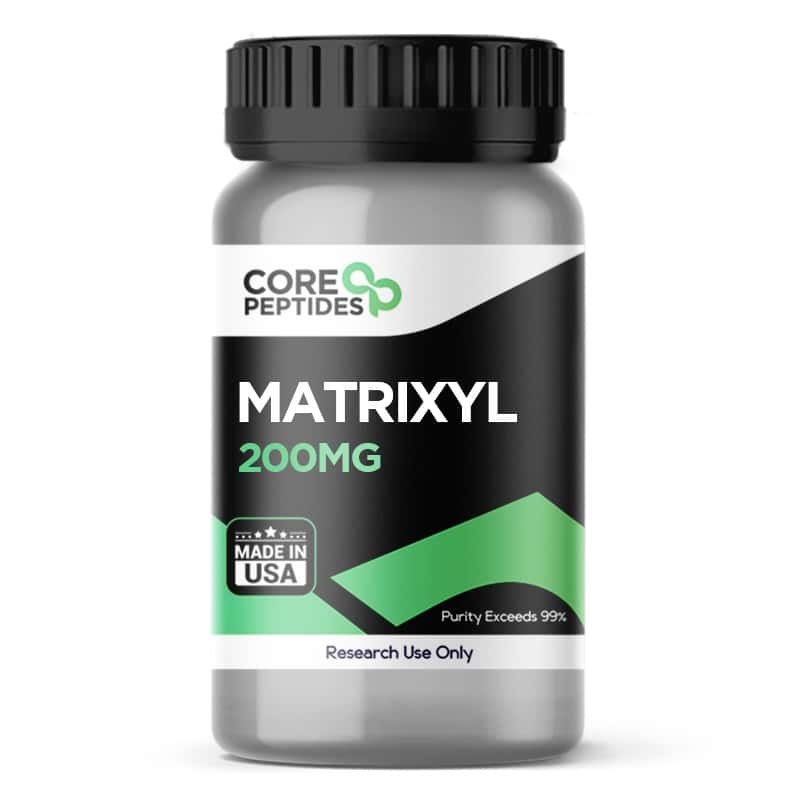

Matrixyl (200mg) Peptide – Advanced Collagen Research Peptide in the USA
Matrixyl (200mg), also known as palmitoyl pentapeptide-4, is a synthetic research peptide widely studied for its potential role in collagen synthesis, extracellular matrix (ECM) signaling, tissue repair, and fibroblast activity. Classified as a matrikine messenger peptide, Matrixyl is designed to interact with specific cellular receptors that may influence connective tissue behavior in laboratory research models.
At Core Peptide, we supply high-purity Matrixyl (200mg) exclusively for research and laboratory use, supporting advanced investigations conducted across the United States.
What Is Matrixyl Peptide?
Matrixyl peptide is a palmitoylated pentapeptide, meaning it consists of five amino acids conjugated with a palmitoyl (fatty acid) chain. This modification may enhance peptide stability and interaction with lipid environments in experimental systems.
Researchers classify Matrixyl as a matrikine, a class of peptides derived from extracellular matrix proteins that act as signaling molecules. These peptides are believed to provide feedback signals to cells—particularly fibroblasts—regarding the state of the surrounding matrix.
Collagen, one of the primary components of the extracellular matrix, plays a critical role in maintaining structural integrity, elasticity, and tensile strength of connective tissues. Matrixyl (200mg) has therefore become an important tool in collagen and ECM research models.
(Source: Frontiers in Chemistry
https://doi.org/10.3389/fchem.2020.572923)
Matrixyl (200mg) and Collagen Synthesis Research
One of the most studied properties of Matrixyl peptide is its potential influence on collagen synthesis. Scientific literature suggests that Matrixyl may function as a signal peptide fragment related to the C-terminal propeptide of type I collagen.
Researchers propose that Matrixyl may interact with fibroblasts, stimulating feedback regulation pathways involved in producing new collagen and extracellular matrix proteins. Fibroblasts are specialized connective tissue cells responsible for secreting collagen, elastin, fibronectin, and laminin—key structural components of the ECM.
Studies suggest that Matrixyl may stimulate collagen production in a concentration-dependent manner, particularly near its critical aggregation concentration. This observation has led researchers to hypothesize that peptide self-assembly mechanisms—such as hydrogen bonding, hydrophobic interactions, and electrostatic forces—may be linked to collagen-related signaling behavior.
(Source: Biomolecules & Therapeutics
https://doi.org/10.4062/biomolther.2014.053)
Matrixyl Peptide and Wrinkle Research Models
Matrixyl has been extensively investigated in laboratory and controlled research models evaluating skin surface texture and wrinkle depth. Several studies have explored bilateral exposure models comparing Matrixyl-containing compounds to placebo controls.
In one such study, researchers reported that areas exposed to Matrixyl showed a measurable reduction in wrinkle depth compared to placebo. Additional investigations introduced Matrixyl-infused compounds twice daily to the periorbital region over several weeks, reporting improvements in skin texture parameters when compared to placebo and other peptide formulations.
Double-blind, randomized research models examining moderate to pronounced periorbital wrinkles also suggested that Matrixyl exposure may reduce visible skin texture irregularities and the depth of larger wrinkles. These findings have contributed to Matrixyl’s reputation as a widely studied peptide in cosmetic science and dermal research models.
Matrixyl (200mg) and Fibroblast Activity
Fibroblasts play a vital role in connective tissue maintenance and wound healing. Matrixyl peptide has been studied for its potential influence on fibroblast signaling pathways, particularly those related to ECM remodeling.
Research suggests that Matrixyl may regulate fibroblast activity by acting as a messenger peptide that reflects ECM degradation products. This signaling mechanism may encourage fibroblasts to initiate reparative responses, including collagen deposition and matrix reorganization.
Due to this activity, Matrixyl (200mg) is commonly used in laboratory research focused on:
-
Fibroblast signaling
-
ECM protein expression
-
Connective tissue regeneration models
Matrixyl Peptide and Scarring Research
Scarring and fibrosis involve excessive collagen deposition and the differentiation of fibroblasts into myofibroblasts. One study examined the effects of Matrixyl on fibroblast contractility and the expression of alpha-smooth muscle actin (α-SMA), a marker associated with myofibroblast activity.
Researchers reported that Matrixyl appeared to reduce α-SMA expression and inhibit fibroblast trans-differentiation into myofibroblasts. This suggests a potential role for Matrixyl in laboratory models studying fibrotic scarring and tissue remodeling.
Since myofibroblasts are heavily involved in pathological scarring, Matrixyl peptide has become relevant in research exploring scar formation mechanisms and ECM regulation.
Matrixyl (200mg) and Tissue Repair Research
Animal research models have explored Matrixyl’s potential involvement in wound healing and tissue repair. In one study, animals were divided into multiple treatment groups and monitored over a 21-day period.
Researchers reported that groups exposed to higher concentrations of Matrixyl showed improved wound closure rates compared to negative control groups. The study suggested that Matrixyl may positively influence tissue repair mechanisms, possibly through enhanced fibroblast signaling and collagen deposition.
Additional research has examined novel Matrixyl conjugates combined with imidazolium-based ionic liquids. These compounds demonstrated both antimicrobial properties and collagenesis-inducing activity comparable to Matrixyl alone, further expanding its relevance in tissue engineering research.
Chemical Specifications of Matrixyl (200mg)
-
Molecular Formula: C₃₉H₇₅N₇O₁₀
-
Molecular Weight: 802.05 g/mol
-
Alternate Names: Palmitoyl pentapeptide-4, Palmitoyl pentapeptide-3 (pre-2006)
-
Form: Lyophilized peptide (research use only)
Why Buy Matrixyl (200mg) from Core Peptide?
Core Peptide USA is a trusted supplier of high-purity research peptides for laboratories, universities, and research institutions.
Why researchers choose Core Peptide:
-
USA-based peptide supplier
-
High-purity peptides for research use
-
Transparent product specifications
-
Secure shipping within the United States
-
Strict adherence to research-only compliance
Browse additional research peptides at:
https://corepeptide.us
References
-
Choi YL et al. Dermal Stability and In Vitro Skin Permeation of Collagen Pentapeptides.
https://doi.org/10.4062/biomolther.2014.053 -
Errante F et al. Cosmeceutical Peptides in the Framework of Sustainable Wellness Economy.
https://doi.org/10.3389/fchem.2020.572923
Be the first to review “Matrixyl (200mg)”
Related products
Peptides
Peptides
Peptides
Peptides
Reviews
There are no reviews yet.